Most moving companies get their first jobs through referrals and never build a system beyond that. Word of mouth works until it does not. A slow January, a competitor opening nearby, or a single damaging review can expose how fragile a business is when it has no real marketing engine beneath it. The companies that consistently fill their calendars month after month are not relying on luck or referrals alone. They have built a deliberate, multi-channel approach that puts them in front of local buyers at every stage of the decision process.
The moving industry is intensely competitive. There are approximately 7,000 licensed moving companies in the United States, with thousands more operating at the local and regional level. Competing in that environment without a structured approach to marketing for moving companies means ceding ground to operators who have already built local authority, review volume, and paid search presence.
This guide covers every channel that matters for moving company marketing in 2026: SEO, Google Ads, local lead generation platforms, referral networks, and the measurement framework that tells you what to keep and what to cut. By the end, you will have a clear picture of what a functional movers marketing strategy looks like and where to start building yours.
Key Takeaways
- Marketing for moving companies requires a coordinated multi-channel approach. No single channel fills a calendar at scale or handles seasonal demand fluctuations consistently.
- Moving company SEO takes time but compounds. A well-built local SEO foundation generates inbound leads at a declining cost per acquisition month after month.
- Digital marketing for movers performs best when channels work together. Paid search fills the gap while organic rankings build; social proof and reviews accelerate both.
- Lead gen for movers through platforms like Thumbtack, Angi, and Google Local Services Ads can bridge short-term volume gaps but should not be the only acquisition channel.
- A movers marketing strategy that is not built around seasonality will consistently overspend in peak months and underinvest in off-peak lead generation when it matters most.
Why Marketing for Moving Companies Is Different From Most Local Services
The fundamentals of local service marketing apply to moving companies, but the dynamics are different in three important ways that shape every strategic decision a marketing team or moving business owner will make.
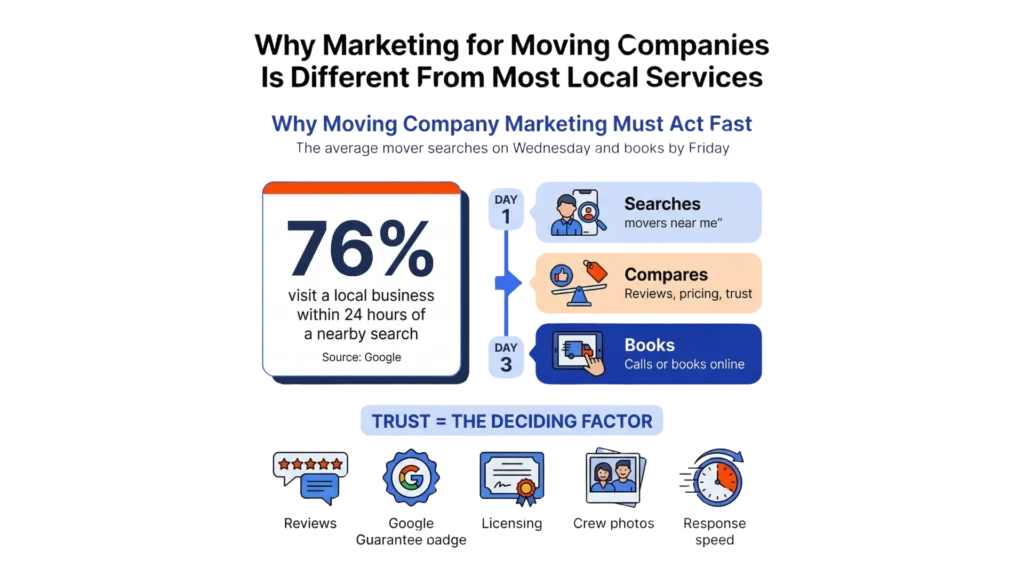
First, the purchase window is short and sequential. A homeowner searching for a mover on a Wednesday may book by Friday. 76% of people who search for something nearby on a smartphone visit a related business within one day. For a moving company, that compresses the conversion window significantly. Your marketing needs to capture attention at the moment of intent, not awareness.
Second, trust signals carry more weight than in most service categories. Moving is high-stakes: a customer is handing over everything they own to a stranger’s crew. Review volume, licensing information, and visible credentials are not differentiators; they are table stakes. Moving business advertising that does not prominently feature social proof is leaving its highest-converting assets unused.
Third, demand is sharply seasonal. Summer months, end-of-month dates, and the period around major school calendar events consistently drive volume spikes. A movers marketing strategy that does not plan around these peaks will overpay for leads when demand is highest and fail to maintain a pipeline through quieter months.
The Competitive Landscape in 2026
The moving industry’s competitive structure has shifted meaningfully. National aggregators, including HireAHelper, Moving.com, and Movinghelp.com have built significant organic authority for high-volume search terms. Individual moving companies competing against these platforms for broad terms like ‘moving companies near me’ face a steep domain authority gap.
The practical implication for digital marketing for movers: focus on specific, locally-targeted, high-intent search terms where a local operator can outrank a national directory with the right content and citation strategy.
What Moving Customers Actually Search For
Understanding real search behavior is foundational to any moving company SEO strategy. Buyer searches cluster into three categories: immediate intent (‘movers [city]’, ‘moving company [zip code]’), comparative intent (‘best moving companies [city]’, ‘affordable movers [city]’), and process intent (‘how much do movers cost’, ‘moving checklist’).
The highest-conversion terms sit in the first cluster. The third cluster attracts volume but converts at a lower rate. A complete SEO for moving companies strategy targets all three clusters with different content types and calls to action calibrated to each stage.
Building Your Moving Company SEO Foundation
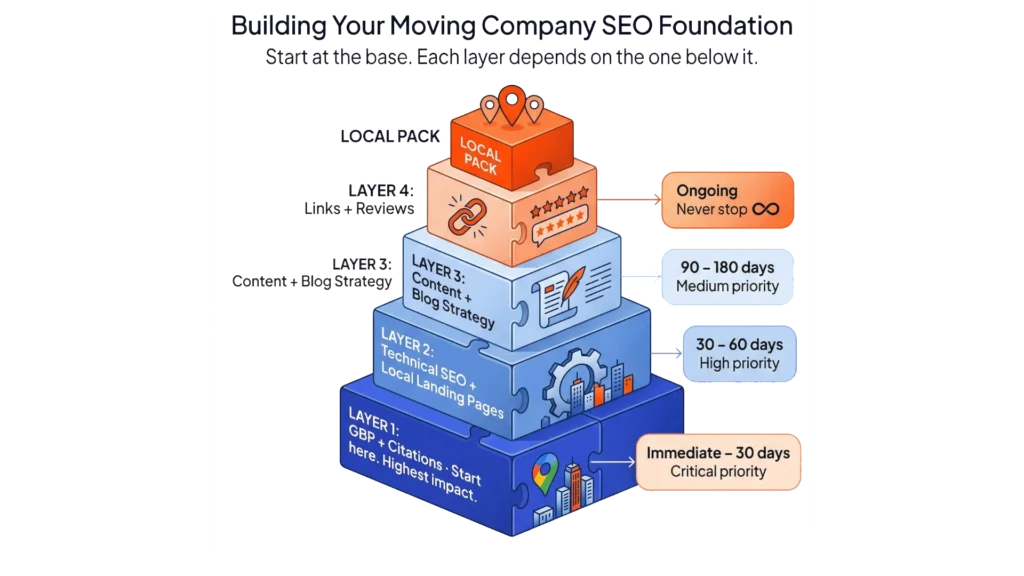
SEO for moving companies is the highest-leverage long-term investment available to a local moving operator. Once pages rank, they generate inbound leads at no additional cost per click. The challenge is that meaningful results take three to six months to arrive, which is why most moving companies do not start early enough and then scramble for paid leads that cost three to five times more.
Moving company SEO experts consistently identify the same set of foundational priorities that determine whether a moving company ranks locally or gets buried by national directories and better-optimized competitors.
Google Business Profile Optimization
Your Google Business Profile is the single highest-impact asset for local moving company visibility. Businesses appearing in the local pack (the three-business map block above organic results) receive 44% of clicks for relevant local searches. For a moving company, appearing in that pack for city-level searches is the difference between consistent inbound calls and depending entirely on paid channels.
Effective GBP management for moving company SEO requires selecting the correct primary category, adding relevant secondary categories, uploading photos of your crew and trucks consistently, publishing GBP posts weekly during peak season, and responding to every review within 24 hours. Each of these signals independently influences local pack eligibility.
Local Keyword Architecture
Most moving company SEO efforts target too broadly. Ranking nationally for ‘moving companies’ is not achievable for a local operator and not worth pursuing. The correct approach is building a keyword architecture based on city, neighborhood, and service-type combinations: ‘apartment movers [city]’, ‘long-distance movers [city] to [city]’, ‘piano movers [city]’, ‘office relocation [city]’. Each cluster deserves a dedicated landing page with locally relevant content, a geo-specific headline, LocalBusiness schema markup, and a click-to-call button visible above the fold.
Technical SEO for Moving Company Websites
Pages loading within 2.5 seconds significantly outperform slower alternatives in bounce rate and conversion. Moving company websites often fail on mobile performance, which is critical given that the majority of local moving searches happen on smartphones.
Moving company SEO experts typically flag the same recurring issues: uncompressed truck and crew photos slowing load times, duplicate city pages with thin content triggering quality suppression, and missing LocalBusiness schema markup that prevents rich results from appearing.
| SEO Task | Priority Level | Ranking Impact | Typical Timeline |
| GBP Optimization | Critical | Very High | Immediate to 30 days |
| Local Keyword Pages | High | High | 60 to 120 days |
| Citation Cleanup | High | High | 30 to 60 days |
| Technical Audit and Fixes | High | Medium to High | 30 days |
| Review Acquisition System | Ongoing | High | Ongoing |
| Blog and Content Strategy | Medium | Medium | 90 to 180 days |
Paid Advertising That Generates Moving Leads Fast
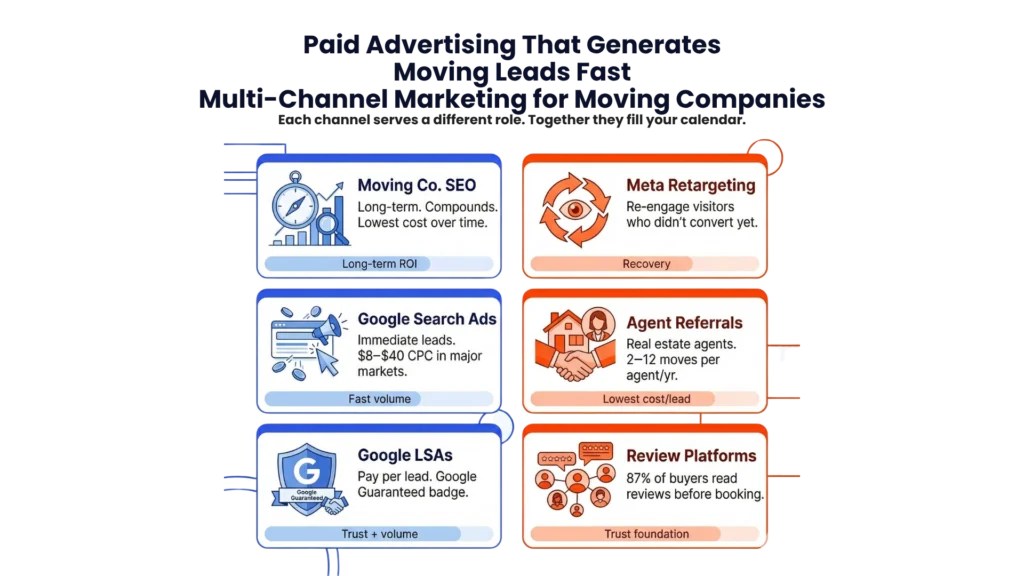
While SEO for moving companies builds long-term organic authority, paid advertising fills the calendar now. The two channels are not alternatives; they are sequenced. Paid search captures high-intent buyers while organic rankings are being built, and organic rankings reduce your dependence on paid channels over time.
Moving business advertising in paid search is competitive and expensive. The average cost per click for moving company keywords in major U.S. markets ranges from $8 to $40. That cost structure makes conversion rate optimization on landing pages as important as the campaigns themselves. A page converting at 8% generates twice the leads from the same ad spend as a page converting at 4%.
Google Search Ads for Movers
Google Search Ads remain the most direct paid channel for lead gen for movers. A well-structured account targets three campaign types: branded campaigns protecting your company name from competitor bidding, service-specific campaigns targeting city and service combinations (‘apartment movers [city]’, ‘office movers [city]’), and competitor campaigns appearing when prospects search for named local competitors.
Negative keyword management is essential in moving business advertising. Moving-related searches attract high volumes of non-buyer queries: people researching cost out of curiosity, renters not yet ready to move, and searches related to self-storage or truck rentals. A maintained negative keyword list can reduce wasted spend by 20 to 30% in the first 90 days.
Google Local Services Ads
Google Local Services Ads (LSAs) deserve dedicated attention as a moving business advertising channel. LSAs appear above traditional search ads, carry a ‘Google Guaranteed’ badge, and charge per lead rather than per click. Businesses using LSAs see measurably higher contact rates than traditional search ads for service categories.
For moving companies, LSAs require a background check, license verification, and insurance documentation. That barrier is worth navigating: the Google Guaranteed badge directly addresses the trust gap that makes moving purchases high-consideration decisions.
Meta Ads for Awareness and Retargeting
Meta Ads (Facebook and Instagram) are not a direct-intent channel for moving companies. People do not scroll Instagram when they need a mover immediately. However, Meta Ads serve two specific functions in a movers marketing strategy: building awareness before the intent moment arrives, and retargeting website visitors who did not convert on their first visit.
A visitor who viewed your pricing page but did not book is a high-value retargeting target. A Meta campaign showing that visitor a recent five-star review or a limited availability message can recover a meaningful percentage of otherwise lost leads.
| Channel | Lead Intent Level | Cost Structure | Best Use Case |
| Google Search Ads | High | Cost per click | Immediate booking intent |
| Google Local Services Ads | High | Cost per lead | Trust-driven local markets |
| Meta Ads (Retargeting) | Medium | Cost per impression or click | Re-engaging non-converting visitors |
| Meta Ads (Prospecting) | Low to Medium | Cost per impression or click | Awareness before intent |
| Thumbtack / Angi | Medium | Cost per lead | Volume gap bridging |
| Yelp Ads | Medium | Cost per click | Review-heavy local markets |
Local Marketing Channels That Drive Booking Intent
Beyond search and paid channels, several local marketing approaches generate moving leads with high booking intent and low cost per acquisition. These are consistently underused by moving companies focused exclusively on digital moving business advertising.
Real estate agent partnerships are among the highest-ROI channels available to any local moving company. A single active agent refers to between two and twelve moves per year, depending on their sales volume. Building a referral network of 20 to 30 agents in your primary market creates a consistent baseline of low-cost leads that does not fluctuate with algorithm changes or ad auction pricing.
Real Estate Agent Referral Programs
A structured referral program for real estate agents should include a dedicated landing page for agent-referred clients, a tracking mechanism (unique phone numbers or URLs per agent), a clear and legally compliant incentive structure, and regular communication to maintain top-of-mind awareness. Agents refer moving companies they trust; trust is built through consistent follow-through on every referred job, not just an introductory meeting.
Apartment Complex and Property Manager Partnerships
Property managers and leasing offices are constantly fielding moving-related questions from residents. A moving company listed on an apartment complex’s recommended vendor board, building app, or move-in packet receives warm referrals at effectively zero marketing cost. Pursue partnerships with complexes in your service area by offering a resident discount, providing branded moving guides, or being present during move-in days during peak months.
Online Review Platforms as Lead Channels
Review platforms including Google, Yelp, and Houzz, function as lead generation channels in their own right, not just trust signals. A moving company with 200 or more Google reviews and a strong average rating will rank higher in the local pack, convert more visitors from that pack, and generate direct inbound calls from users browsing the platform. 87% of consumers read online reviews for local businesses before making a decision. Moving company reviews are particularly weighted toward recency and specificity: recent reviews describing a smooth move outperform generic five-star ratings.
How to Build a Movers Marketing Strategy Around Your Peak Season
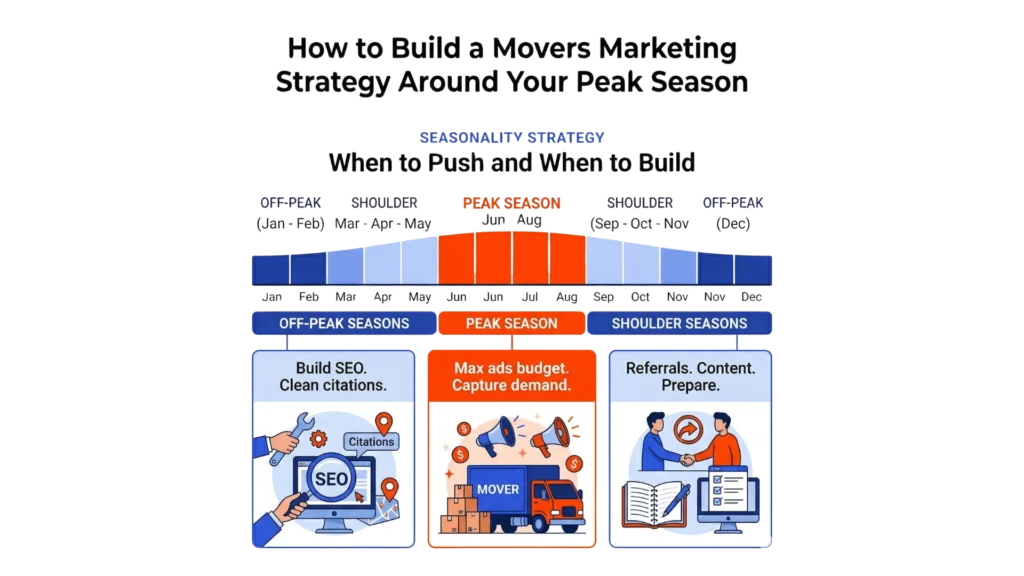
Seasonality is the defining operational challenge for any moving company. Understanding how to adjust your digital marketing for movers budget, messaging, and channel mix across peak and off-peak periods separates companies that maintain steady revenue from those that feast in summer and struggle in winter.
A movers marketing strategy built around seasonality requires planning three to four months ahead of each major demand cycle, not reacting to volume shifts after they have already arrived and your competitors have already captured the demand.
Peak Season Strategy (May to September)
During peak season, demand exists without significant marketing effort. The strategic priority is capturing as much of that demand as possible at the lowest cost per booked move. That means increasing Google Ads budgets in April and May before peak season fully arrives, optimizing landing pages for conversion rate rather than traffic volume, accelerating review acquisition from every completed move, and maximizing GBP post frequency to maintain local pack visibility throughout the season.
Do not reduce SEO investment during peak season. The three to four months when organic rankings benefit most from high review velocity and GBP engagement activity are exactly the months when many companies reduce their content spend because they are already busy. This creates an organic visibility gap that arrives in the following off-peak season.
Off-Peak Season Strategy (October to April)
The off-peak period is when moving company SEO experts deliver their most durable value. This is when the foundational work that generates summer leads gets done: new location pages built, citation profiles cleaned up, blog content targeting process-intent queries published, and link acquisition campaigns executed. Companies that treat off-peak months as a marketing pause arrive at the next summer with no improvement in organic rankings and the same dependence on expensive paid channels.
Paid advertising budgets can be reduced in off-peak months, but should not be eliminated. A focused Google Ads presence targeting long-distance moves, commercial relocations, and storage-adjacent searches can maintain baseline lead gen for movers through slower periods while keeping your account data fresh and your quality scores maintained.
| Channel | Peak Season (May-Sep) | Shoulder Season (Mar-Apr, Oct-Nov) | Off-Peak (Dec-Feb) |
| Google Search Ads | 40% of budget | 30% of budget | 20% of budget |
| Google Local Services Ads | 25% of budget | 20% of budget | 15% of budget |
| SEO and Content Production | 15% of budget | 25% of budget | 35% of budget |
| Meta Ads | 10% of budget | 10% of budget | 15% of budget |
| Referral and Partnerships | 10% of budget | 15% of budget | 15% of budget |
Lead Generation Systems That Keep the Calendar Full
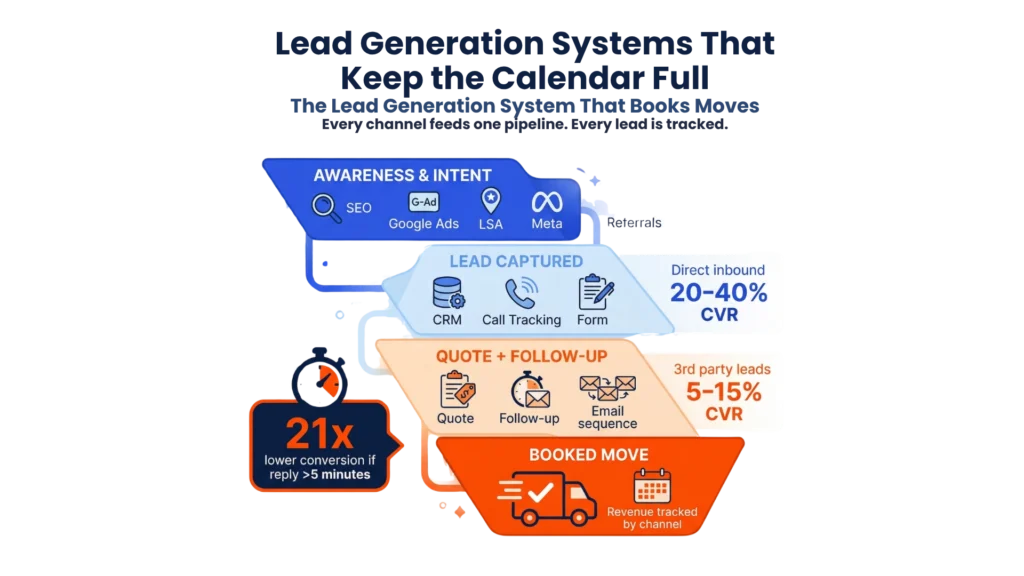
Lead gen for movers is only valuable if the leads are qualified, trackable, and systematically followed up on. Many moving companies invest in marketing channels and then lose leads in the follow-up gap. A lead that does not receive a response within five minutes is 21 times less likely to convert than one that receives an immediate reply.
Building a lead generation system means more than running ads or publishing content. It means having the infrastructure in place to capture, route, and follow up on every lead that your digital marketing for movers generates.
Third-Party Lead Platforms
Platforms including Thumbtack, Angi, HireAHelper, and Bark provide a shortcut to lead volume for moving companies without strong organic or paid search presence. The economics are less favorable than owned channels: third-party leads typically convert at 5 to 15%, compared to 20 to 40% for direct inbound calls from branded or local-pack searches. For a company building its calendar from scratch or filling gaps during off-peak months, these platforms provide immediate volume while SEO and paid search campaigns are being established.
Booking and CRM Integration
Every inbound lead, whether from a phone call, website form, or third-party platform, should be captured in a CRM system from day one. A properly configured CRM tracks lead source, quote status, follow-up history, and booked move value. That data is the foundation of every future marketing decision.
Without it, you cannot calculate cost per booked move by channel, and you cannot make rational budget allocation decisions. Moving company SEO experts and paid media managers alike consistently identify poor lead tracking as the single biggest barrier to marketing accountability in this industry.
Email Follow-Up for Non-Converting Leads
Most people who request a moving quote do not book immediately. A structured email follow-up sequence targeting non-converting leads can recover 10 to 20% of otherwise lost inquiries, particularly for long-distance moves where the decision timeline is longer. The sequence should include the original quote, a follow-up addressing the most common objections around timing and cost, and a final availability check one to two weeks before the most likely move date.
Agencies that manage digital marketing for movers at scale, like Rankfast, have increasingly built automated follow-up sequences directly into their clients’ lead management workflows, treating email nurture as a standard component of the lead generation system rather than an afterthought added after a slow month.
Conclusion
Marketing for moving companies has never been more measurable or more competitive at the same time. The operators that consistently fill their calendars are not doing anything exotic. They have built a local SEO foundation that generates inbound leads at a compounding rate, a paid search presence that captures high-intent buyers before the competition does, and a referral network that provides a steady baseline of low-cost, high-trust pipeline.
A movers marketing strategy that accounts for seasonality, tracks every channel against cost per booked move, and invests in organic foundations during off-peak months will consistently outperform one that reacts to demand only after it arrives. The seasonal window is predictable. The companies that prepare for it three to four months in advance are the ones that dominate local pack rankings when summer search volume peaks.
Start with whatever is weakest in your current setup. If your Google Business Profile is incomplete, that is the highest-leverage fix available today. If you have strong organic presence but slow months, a targeted campaign built around long-distance or commercial keywords will move the needle fastest. Build from your existing strengths, fill the structural gaps, and measure everything against cost per booked move.
Frequently Asked Questions
What is the most effective marketing channel for moving companies?
There is no single most effective channel because the answer depends on your current position. If your Google Business Profile is incomplete and you have fewer than 50 reviews, that is the highest-leverage starting point available to you. If you have strong local SEO foundations but slow months, a targeted Google Ads campaign built around long-distance or commercial keywords will deliver the fastest volume lift. A complete movers marketing strategy uses organic search for long-term cost efficiency, paid search for immediate intent capture, and referral networks for low-cost, high-trust leads.
How long does SEO take for moving companies?
Moving company SEO typically shows measurable ranking improvements within 90 to 120 days of a structured campaign starting, with meaningful traffic and lead volume gains arriving in months five through eight. The timeline depends on the starting domain authority, current citation health, and how competitive your target city is. Moving company SEO experts consistently recommend beginning SEO work during the fall or winter off-peak period so that organic rankings are established before the summer peak arrives and paid channel costs spike.
Should moving companies use Google Local Services Ads?
Yes, for any licensed and insured moving company that can pass Google's verification process. Google Local Services Ads appear above traditional search ads, charge per lead rather than per click, and carry a Google Guaranteed badge that directly addresses the trust concerns buyers have when handing their belongings to a moving crew. LSAs work particularly well in markets where traditional search ad click costs are high, because the pay-per-lead structure provides more predictable acquisition costs and typically higher contact rates than standard cost-per-click campaigns.
How do moving companies generate leads in the off-peak season?
Off-peak lead gen for movers requires a different channel mix than summer marketing. The highest-ROI tactics include targeting long-distance and commercial move searches, which are less seasonal than local residential moves, running Meta retargeting campaigns to past website visitors and quote requesters, and investing in real estate agent referral network development. Maintaining a baseline Google Ads presence for non-seasonal query types and publishing SEO content targeting process-intent searches also generates a qualified pipeline during slower months.
How do I measure ROI from marketing for moving companies?
Measure ROI by calculating the cost per booked move by channel. Implement call tracking with unique numbers per channel, use a CRM to log every lead and its outcome, and review the combined data monthly. Divide the total channel spend by the number of booked moves it generated to calculate the cost per acquisition. Compare that figure against your average job value and margin to determine which channels are profitable and which need adjustment. Moving company SEO experts and paid media managers who cannot produce this calculation are not managing your account with sufficient accountability.