Long-term organic search growth is not a natural outcome of doing SEO. It is the outcome of doing the right things in the right order, consistently, over a sustained period. Most businesses that fail to achieve it are not working with bad people. They are working with people who are optimizing for the wrong outputs.
According to BrightEdge, organic search drives 53% of all website traffic across industries. For B2B companies, that share frequently exceeds 60%. The organizations that capture that traffic systematically, rather than opportunistically, have built something more durable than a keyword strategy. They have built an authority infrastructure that compounds.
This guide covers what genuine organic search growth requires at every layer: technical, content, authority, and measurement. It explains what separates a specialist organic SEO agency from a generalist provider, and what you should expect from a properly structured organic SEO services engagement in 2026.
Key Takeaways
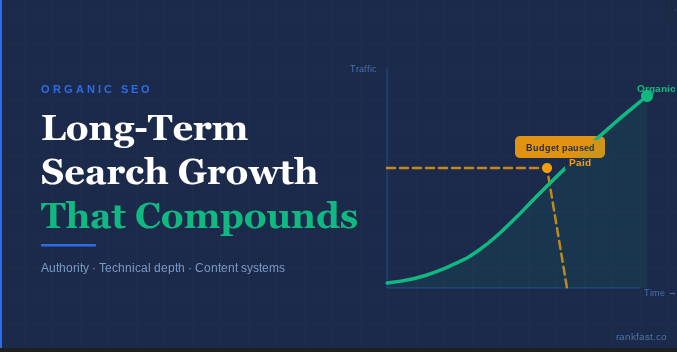
- Organic search growth compounds over time because every piece of content published, every link earned, and every technical improvement made adds to a cumulative authority base that paid search cannot replicate.
- A specialist organic SEO agency builds the underlying systems: technical infrastructure, content architecture, and link authority, that make growth self-reinforcing rather than dependent on continuous input.
- Organic vs paid search is not an either-or choice. The right sequencing uses paid to fill the pipeline while organic foundations are built, then reduces paid dependence as organic authority scales.
- Organic SEO services fail most often because they optimize for activity rather than compounding outcomes: ranking reports instead of share of voice, content volume instead of topical authority, and link counts instead of editorial quality.
- Measuring organic search growth correctly requires tracking organic pipeline contribution and cost per organic lead alongside traffic, because those are the metrics that justify sustained investment.
Why Organic Search Growth Compounds While Paid Search Stalls
The structural difference between organic and paid search is not about quality or trust, though both matter. It is about the economics of accumulation. Every dollar spent on paid search produces a return that ends the moment the spend stops. Every dollar invested in organic SEO services builds on the dollar before it, because the content, links, and authority generated do not disappear when the invoice is paid.
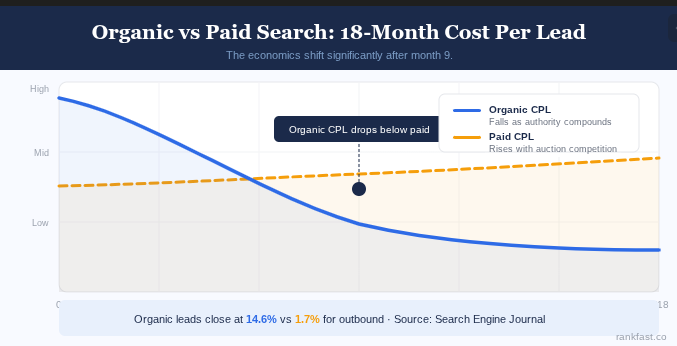
This compounding dynamic is the reason that businesses with mature organic programs consistently report declining cost per lead over time. The audience grows, the authority deepens, and the marginal cost of each additional organic visitor falls. Paid search, by contrast, faces rising costs as auction competition intensifies, particularly in industries where keyword commercial intent is high.
According to Search Engine Journal, organic leads close at a 14.6% rate compared to 1.7% for outbound channels. That conversion differential, combined with the compounding cost structure of organic, creates a revenue impact that most paid-only businesses are significantly undervaluing.
The compounding effect requires time and consistency to materialize. According to Ahrefs, only 5.7% of newly published pages reach Google’s top 10 within a year of publication. The pages that do get there stay there for extended periods, generating traffic at zero marginal cost per visit. That is the return profile that makes organic SEO agency investment rational at a 12 to 24 month horizon.
What an Organic SEO Agency Does Differently
A generalist SEO agency and a specialist organic SEO agency will produce very different output from the same brief. The difference is not primarily in the tactics they deploy. It is in how they sequence work, which outcomes they optimize for, and how they build systems rather than campaigns.
A campaign-oriented approach optimizes for near-term ranking improvements on a defined keyword set. A systems-oriented approach builds the infrastructure that allows ranking to accumulate across an expanding keyword universe without proportional increases in resource input. The first produces results that plateau. The second produces results that compound.
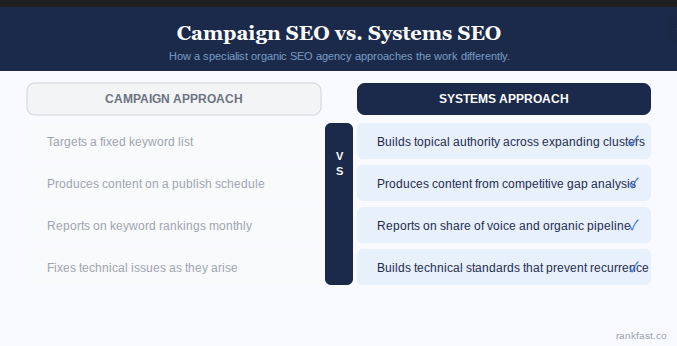
The practical difference in output is significant. A campaign-oriented SEO agency might deliver 12 months of keyword ranking improvements followed by a plateau as the initial gains are absorbed and the competition responds. A systems-oriented organic SEO agency delivers a program where month 12 outperforms month 6, month 18 outperforms month 12, and the cost per organic lead is lower at the end of year two than at the start of year one.
The Technical Foundation Organic Search Growth Requires
Organic search growth does not start with content. It starts with technical health, because technical problems directly constrain how much of a site’s content Google can crawl, index, and rank. A site with excellent content and poor technical infrastructure will underperform a site with average content and excellent technical infrastructure, because Google cannot rank what it cannot reliably access and understand.
The technical priorities that matter most for organic SEO services are sequenced by their impact on crawl efficiency and indexation quality. Addressing them in order prevents the common scenario where content investment precedes the technical work that makes that content rankable.
According to Google’s own guidance on indexing, crawl budget matters most for large sites, but the underlying principles apply at any scale: Google prioritizes crawling pages that demonstrate quality signals, and wastes crawl resources on low-value pages reduce the attention available for high-value ones.
The four technical foundations that a specialist organic SEO agency addresses before scaling content or link acquisition are site architecture and internal linking, Core Web Vitals performance across page templates, structured data implementation for content types that qualify for rich results, and canonical and duplicate content management. Each of these is a system, not a setting, and each requires ongoing maintenance rather than one-time configuration.
| Technical Priority | Impact on Organic Growth | When to Address |
| Site architecture and internal linking | Controls how authority flows from high-value pages to commercial pages | Before content scaling |
| Core Web Vitals by page template | Page experience signal affects competitive ranking for closely matched pages | Within first 60 days |
| Structured data and schema | Rich result and AI Overview eligibility for qualifying content types | Before content publishing at scale |
| Canonical and duplicate content | Prevents crawl budget waste and authority dilution across similar pages | Before any content or link investment |
| XML sitemap quality | Directs Googlebot to priority URLs and signals freshness | Ongoing |
Content Strategy That Builds Lasting Organic Authority
Content is where organic search growth becomes visible, but content volume without strategic architecture produces diminishing returns quickly. A domain that publishes 200 blog posts targeting loosely related keywords will consistently underperform one that publishes 60 pieces of content built around a coherent topical authority model.
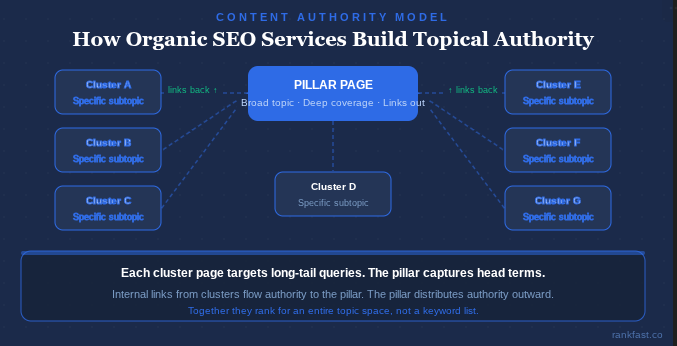
Topical authority means Google associates your domain with comprehensive expertise on a defined subject area. That association is built through a deliberate hub-and-spoke content architecture: pillar pages that address a broad topic at depth, cluster pages that address specific subtopics in detail, and internal linking that connects the cluster to the pillar and signals the hierarchical relationship to search engines.
According to HubSpot, companies with a documented content strategy are 414% more likely to report success with content marketing than those without one. For organic SEO services, the content strategy document is not a publishing calendar. It is a keyword ownership map, a topical hierarchy, a content format guide, and an internal linking specification.
The content formats that perform best in organic search in 2026 are those that answer a specific question directly, demonstrate genuine subject matter expertise, and provide information that the searcher cannot easily find synthesized elsewhere. Thin overviews of popular topics, content that aggregates what competitors have already published, and pieces that rank a keyword without serving the reader rarely hold ranking positions once competitors respond.
Agencies like Rankfast build organic SEO services around what they call a “competitive gap content model”: producing content in the spaces where search demand exists but existing competitor coverage is shallow, rather than competing directly against well-established pages on head terms without a clear quality advantage.
Organic vs Paid Search: The Right Strategic Framing
The organic vs paid search debate is frequently framed as a budget allocation question when it is actually a timeline question. Paid search delivers results immediately and stops delivering results immediately when the budget is removed. Organic search delivers results slowly and continues delivering results indefinitely after the investment that produced them.
Understanding organic vs paid search as a sequencing problem rather than a competition changes how businesses should approach both channels. The correct structure for most organizations is a sequenced investment: paid search runs at full budget while organic foundations are being built, then paid budgets are reduced proportionally as organic traffic scales and the cost per organic lead falls below the paid channel equivalent.
| Factor | Organic SEO | Paid Search |
| Time to first results | 3 to 6 months | Immediate |
| Cost structure | Declining cost per lead over time | Stable or rising with auction competition |
| Traffic after investment stops | Sustained | Stops immediately |
| Competitive defensibility | High — authority compounds | Low — anyone can outbid |
| AI Overview eligibility | Yes, for qualifying content | No |
| Long-term ROI | High at 12 to 24 months | Dependent on sustained spend |
According to WordStream’s industry benchmarks, the average cost per click across industries on Google Ads reached $4.66 in 2024, with competitive B2B and legal verticals averaging significantly higher. At that cost structure, a business driving 10,000 organic visits per month at a 3% conversion rate is generating 300 leads at effectively zero marginal cost once organic authority is established. The same volume from paid search at average CPC rates costs approximately $46,600 per month.
The organic vs paid search calculation becomes more favorable for organic at every point beyond the 12-month mark, and continues to improve as authority compounds. The businesses that understand this dynamic invest in organic SEO agency relationships at the point of pain in paid channel costs, not after they have exhausted their paid budget.
Link Authority and What Organic SEO Services Get Wrong About It
Link acquisition is where organic SEO services most frequently underdeliver. The failure mode is volume optimization: an agency that measures its link building success in the number of links acquired per month will consistently prioritize acquirable links over valuable ones. A domain with 50 links from tier-one industry publications will outperform a domain with 500 links from low-authority blogs on any commercially meaningful query cluster.
The link acquisition strategy that produces durable organic search growth is built around editorial quality rather than outreach volume. The three mechanisms that generate genuinely valuable links are original research and data assets that journalists cite without being asked, digital PR programs that create news value around company expertise or proprietary data, and thought leadership content published in industry media by named company experts.
Each of these mechanisms is slow and requires genuine institutional credibility to execute. That is precisely what makes the links valuable. A competitor can replicate a high-volume guest post campaign in 90 days. They cannot replicate three years of original research citations in Financial Times or Forbes.
According to Moz’s link research, the correlation between domain authority (as measured by the quality and quantity of referring domains) and organic ranking positions remains one of the strongest predictive signals in SEO. For organic search growth at scale, link quality is a prerequisite, not a supplement to content and technical work.
Measuring Organic Search Growth Correctly
Organic SEO services are frequently undervalued because they are measured incorrectly. Keyword rankings measure inputs. Traffic measures one dimension of output. Neither connects to the financial outcomes that justify investment decisions.
The measurement framework for an organic SEO agency engagement should connect directly to business outcomes: qualified leads generated from organic sessions, revenue attributed to organic traffic, cost per organic lead compared to paid channel equivalents, and share of voice across the commercial keyword clusters that matter to the business.
Share of voice is particularly important because it accounts for competitive dynamics that aggregate traffic figures obscure. A business that grew organic traffic by 20% in a quarter where total market search volume grew 35% is losing competitive ground, even though the traffic graph points upward. Share of voice data surfaces that distinction and drives the right strategic response.
According to Semrush’s State of Content Marketing report, 57% of marketers who measure content ROI systematically report that content marketing is among their highest-performing acquisition channels. The correlation is not coincidental. Measurement disciplines investment. Investment disciplines strategy. Strategy produces compounding organic search growth.
Conclusion
Organic search growth is the most durable acquisition channel available to most businesses, and the most consistently underinvested one. The companies that build genuine organic authority do not outspend their competitors. They outwork them on the fundamentals: technical health that lets Google index the right pages efficiently, content that builds topical authority across an expanding query universe, and links that signal institutional credibility rather than outreach volume.
The timeline is the barrier for most organizations. Twelve months of disciplined investment in organic SEO services produces returns that compound through year two and beyond. Most businesses give up at month four, declare SEO ineffective, and return to paid channels that cost three to five times more per lead and stop producing the moment the budget is cut.
Choosing the right organic SEO agency means choosing one that builds systems rather than campaigns, measures outcomes rather than activity, and treats month 18 as the benchmark rather than month three.
Ready to build an organic search program that compounds rather than plateaus? Start with an honest assessment of your current technical foundations and topical authority gaps before setting any keyword targets.
Frequently Asked Questions
How long does organic search growth take to show results?
Initial technical improvements produce measurable crawl and indexation gains within 30 to 60 days. Content targeting low-to-medium competition queries typically shows ranking movement within 90 to 120 days. Meaningful traffic and lead volume growth from organic SEO services is typically visible at the five to eight month mark. At 12 to 18 months, the compounding effects of authority accumulation become measurable as cost per organic lead falls and organic pipeline contribution grows. The businesses that stop before month 12 are the ones that never see the ROI.
How is organic vs paid search best structured for a growing business?
The optimal structure is sequenced rather than either-or. Run paid search at full budget during the first three to six months of an organic SEO engagement, because organic traffic takes time to arrive. As organic rankings establish themselves and organic lead volume grows, reduce paid budgets in the query clusters where organic has achieved strong positioning. The goal is to reach a state where organic carries the majority of acquisition volume at a fraction of the paid channel cost per lead.
What should organic SEO services include in 2026?
A complete organic SEO services engagement in 2026 covers technical SEO audit and remediation, topical authority content architecture and production, competitive gap analysis and keyword ownership mapping, editorial link acquisition and digital PR integration, structured data implementation for AI Overview and rich result eligibility, and a monthly reporting framework tied to share of voice, organic leads, and cost per organic lead. Any engagement that does not cover all six areas is addressing part of the problem.
How do you evaluate whether an organic SEO agency is producing real results?
Track share of voice across your target keyword clusters monthly, not just aggregate keyword rankings. Track organic lead volume and cost per organic lead, not just organic sessions. Evaluate whether the content being produced is targeting competitive gaps or publishing for publishing's sake. Review the link acquisition program for editorial quality, not link count. And compare organic channel cost per lead against paid channel equivalents every quarter to assess whether the investment thesis is tracking correctly.