There are over 1.2 million Google searches for ‘dentist near me’ every month in the United States, and 71% of people looking for a dentist run a search before scheduling an appointment. The patient acquisition opportunity in dental search is enormous. The question most practice owners face is not whether to invest in SEO but who to hire. A general marketing firm might look capable on paper, particularly if it offers a long list of services. A specialist dental SEO agency looks narrower by comparison. That narrowness is exactly why it tends to perform better.
The difference between a dental marketing agency vs SEO firm is not simply a matter of specialization preference. It reflects a structural gap in how each type of provider understands the dental patient journey, approaches compliance, and builds content that Google actually rewards in a healthcare context. This guide explains where those gaps are and what they mean for your practice.
KEY TAKEAWAYS
- 71% of people looking for a dentist run a search before booking. Capturing that intent requires treatment-specific keywords and Map Pack visibility that general marketing firms rarely prioritize.
- Over 70% of clicks on dental searches go to the top three Map Pack positions. Specialist dental SEO services build the GBP authority and review velocity that gets practices into those positions.
- HIPAA rules govern how dental practices can use patient information in marketing, including testimonials and before-and-after photos. A specialist SEO for dentists agency embeds compliance review in every content workflow. A generalist firm typically does not.
- Dental content sits in the YMYL category under Google’s quality rater guidelines. Google gives more weight to EEAT signals for this content type, which means writer credentials, accurate sourcing, and expert review are ranking inputs, not optional extras.
What a General Marketing Firm Actually Delivers
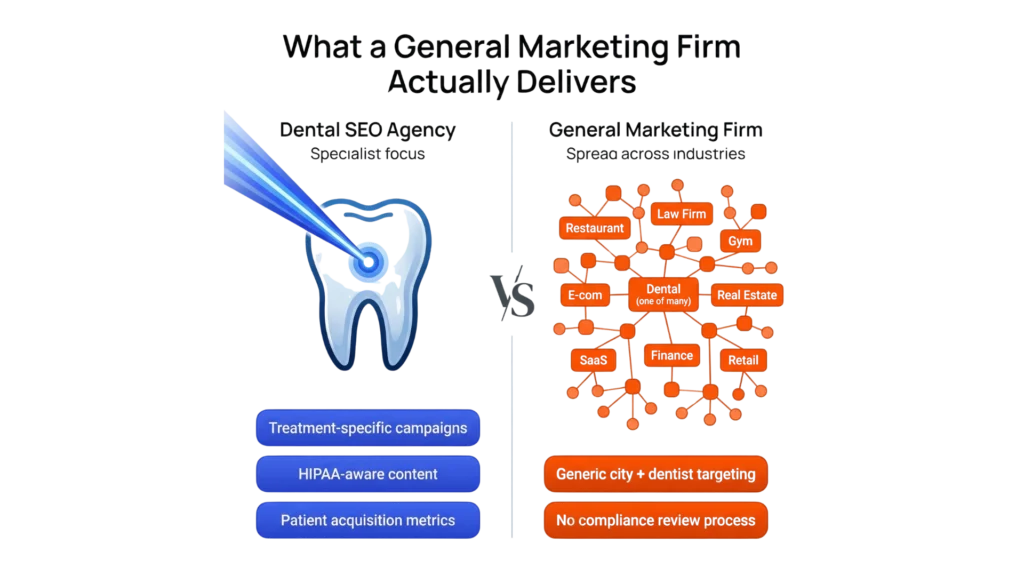
A general marketing firm typically covers a wide range of services: social media management, paid advertising, brand design, email marketing, and some combination of SEO and content. For many small businesses, this breadth is exactly what they need. For a dental practice, it creates a specific problem.
Dental marketing SEO is not interchangeable with SEO for a restaurant, an e-commerce store, or a professional services firm. The keyword intent is different. The compliance requirements are different. The trust signals that convert a search into a booked appointment are different.
Agencies spread across many services rarely excel at all of them. Social media specialists are not typically SEO specialists, and PPC managers generally do not understand organic search dynamics to the depth required to rank competitive dental terms.
When a practice hires a general firm for dental SEO marketing, it usually receives generic service pages, city-level keyword targeting, and a content approach that would be indistinguishable from the output produced for any local service business. That approach produces mediocre results in dental markets, where competing practices in the same area are often investing in genuinely specialized programs.
The Specific Ways Dental SEO Services Differ
The operational differences between a dental SEO agency and a general marketing firm are most visible in four areas: content, keyword strategy, compliance, and local SEO execution. Understanding each one helps practice owners evaluate proposals accurately.
Treatment Specific Keywords and Patient Intent
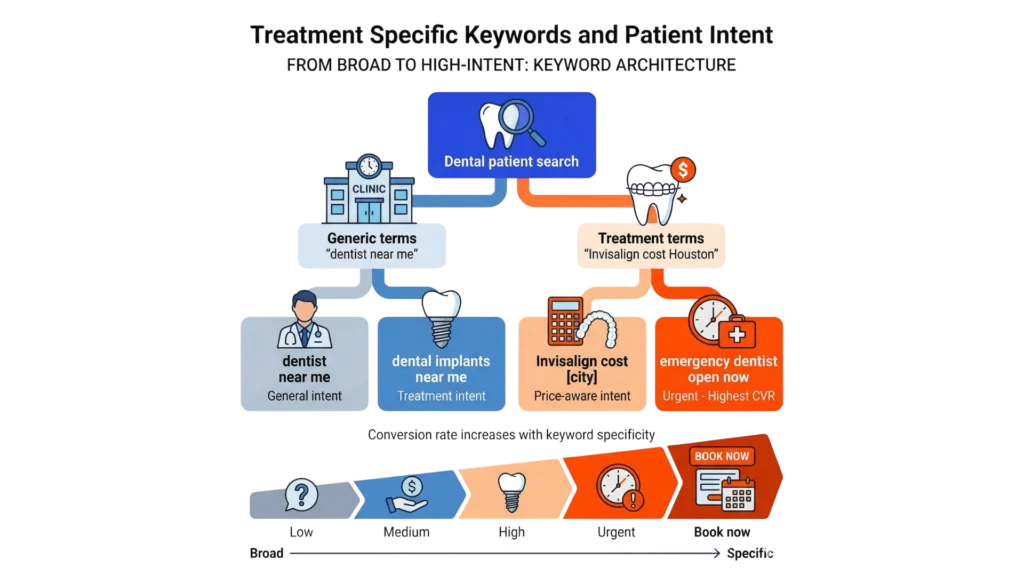
A generalist firm targets broad terms like ‘dentist near me’ or ‘dental clinic in the city’. A dental SEO agency maps keywords to specific treatment types, patient urgency signals, and procedure-specific search intent. ‘Emergency dentist near me’ searches convert at dramatically higher rates than general dental terms because they represent an immediate need. Dedicated service pages for terms like ‘Invisalign cost’, ‘dental implants near me’, and ’emergency dentist open now’ capture patients who are ready to book rather than still researching.
Here is how keyword targeting differs between the two provider types:
- General firm approach: City plus dentist, dental services in location, dentist near me as the primary targets across a handful of pages.
- Dental SEO agency approach: Treatment-specific pages for implants, Invisalign, cosmetic procedures, pediatric care, emergency services, and orthodontics, each targeting the exact search phrasing patients use at the point of booking.
- Neighborhood and suburb pages: Specialist agencies build dedicated pages for the smaller geographies around the practice, capturing patients who search by neighborhood rather than city.
- Long tail and question-based queries: Content answering ‘how much does a dental crown cost’ or ‘what is included in a dental implant procedure’ targets research stage patients and builds topical authority.
HIPAA Compliance and Healthcare Advertising Rules
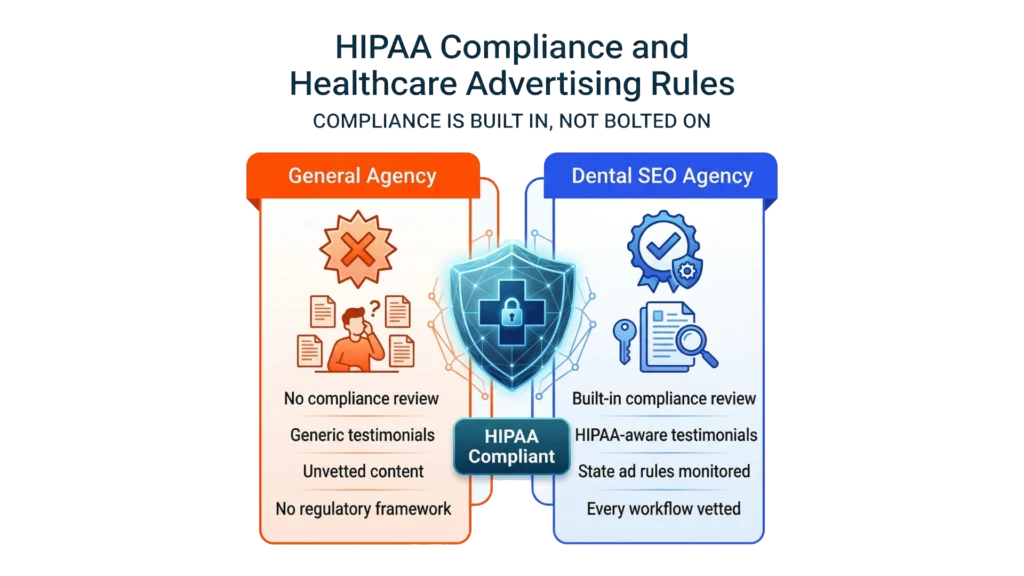
This is where the gap between a dental marketing agency vs SEO firm comparison becomes most consequential. HIPAA rules strictly govern how dental practices can use or display patient information in marketing.
This covers testimonials, before and after images, case study content, and any reference to identifiable patient experiences. Active Marketing’s 2025 dental SEO agency guide notes that state dental advertising regulations differ significantly by location, which means a compliance review process must account for the jurisdiction of each practice, not just federal HIPAA requirements.
A specialist agency embeds this review in every content production step. A general firm typically does not have a compliance review process at all, because none of its other clients need one.
Google Business Profile and Map Pack Optimization
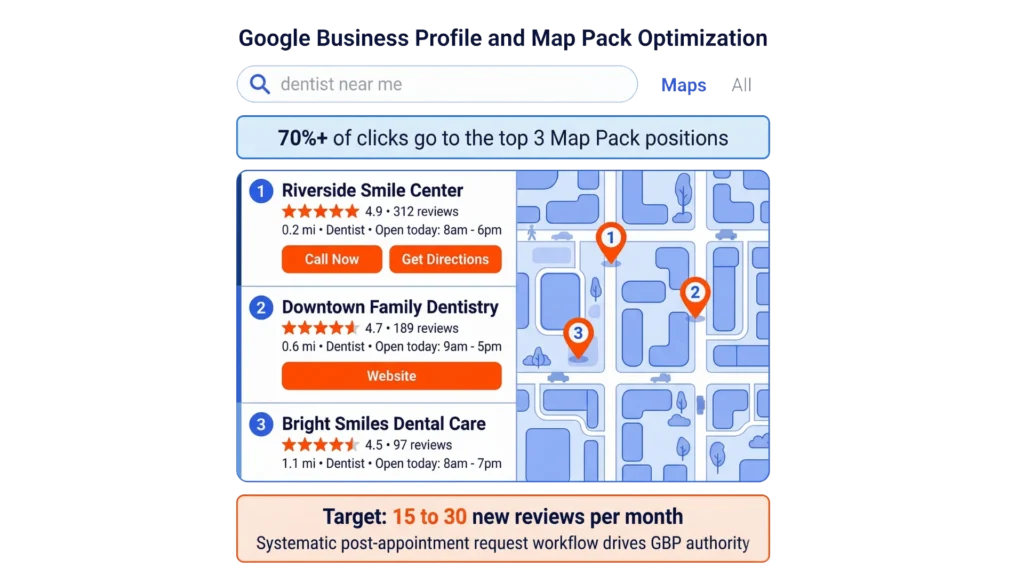
Local search is the primary acquisition channel for most dental practices. Over 70% of clicks on dental searches go to Map Pack positions, and appearing in the top three locally is the most direct path to new patient calls. A specialist dental SEO agency treats Google Business Profile optimization as a core monthly workstream, not a one-time setup task. This includes:
- Selecting the correct primary and secondary GBP categories, including Dentist, Cosmetic Dentist, Pediatric Dentist, and Emergency Dental Service, where applicable
- Maintaining consistent NAP information across all directories, citations, and the practice website
- Building review velocity through systematic post appointment request workflows, targeting 15 to 30 new reviews per month
- Uploading real clinical and team photos regularly to improve engagement and signal an active profile
- Adding treatment-specific service descriptions to the GBP services section for Invisalign, implants, and emergency care
- Publishing Google Posts for seasonal availability, appointment reminders, and procedure promotions
Fully optimized Google Business Profiles receive up to 18 times more search visibility than incomplete profiles. A general marketing firm may set up a GBP as part of onboarding and never touch it again. A specialist agency maintains it as an active monthly deliverable.
YMYL Content Standards and EEAT in Dental Marketing
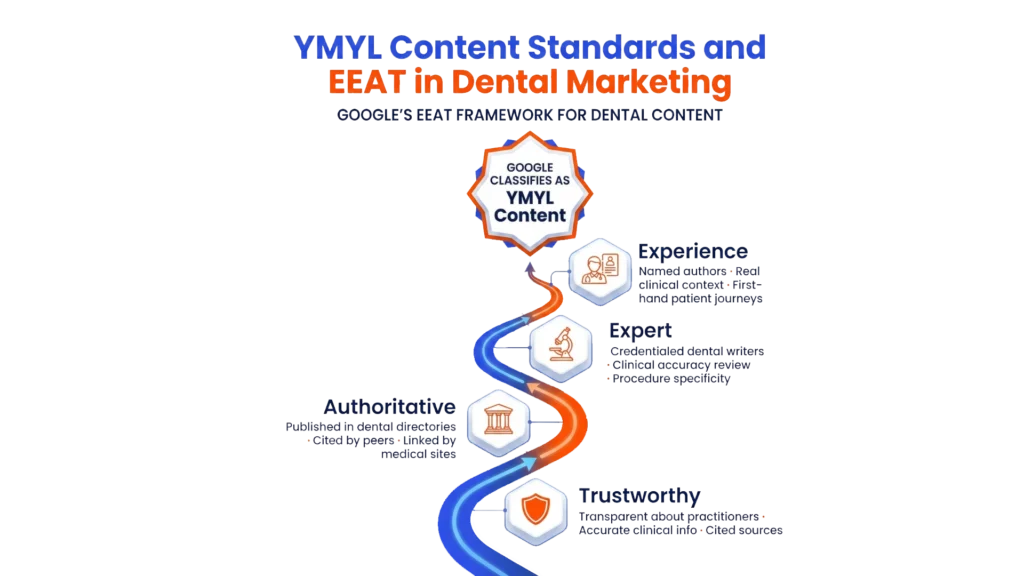
All dental content is classified as YMYL (Your Money or Your Life) under Google’s quality rater guidelines, because it could influence decisions that affect a patient’s health. This means Google applies a higher quality bar to dental content than to most other categories. A top dental SEO agency understands how patients search for care and what builds trust in healthcare content. A generalist firm treats content production the same way regardless of industry.
EEAT (Experience, Expertise, Authoritativeness, and Trustworthiness) signals in dental content require named authors with visible credentials, accurate sourcing from dental and medical literature, specific clinical accuracy in treatment descriptions, and transparent information about the practice and its practitioners. These are not cosmetic signals. They are structural inputs to how Google evaluates the page for YMYL queries.
Dental Marketing Agency vs SEO Firm: Side by Side
The following comparison summarises the operational differences that practice owners most frequently discover only after a general firm has been engaged for several months without producing meaningful results.
| Capability | Dental SEO Agency | General Marketing Firm |
|---|---|---|
| Treatment keyword targeting | Dedicated pages per procedure and patient intent signal | City plus dentist broad targeting across general pages |
| HIPAA content compliance | Embedded in every content workflow | Not addressed as a standard process |
| Google Business Profile | Active monthly maintenance and optimization | One time setup, rarely updated |
| YMYL and EEAT content | Credentialed authors, clinical accuracy review, sourcing | Generalist content writers without healthcare background |
| Review generation | Systematic post appointment workflow targeting 15 to 30 per month | Ad hoc or not managed |
| Reporting metrics | Patient calls, booked appointments, cost per acquisition | Traffic, rankings, impressions |
| Regulatory awareness | Monitors state dental advertising rules per jurisdiction | No regulatory framework in place |
This gap between niche SEO agencies and general firms is consistent across verticals, but it is particularly pronounced in dental because the compliance and YMYL requirements create concrete risks for practices that publish content without specialist oversight.
At Rankfast, the distinction shows up regularly in audits of dental practices that previously worked with generalist providers: the most common issues found are GBP categories set incorrectly, service pages written without clinical accuracy review, and review counts stagnant for six months or more because no systematic request process was ever implemented.
How to Evaluate Dental SEO Services Before Committing
When comparing SEO services for dentists providers, the questions that reveal genuine dental expertise are different from the questions used to evaluate general SEO agencies. The following criteria separate specialist providers from generalists who have added dental to their service list.
- Ask to see examples of dental content they have produced, including who wrote it and what review process was applied before publication.
- Ask specifically how they handle HIPAA and state dental advertising compliance in content and testimonials. If the answer is vague, the firm has not built a compliance process.
- Ask for their GBP management process and what they do on a monthly basis beyond the initial setup.
- Ask what metrics appear in their reporting and whether those metrics include patient calls and booked appointments, not just organic traffic.
- Ask how they approach YMYL content and EEAT signals. A specialist agency will be able to explain author credential requirements and sourcing standards without prompting.
Choosing the Right Dental SEO Partner
The case for working with a specialist dental SEO agency rather than a general marketing firm is not about agency size or the number of services on offer. It is about whether the provider has built workflows that account for what dental search actually requires: treatment-specific content, HIPAA-aware production processes, active Google Business Profile management, and metrics that reflect patient acquisition rather than traffic volume.
The practices filling their appointment books through organic search in 2026 are not doing so because they hired the biggest agency. They are doing so because they hired the right one. Contact Rankfast to review your current dental SEO marketing program and identify where the gaps are.
Frequently Asked Questions
How much do dental SEO services cost?
According to Embarque's 2025 guide, dental SEO services typically range from $1,000 to $3,000 per month for local SEO basics, including Google Business Profile management and foundational service pages, scaling to $3,000 to $6,000 per month for content creation, review management, and link building, and above $6,000 per month for multi location support and advanced technical SEO. The appropriate budget depends on the competitive intensity of the practice's market and the number of locations being managed.
What is the difference between dental SEO marketing and general SEO?
Dental SEO marketing requires treatment-specific keyword architecture targeting patient intent at the procedure level rather than at the generic dentist level. It also requires HIPAA-aware content production, YMYL and EEAT compliance for healthcare content, structured Google Business Profile management, and reporting tied to appointment bookings rather than pageviews. General SEO does not address compliance requirements and typically produces city-level keyword targeting that underperforms in competitive dental markets.
How long does SEO for dentists take to produce results?
Most practices begin seeing Map Pack ranking improvements within 3 to 6 months of a well-executed program, with consistent patient acquisition from organic search typically beginning between months 6 and 12. The timeline depends on the competitive intensity of the local market, the current state of the website and GBP, and how aggressively the review generation program is executed. Emergency dental terms typically show the fastest improvement because they carry high conversion intent.
What questions should I ask a dental SEO agency before signing?
Ask who writes their dental content and what their compliance review process looks like. Ask how they manage Google Business Profile on a monthly basis beyond initial setup. Ask what metrics appear in their reporting and whether those include patient calls and booked appointments. Ask how they handle YMYL content requirements and EEAT signals. Ask for references from dental practices specifically, not just healthcare clients in general. An agency that cannot answer these questions clearly does not have dental-specific workflows in place.