Most industries treat SEO as a visibility problem. In financial technology, it is also a trust problem, a compliance problem, and a content governance problem, all at once. The FinTech sector now comprises approximately 5,790 SaaS companies globally as of January 2025, competing for a user base that searches carefully before handing over financial data, moving money, or signing contracts. Winning organic visibility in that environment requires a fundamentally different approach than standard SEO.
The reason is straightforward: all fintech content sits inside what Google formally classifies as YMYL, or Your Money or Your Life. Under the September 2025 update to Google’s Search Quality Rater Guidelines, YMYL Financial Security now covers any content that could damage a person’s ability to support themselves and their families. That is not a narrow definition.
This guide explains what that bar looks like, how specialist fintech SEO services clear it, and what marketing leaders at financial technology companies should evaluate when choosing a finance SEO agency in 2026.
KEY TAKEAWAYS
- YMYL Financial Security covers all content that could affect a person’s financial stability. Google’s September 2025 guidelines update expanded this definition, raising the floor for what constitutes acceptable quality in financial content.
- SEO converts 7.3 times more than paid search in financial services, per FirstPageSage benchmark data, making organic the highest value acquisition channel in the sector.
- EEAT (Experience, Expertise, Authoritativeness and Trustworthiness) is not a direct ranking score, but Google’s own guidance confirms that systems give more weight to content with strong EEAT for YMYL topics.
- AI generated content without human review and unique value is now explicitly rated as lowest quality under the September 2025 guidelines update, making human editorial oversight a non-negotiable requirement for fintech content programs.
- 61% of marketers in finance cite improving SEO and growing organic presence as their top inbound marketing priority, per Promodo’s 2025 finance marketing report, yet most lack the compliance infrastructure to execute well.
What Makes FinTech SEO Different from Standard SEO
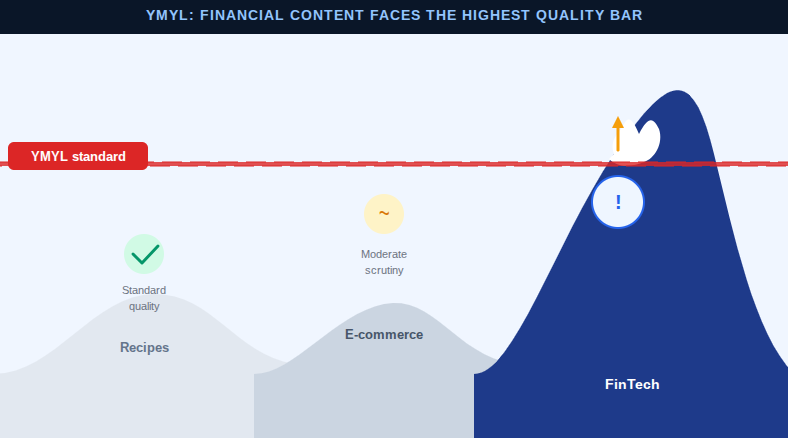
FinTech SEO begins from the same technical and content foundations as any SEO discipline. What separates it is the combination of regulatory constraints, user trust requirements, and the structural difficulty of Google’s own quality standards for financial content.
The sector is also exceptionally competitive. With 5,790 FinTech SaaS companies now operating globally, combined with established banks, credit unions, and insurance providers all investing in organic search, the cost of ranking for high intent financial keywords in 2026 is among the highest of any vertical.
Average cost per click in financial services on Google Ads exceeds $9 in some categories, making organic visibility a critical lever for sustainable customer acquisition.
Regulatory Constraints on Content
Unlike most industries, financial content in most markets is subject to advertising and disclosure regulations. In the United States, FINRA and SEC guidelines govern how investment products can be described. In the United Kingdom, FCA rules govern financial promotions.
In the European Union, MiFID II and the Consumer Credit Directive apply to specific content types. A fintech SEO agency operating in regulated markets must build compliance review into the content production workflow before publication, not after.
Longer and More Complex Buyer Journeys
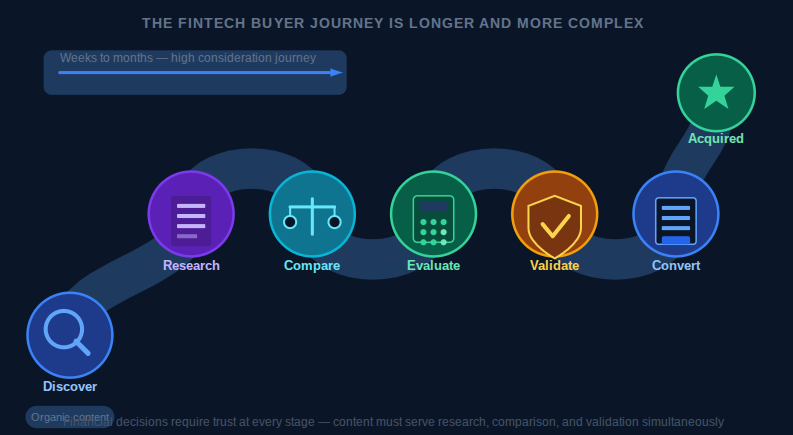
Financial decisions are among the highest consideration purchases a consumer makes. A person choosing a business banking account, a payment gateway, or a lending product will research extensively before converting.
This means fintech content must serve multiple stages of the journey simultaneously: educational content that builds familiarity, comparison content that addresses evaluation criteria, and trust content that resolves the final objections before a prospect submits an application or contact form.
Sophisticated Competitors
The competitive landscape in fintech search is unusual because it mixes pure technology startups with some of the most established and trusted institutions in the world. A challenger bank ranking for ‘business savings account’ is competing against national banks with a domain authority built over decades. Outranking them requires a strategy built around topical depth, EEAT signals, and structured content architecture rather than raw link volume alone.
YMYL in Financial Services: What Google Actually Requires
YMYL is a quality standard. Google’s Search Quality Rater Guidelines, updated September 11, 2025, define YMYL Financial Security as covering topics that could damage a person’s ability to support themselves and their families. The practical scope is broad: investment advice, loan product explanations, credit card comparisons, payment infrastructure descriptions, and regulatory compliance content all fall within it.
According to the guidelines, Google gives more weight to EEAT signals for content in this category precisely because the cost of inaccuracy is high for the reader. A misleading article about investment risk can influence a financial decision.
Building EEAT That Satisfies Google and Regulators Simultaneously
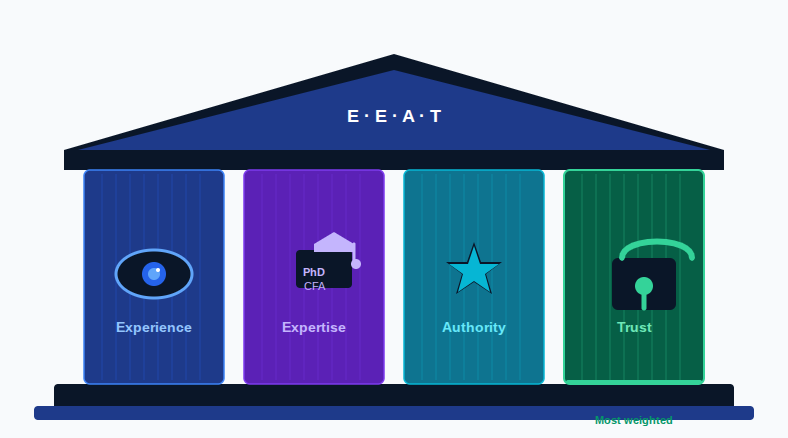
EEAT stands for Experience, Expertise, Authoritativeness and Trustworthiness. As Google’s Search Central documentation clarifies, EEAT is not a ranking score but a framework that Google’s systems use to evaluate content quality signals indirectly. In financial services, building strong EEAT is also, coincidentally, exactly what most regulators require for compliant content.
Experience
The Experience component of EEAT asks whether the content creator has genuine first hand knowledge of the topic. For a fintech company, this means content about lending products should be authored or reviewed by someone who has worked in credit underwriting or loan origination.
Content about payment infrastructure should carry input from someone with practical experience building or operating payment systems. Generic financial content written by generalist writers without practitioner input fails both the EEAT test and the credibility test with sophisticated financial buyers.
Expertise and Authoritativeness
Expertise refers to the verifiable knowledge level of the content creator for the specific topic. Authoritativeness refers to the broader reputation of the site and author within the subject domain.
For fintech SEO, this requires establishing named author profiles with verifiable credentials, maintaining consistent coverage of a defined topic cluster (rather than producing scattered content across unrelated financial subjects), and earning references and links from established financial publications and regulatory bodies.
Trustworthiness
Trust is the most weighted component of EEAT for YMYL content, per the Search Quality Rater Guidelines. A page can appear expert and authoritative but still be untrustworthy if it omits material risk disclosures, presents biased comparisons without declaration, or is associated with a site that has a history of misleading users.
For fintech brands, trust signals include verifiable business registration, regulatory license information where applicable, transparent ownership and contact information, and a clearly identified editorial review process for published content.
Keyword Strategy for Regulated Financial Content
Keyword research for fintech SEO services requires an additional layer beyond standard commercial intent targeting: compliance review.
High Intent vs. Regulatory Risk
Some of the highest intent keywords in financial services carry regulatory exposure. Keywords that imply guaranteed returns, specific investment performance, or unconditional approval are difficult to use accurately in content that also needs to comply with advertising regulations.
A finance SEO agency with sector experience will map keyword opportunities against the regulatory environment of the relevant jurisdiction before building content briefs, avoiding situations where a ranking page creates compliance risk.
Informational Keywords as Trust Builders
The most sustainable organic traffic strategy for most fintech companies involves building topical authority through informational content before targeting high competition transactional terms.
A company offering embedded finance APIs, for example, would benefit from owning the informational cluster around ‘how embedded finance works’, ‘open banking explained’, and ‘BaaS vs payment gateway’ before competing for ’embedded finance platform’ or ‘best BaaS provider’.
The informational content builds the domain authority and topical signals that support the transactional pages.
| Content Type | Intent Stage | YMYL Risk Level | Compliance Review Required | SEO Priority |
|---|---|---|---|---|
| Product feature pages | Transactional | High | Always | Primary |
| Category explainers | Informational | Medium | Recommended | Secondary |
| Product comparisons | Consideration | High | Always | Primary |
| Regulatory guidance content | Informational | Very High | Mandatory with qualified reviewer | High |
| Use case or industry guides | Awareness | Low to Medium | Recommended | Secondary |
| Thought leadership and research | Awareness | Low | Light review | Supporting |
Long Tail Keywords in Fintech
Long tail financial keywords (specific, multi-word queries with lower search volume but higher conversion intent) are often less competitive and easier to rank for than category-level terms, yet they attract buyers who are further along in their research.
Keywords like ‘can a startup apply for business banking without credit history’ or ‘how does settlement time affect cash flow for payment processors’ are rarely targeted by large incumbents but consistently convert when they reach the right audience.
Technical SEO Priorities for FinTech Platforms
Technical SEO for financial platforms involves the same foundations as any site: crawlability, indexability, Core Web Vitals, and structured data. In fintech, however, two categories receive additional weight: page security and structured data for trust signals.
Core Web Vitals and Page Experience
Financial research is disproportionately conducted on mobile devices, with a significant share of fintech queries occurring during financial moments of need at the point of a purchase decision, when comparing loan rates, or when evaluating payment options.
Pages that load slowly or shift layout unpredictably during that moment create friction at exactly the wrong stage of the buyer journey. Google’s Core Web Vitals scores directly influence rankings for pages competing at the margin in high authority financial verticals.
Structured Data for Financial Content
Schema markup allows fintech companies to signal content context directly to Google, improving the accuracy of how content is classified and increasing eligibility for rich results and AI Overview citations.
Relevant schema types for financial content include Article schema with author and organization markup, FAQPage schema for regulatory and product explainers, and FinancialProduct schema, where applicable.
Security and Trust Technical Signals
Beyond HTTPS, which is a baseline requirement, fintech sites benefit from visible trust infrastructure: displayed regulatory license numbers where applicable, verifiable business identity markers, and security certification displays where relevant to the product.
At Rankfast, technical audits of financial services sites consistently show that missing author schema and incomplete organizational markup are among the most common EEAT signal gaps.
FinTech Content Marketing: The Compliance and Visibility Balance
Content is the primary EEAT signal. But for fintech companies, content production involves a workflow that most content agencies have never managed: pre-publication compliance review.
Building a Compliant Content Production Process
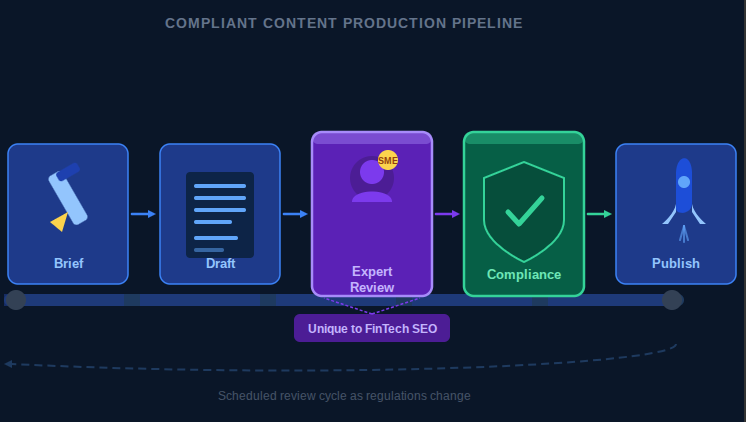
A compliance aware content workflow for fintech companies typically involves: initial brief and keyword approval against regulatory suitability criteria; first draft by a writer with relevant domain knowledge; subject matter review by an internal or external qualified professional; compliance review against applicable regulations before publication; and a scheduled review cycle to update content as regulations or market conditions change.
Original Research as an Authority Signal
Fintech companies are uniquely positioned to produce original research from their own product data. Lending platforms can publish anonymized borrower behavior analyses. Payment processors can report on transaction trends by sector or region.
Expense management tools can publish data on business spending patterns. This type of proprietary dataset content earns backlinks from financial publications, earns citations in analyst reports, and signals to Google that the domain is a primary source rather than a content aggregator.
A one thousand percent growth in organic clicks over twelve months, such as that achieved by B3 in Brazil through an integrated SEO and content strategy, is not typical, but it illustrates the ceiling for fintech companies willing to invest in content that institutional audiences treat as reference material.
Topical Clusters Over Individual Articles
Google evaluates the depth of a site’s coverage of a topic cluster, not just the quality of individual pages. For fintech SEO, this means building content architecture around defined topic pillars: open banking, embedded finance, digital lending, payment infrastructure, regulatory compliance, and so on.
Each pillar requires a comprehensive central guide and a set of supporting articles that address specific questions within the subject. Internal linking between the pillar and supporting content distributes topical authority across the cluster and signals to Google that the site is a definitive resource on the subject, not a single article producer.
What to Look for in a FinTech SEO Agency
Selecting a finance SEO agency requires different evaluation criteria than selecting a generalist SEO provider. The core distinction is whether the agency understands the regulatory and trust infrastructure of financial content, not just the technical and content mechanics of organic search.
| Evaluation Criterion | What a Specialist Agency Demonstrates | Red Flag from a Generalist |
|---|---|---|
| YMYL and EEAT understanding | Can explain how compliance review integrates with content workflow | Treats EEAT as a checklist item without process implications |
| Financial content experience | Has produced compliant content for regulated financial products | Relies on generic writers without financial domain expertise |
| Compliance review process | Has a named compliance review step in the production workflow | No mention of compliance or disclosure review in the brief |
| Technical SEO for financial platforms | Understands author schema, FinancialProduct markup, and trust signals | Focuses only on page speed and meta tags |
| Attribution and reporting | Reports on revenue and conversion contribution, not just rankings | Delivers keyword ranking reports without revenue context |
| AI Overview strategy | Has a named process for optimizing content for AIO citation | No mention of AI Overviews or generative search optimization |
| Note: Evaluate prospective agencies against all six criteria before committing to a retainer. | ||
Questions to Ask Before Engaging a Finance SEO Agency
- How do you integrate compliance review into the content production workflow, and who conducts it?
- What experience do your writers and editors have in regulated financial markets?
- How do you identify YMYL risk in keyword selection before content is briefed?
- How do you structure reporting to show revenue and conversion contribution from organic, not just traffic?
- What is your process for updating content when regulatory conditions or product terms change?
- How do you optimize content for AI Overview inclusion alongside traditional search rankings?
Conclusion
FinTech is one of the few industries where organic SEO is both the highest ROI channel and the most operationally complex to execute. The YMYL classification does not make organic traffic inaccessible. It makes it harder to reach quickly and easier to sustain once reached.
The September 2025 Quality Rater Guidelines update, the continued expansion of AI Overviews across financial queries, and the growing number of fintech competitors targeting the same keywords all point in the same direction: the minimum viable standard for fintech content is rising every quarter. Agencies and in house teams that treat EEAT and YMYL compliance as a baseline rather than a differentiator will continue to outrank those treating SEO as a volume game.
If your current fintech content program lacks a defined compliance review step, named expert authorship, or a structured topical cluster architecture, those are the three places to begin. Get those foundations in place, and the organic results will compound from there. Contact Rankfast to discuss a fintech SEO audit.
Frequently Asked Questions
Why is YMYL important for fintech SEO?
YMYL (Your Money or Your Life) is Google's classification for content that could significantly affect a person's financial stability or safety. All fintech content falls into this category. Google's Search Quality Rater Guidelines state that systems give more weight to content with strong EEAT signals for YMYL topics. In practice, this means fintech content faces a higher quality bar than general content, requiring verifiable author expertise, accurate sourcing, and regular updates to maintain quality ratings.
How does fintech SEO differ from standard SEO?
FinTech SEO differs in four key ways: the requirement for compliance review in the content workflow; the need to build EEAT signals that satisfy both Google quality standards and regulatory expectations; a more complex buyer journey requiring content across multiple intent stages; and a competitive landscape that includes both technology startups and established financial institutions with decades of domain authority. Keyword strategy must also account for the regulatory risk of certain financial content types before targeting them.
How long does it take for fintech SEO to show results?
Fintech SEO timelines are generally longer than those in less regulated verticals due to the time required to build topical authority in a compliance-aware way. Most campaigns begin showing meaningful ranking improvements within 6 to 9 months. Revenue contribution from organic becomes measurable around months 9 to 12. B2B fintech companies with longer sales cycles may see organic influence on the pipeline within 6 months, but conversion impact later. Based on FirstPageSage benchmark data, SEO in financial services converts 7.3 times more than paid search once organic rankings are established.
How much do fintech SEO services cost?
Fintech SEO services typically command a premium over generalist SEO retainers due to the compliance infrastructure and specialized expertise required. Monthly retainers for specialist fintech SEO agencies typically range from $4,000 to $20,000 depending on content volume, technical scope, and the number of markets or jurisdictions covered. This range excludes paid promotion costs. Given that SEO converts 7.3 times more than paid search in financial services, the organic channel typically delivers a significantly lower cost per lead than paid media at scale.