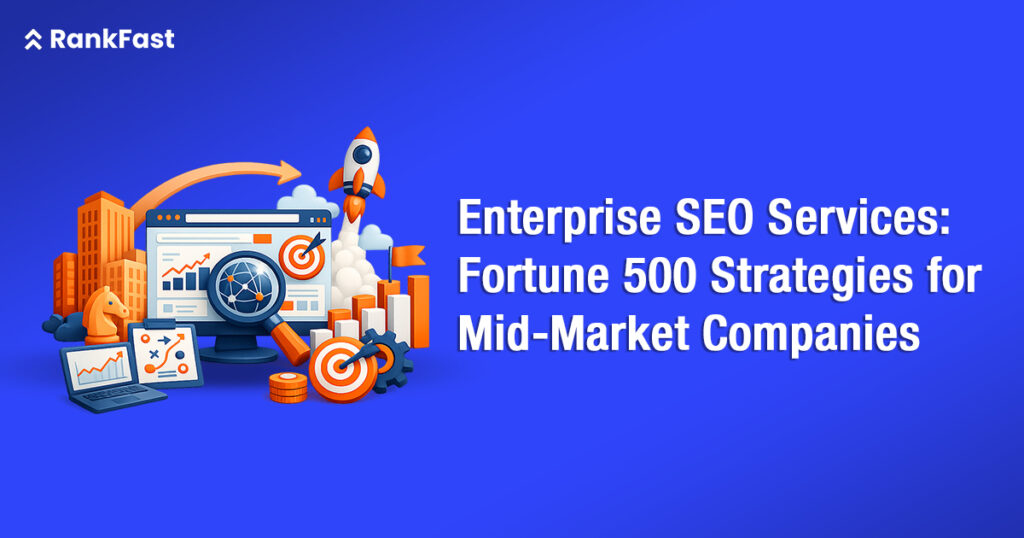

The gap between how Fortune 500 companies approach organic search and how most mid-market businesses approach it is not a gap in budget. It is a gap in the process. Enterprise SEO services are built around governance, scalability, and cross-functional integration that most smaller organizations have never seen modelled. The companies that apply these methods at the mid-market level gain a structural advantage over competitors that are still treating SEO as a single person’s responsibility.
Organic search drives 53% of all website traffic across industries. For mid-market B2B and enterprise-facing companies, that share is typically higher because buyers in complex purchasing cycles research extensively before they reach a sales conversation. The organizations that appear consistently and authoritatively throughout that research process win a disproportionate share of consideration.
This guide covers what enterprise SEO services actually involve at operational scale, how to build a corporate SEO framework that functions across teams and business units, the technical architecture decisions that define large business SEO outcomes, and how mid-market companies can apply these methods without the headcount of a Fortune 500 marketing department.
Key Takeaways
- Enterprise SEO services are distinguished from standard SEO by their emphasis on governance, cross-functional integration, and programmatic content and technical systems that scale across thousands of pages.
- A corporate SEO framework is the operating document that governs how SEO requirements are embedded into product, content, and development workflows rather than applied as an afterthought.
- Large business SEO prioritizes crawl efficiency, international architecture, and site-wide schema implementation at a level of complexity that requires dedicated technical SEO resource rather than generalist management.
- Scalable SEO services for mid-market companies succeed when they apply enterprise methodology selectively, focusing on the highest-leverage systems rather than attempting to replicate Fortune 500 headcount.
- Measuring enterprise SEO performance requires tracking share of voice, organic pipeline contribution, and content ROI by business unit, not just aggregate traffic and ranking movement.
What Enterprise SEO Services Actually Involve at Scale
Enterprise SEO services are frequently misunderstood as standard SEO with a larger budget. The reality is that the operational model is fundamentally different. At enterprise scale, SEO cannot function as a siloed marketing activity. It must be embedded into the systems that govern how content is created, how code is deployed, how product teams make URL and navigation decisions, and how multiple business units coordinate their digital presence.
The Four Pillars of Enterprise SEO
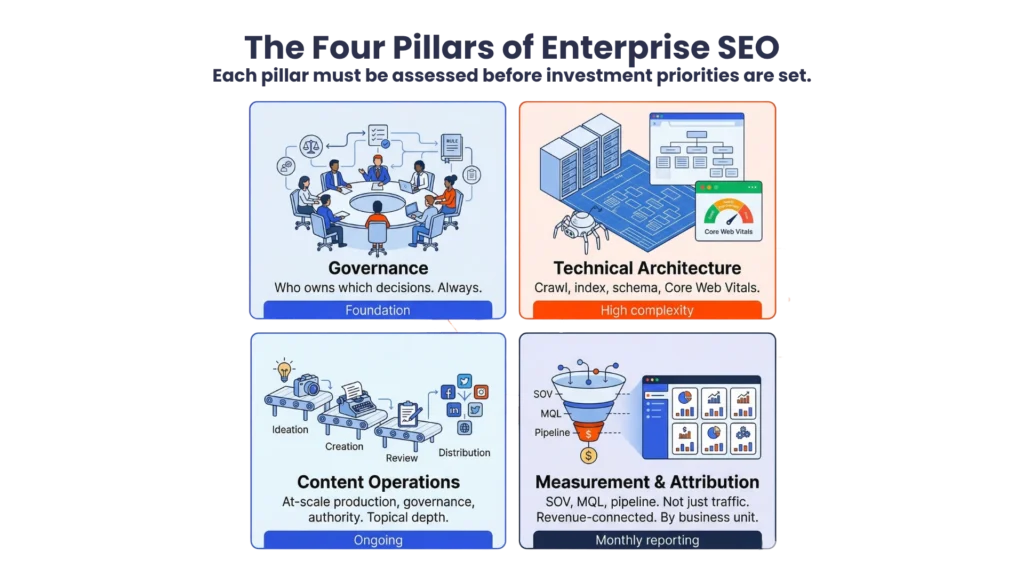
A fully developed enterprise SEO strategy operates across four integrated pillars. Governance defines who owns what decisions and how SEO requirements enter into product and content workflows. Technical architecture covers the site infrastructure decisions that determine how effectively search engines can crawl, index, and understand a large property. Content operations covers the systems for producing, reviewing, and distributing content at scale without sacrificing quality or topical authority. Measurement and attribution covers how organic performance is connected to revenue outcomes across multiple business units or product lines.
An enterprise SEO agency will typically assess maturity across all four pillars before recommending investment priorities. A company with strong technical infrastructure but no content governance will face different bottlenecks than one with excellent content operations but fragmented domain architecture. The diagnosis precedes the prescription.
Where Enterprise and SMB SEO Diverge
The practical divergence between enterprise SEO services and standard SEO shows up most clearly in three areas. First, page volume: an enterprise site may have hundreds of thousands of indexed pages, which means crawl budget management, canonical strategy, and structured data consistency become operational programs rather than one-time fixes.
Second, stakeholder complexity: enterprise SEO decisions involve legal, compliance, product, engineering, and multiple marketing teams, each with different priorities and timelines. Third, international scope: enterprise organizations typically operate across multiple countries, languages, and search markets, each with different competitive dynamics and technical requirements.
Building a Corporate SEO Framework That Scales
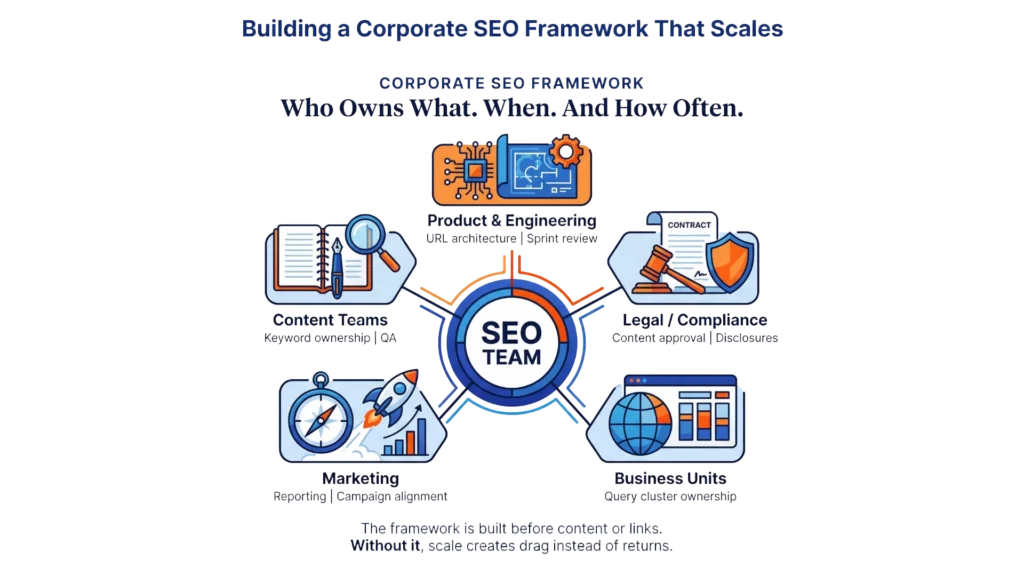
Building a functional corporate SEO framework is typically the first engagement deliverable from a specialist enterprise SEO agency, because nothing that follows executes reliably without it.
Defining SEO Ownership Across Teams
In a mid-market or enterprise organization, SEO touches at least five functional teams: marketing, content, product, engineering, and sometimes legal or compliance. The framework must define which team owns which decisions, what the escalation path is when teams disagree, and how SEO requirements are communicated to teams that do not have SEO expertise.
A single centralized SEO team that makes recommendations with no enforcement mechanism is a structural failure waiting to happen. Effective large business SEO governance gives SEO teams the organizational standing to block or delay launches that would create significant organic performance issues.
SEO Requirements in the Product Development Cycle
The most expensive enterprise SEO problems are the ones created by product teams that launch new URL structures, navigation changes, or content management systems without SEO review. Retrofitting SEO into an existing product decision is always more expensive than building it in from the start.
A corporate SEO framework establishes an SEO review checkpoint in the product development process, typically at the specification stage rather than the launch stage, so that URL architecture, internal linking logic, and metadata systems are designed correctly the first time.
Content Governance for Scalable SEO Services
At enterprise scale, content governance determines whether a large content operation improves organic authority over time or fragments it. Governance covers keyword ownership (which team or product line owns which query clusters), content standards (what quality bar must be met before publication), update cadence (how frequently existing content is reviewed and refreshed), and deprecation policy (how outdated content is handled without creating crawl or redirect issues).
| Framework Component | What It Governs | Who Owns It | Review Cadence |
| Keyword ownership map | Which team owns which query clusters | SEO lead and business unit heads | Quarterly |
| URL and architecture standards | How new pages and sections are named and structured | SEO and product/engineering | Per launch |
| Content quality standards | What meets the bar for publication | Content and SEO teams | Annually with updates |
| Technical SEO review process | How code changes are reviewed before deployment | SEO and engineering leads | Per sprint or release |
| Performance reporting cadence | How results are tracked and shared across stakeholders | SEO lead and marketing leadership | Monthly and quarterly |
| Content deprecation policy | How outdated pages are redirected or consolidated | SEO and content teams | Ongoing |
Technical SEO Priorities for Large Business Websites
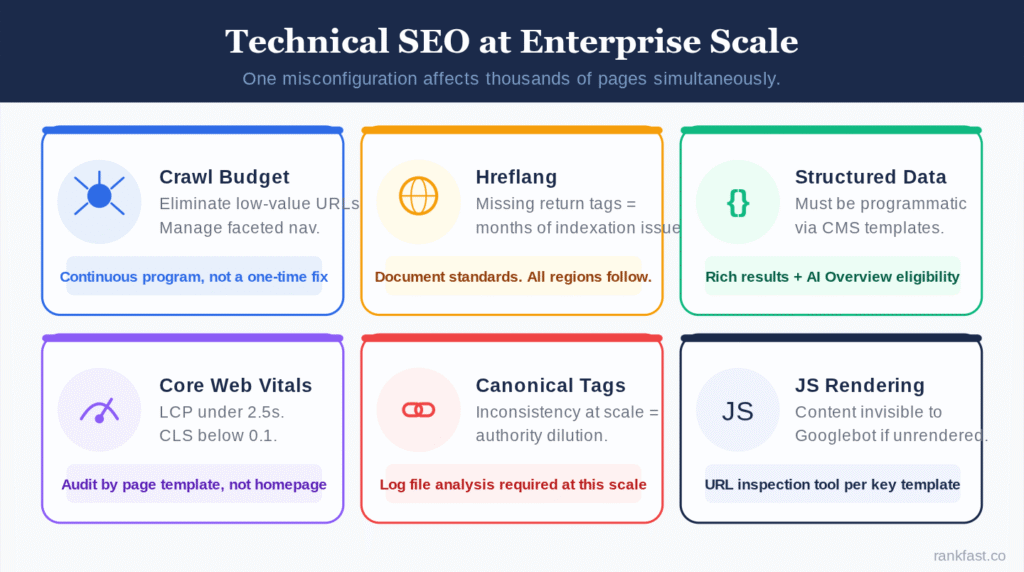
A specialist enterprise SEO company will typically prioritize technical work by potential page-impact, addressing issues that affect the largest proportion of the site’s indexed pages before moving to more localized fixes.
Crawl Budget Management at Scale
Crawl budget is the number of pages Googlebot will crawl on a given site within a given timeframe. For large enterprise sites, inefficient crawl budget allocation means that important new content and updated pages take longer to index. Large sites should prioritize eliminating low-value URLs, managing faceted navigation, and using crawl stats reports to identify and address crawl inefficiencies. For an enterprise e-commerce site with millions of product combinations or a media property with years of archived content, crawl budget management is a continuous operational responsibility rather than a one-time fix.
International SEO Architecture
Enterprise organizations operating across multiple countries and languages require a technically precise international SEO architecture. The core decisions are domain strategy (ccTLDs, subdirectories, or subdomains), hreflang implementation across the entire site, and duplicate content management across language variants.
Errors in hreflang implementation at enterprise scale, such as missing return tags or incorrect language codes, create indexation problems that take months to diagnose and resolve. A corporate SEO framework should include a documented international architecture standard that all regional teams follow rather than implementing independently.
Structured Data at Enterprise Scale
Structured data implementation across a large enterprise site requires a programmatic approach rather than manual page-by-page markup. Correctly implemented structured data is a prerequisite for rich results eligibility, which increases click-through rate for qualifying pages.
For an enterprise site with thousands of product, FAQ, article, or event pages, structured data must be generated dynamically through the CMS or templating layer. A specialist enterprise SEO agency will build the schema templates and CMS integration logic rather than marking up individual pages.
Core Web Vitals Across a Large Property
Core Web Vitals scores vary significantly by page template and content type across large sites. An enterprise homepage may pass all three thresholds while thousands of product or category pages fail due to unoptimized image loading, third-party script loading on render-blocking paths, or layout shifts caused by dynamically loaded content.
Largest Contentful Paint should be under 2.5 seconds and Cumulative Layout Shift below 0.1 for pages to meet the page experience threshold. Identifying which page templates are underperforming and prioritizing engineering resources accordingly is a core function of scalable SEO services at enterprise scale.
| Technical Priority | Scale Risk | Diagnostic Tool | Responsible Team |
| Crawl budget efficiency | Slow indexation of new and updated content | Google Search Console crawl stats | SEO and engineering |
| Hreflang implementation | International indexation conflicts and duplicate content | Screaming Frog, hreflang testing tools | SEO and international teams |
| Programmatic structured data | Missing rich result eligibility at scale | Google Rich Results Test, GSC enhancements | SEO and engineering |
| Core Web Vitals by template | Page experience underperformance across key page types | Google PageSpeed Insights, CrUX data | Engineering and SEO |
| Canonical tag consistency | Authority dilution and indexation conflicts | Log file analysis, crawl tools | SEO and engineering |
| JavaScript rendering | Content invisible to search engines on JS-heavy pages | Google Search Console URL inspection | Engineering and SEO |
Content Strategy and Governance at Enterprise Scale
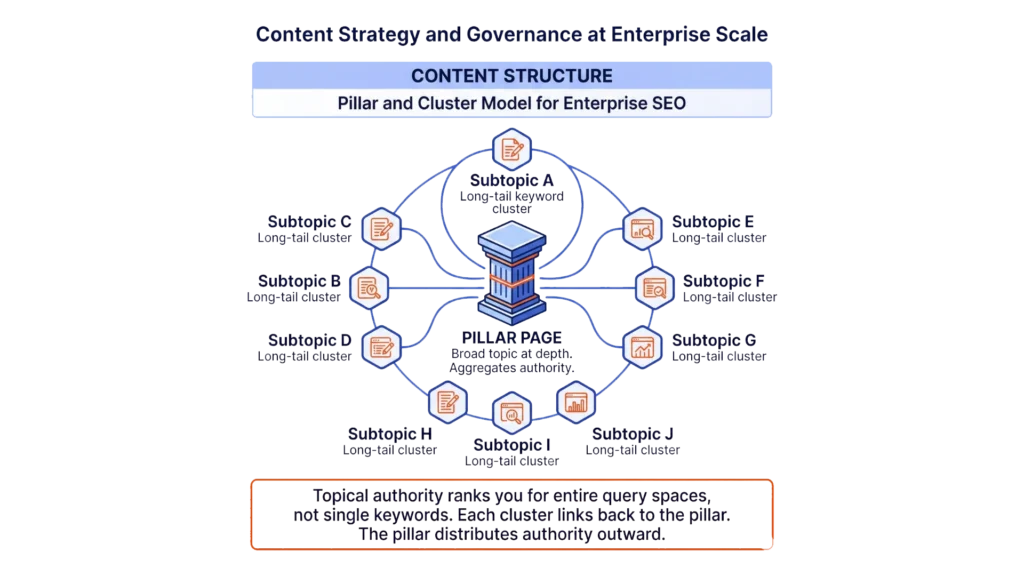
The content strategy for an enterprise SEO engagement must answer three questions before any writing begins: which query clusters does each business unit own, what content format is appropriate for each audience stage, and how does new content connect to existing content through deliberate internal linking architecture.
Topical Authority and Pillar Architecture
Enterprise SEO strategy for content is built around topical authority rather than individual keyword targeting. Topical authority means that a domain ranks not just for individual keywords but for the full range of related queries within a subject area, because it has published a comprehensive, internally linked library of content on that topic.
Building topical authority requires a pillar-and-cluster architecture: a primary pillar page that covers a broad topic at depth, supported by cluster pages that address specific subtopics and link back to the pillar. For an enterprise with multiple product lines, this architecture is replicated across each core topic area with clear ownership assigned to each cluster.
Content Governance Across Multiple Teams
When content is produced by multiple teams across multiple business units, governance becomes the mechanism that prevents the most common enterprise content problems: duplicate content across business lines, keyword cannibalization between product categories, inconsistent brand voice and technical accuracy, and orphaned pages that receive no internal links and therefore accumulate no authority.
A functional large business SEO content governance system includes a content calendar with keyword assignments, a pre-publication SEO checklist, a regular content audit schedule, and a clear decision tree for when existing content should be updated versus when a new page should be created.
Programmatic Content at Scale
For enterprise organizations with large product catalogues, location networks, or data sets, programmatic content production offers a way to create thousands of optimized pages from structured data without manual writing for each page. Pages that are genuinely useful to the searcher, even when generated programmatically, can rank well and accumulate organic traffic.
The risk is thin content: pages that are technically unique but practically identical in value. An enterprise SEO company will establish quality thresholds for programmatic content, require that each page template passes a minimum useful-content bar, and implement canonical and noindex directives on page types that cannot meet that standard.
Enterprise Link Acquisition: Authority Building for Complex Organizations
An enterprise SEO agency will typically distinguish between three categories of link acquisition: passive acquisition from existing content assets, active acquisition through original research and editorial programs, and digital PR through journalist and analyst relationships. Each category serves a different function in the authority-building program.
Passive Acquisition Through Linkable Asset Development
Passive link acquisition means creating assets that attract links without outreach. Original research reports, industry data sets, interactive calculators, and proprietary benchmark studies generate inbound links from journalists, academics, and industry commentators who reference the data in their own work.
Original research content attracts 4.5 times more links than standard blog content. For an enterprise SEO company managing a domain that already has substantial authority, investing in one high-quality original research asset per quarter typically delivers more link value than the equivalent investment in individual outreach campaigns.
Digital PR and Analyst Relations as Link Channels
At enterprise scale, the most authoritative links come from tier-one media coverage, analyst reports, and academic citations. These links are not acquired through outreach templates; they are earned through genuine news value, research quality, and executive thought leadership.
A corporate SEO framework should include a coordinated digital PR program where the SEO team identifies which content assets are worth pitching to journalists, which data points are likely to generate coverage, and how to track the resulting links as part of the organic authority-building program.
Internal Link Architecture as an Authority Distribution System
Internal linking at enterprise scale is an authority distribution problem as much as a user experience decision. With thousands of pages on a domain, ensuring that authority flows from high-authority pages to commercially important but lower-authority pages requires a deliberate internal linking strategy, not just editorially placed links on individual pieces.
A specialist enterprise SEO strategy will include an internal link audit that maps current authority flow, identifies pages that are commercially important but internally isolated, and establishes linking standards that propagate authority efficiently across the site architecture.
How Mid-Market Companies Apply Fortune 500 SEO Methods
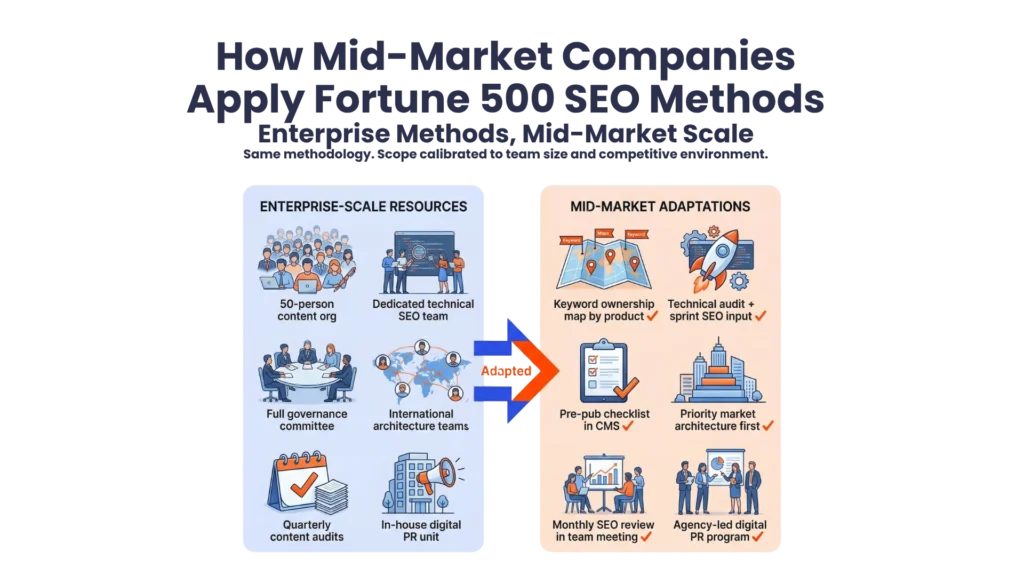
The enterprise SEO methods described above are not exclusive to companies with eight-figure marketing budgets. Mid-market companies can apply the same principles, with the scope calibrated to their team size, site complexity, and competitive environment. The key is applying enterprise methodology selectively, starting with the systems that have the highest leverage given the company’s current organic performance gaps.
Starting With a Scalable Technical Foundation
For a mid-market company transitioning from standard to enterprise SEO services, the technical audit is the right starting point. Understanding what proportion of the existing site is indexed, how authority is currently distributed across the domain, where crawl budget is being wasted on low-value URLs, and what structured data opportunities exist gives the SEO team a clear priority order.
Addressing the technical foundation before scaling content or link acquisition means that the additional pages and links created will actually drive performance rather than adding volume to a site with unresolved structural issues.
Adapting Governance to Mid-Market Org Structures
A mid-market company with a team of 10 marketing professionals cannot implement the same SEO governance structure as a Fortune 500 with a 50-person content organization. The adapted version achieves the same outcomes with fewer formal processes: a keyword ownership map that covers the key query clusters by product line, a pre-publication checklist embedded in the content management system, a monthly SEO review in the marketing team meeting, and a standing SEO input on product and engineering sprint planning.
Scalable SEO Services From a Specialist Agency
Mid-market companies that choose to work with an enterprise SEO agency rather than build entirely in-house gain access to the methodology, tooling, and cross-client pattern recognition that comes from managing large-scale SEO programs across multiple organizations.
Agencies like Rankfast that operate across both enterprise and mid-market clients apply corporate SEO framework methodology developed in complex enterprise environments to mid-market accounts, giving those companies a structural advantage over competitors that are working from generalist SEO playbooks. The differentiator is not the volume of output but the quality of the underlying systems.
Conclusion
Enterprise SEO services exist because organic search at scale is an organizational challenge as much as a technical one. The companies that dominate high-value query clusters in competitive markets have not just optimized more pages or acquired more links. They have built governance structures that prevent their own teams from undermining organic performance, technical architectures that allow search engines to understand and index their content efficiently, and content operations that deepen topical authority systematically rather than publishing opportunistically.
Mid-market companies that apply this methodology gain a compounding advantage over competitors that are still treating large business SEO as a channel to be managed rather than a system to be built. The investment in governance and architecture is less visible than published content and acquired backlinks, but it is what makes every subsequent investment perform at a higher return.
The entry point for any enterprise SEO strategy, regardless of company size, is an honest assessment of where the current program is generating structural drag rather than compounding returns. That assessment, done rigorously, creates the priority order that every subsequent decision should follow.
Frequently Asked Questions
How does an enterprise SEO agency approach large business SEO differently?
A specialist enterprise SEO agency begins with a governance and architecture assessment before recommending any content or technical execution. They identify which organizational processes are creating recurring SEO problems, which technical systems need to be addressed at the template or platform level rather than page by page, and how authority is currently distributed across the domain.
What should a corporate SEO framework include?
A corporate SEO framework should define keyword ownership by business unit, establish SEO review checkpoints in the product development and content production cycles, document URL and information architecture standards, set quality thresholds for content publication, define a content deprecation and consolidation policy, and specify the reporting cadence and metrics used to track performance across stakeholders.
How long does enterprise SEO take to show results?
Enterprise SEO timelines vary by the complexity of the site and the severity of existing technical and content issues. Most organizations begin to see measurable ranking and traffic improvements within four to six months for targeted content clusters, assuming technical foundations are addressed in the first 90 days. Share of voice gains at a competitive level typically become visible at the six to twelve month mark.
Can mid-market companies use enterprise SEO strategies effectively?
Yes. Mid-market companies that apply enterprise SEO methodology selectively, starting with governance structures, technical foundations, and topical authority architecture, gain a meaningful competitive advantage over peers that are running standard keyword-and-backlink SEO programs. The adaptation is in scope and staffing, not in methodology.