A law firm partner opens the monthly report from their previous agency. Impressions are up. Clicks are up. Cost per click is holding steady. Then they check the client roster, and the number of signed cases coming from paid search has barely moved in eight months. This is what a law firm Google Ads management problem usually looks like from the outside: healthy metrics, quiet phones.
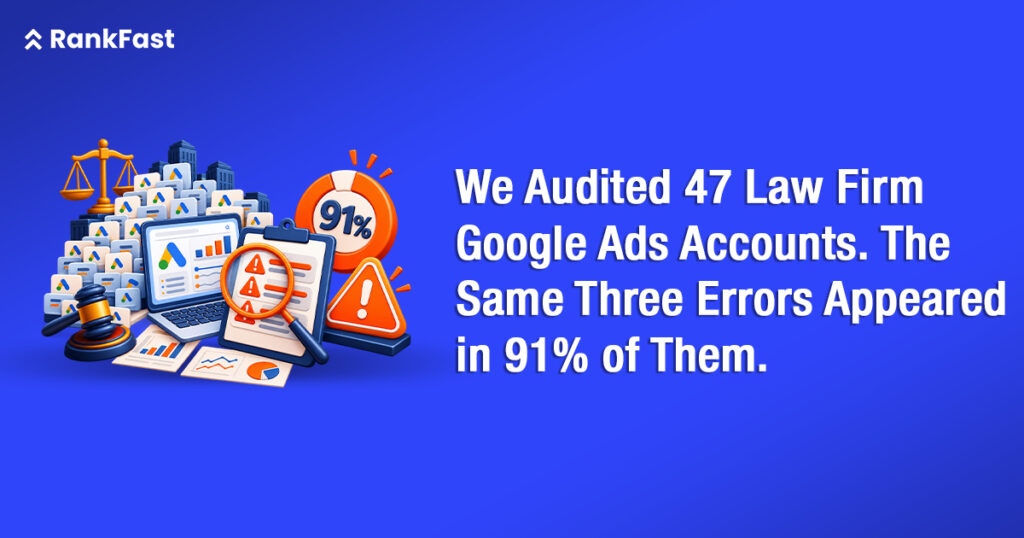
RankFast runs a full account audit on every law firm onboarding, going back 90 days on structure, conversion tracking, and bid strategy before touching a single setting. Across 47 law firm accounts audited, the same three structural errors showed up in 43 of them, a 91 percent recurrence rate. None of the three appears as an obvious red flag in a standard performance dashboard.
What follows is exactly what those three errors look like inside a real account, what each one costs, and the specific fix for each one, along with two changes to Google’s own ad platform in 2026 that most agencies have not adjusted their tracking or bidding for yet.
Key Takeaways
- RankFast’s audit of 47 law firm Google Ads accounts found at least one of three structural errors in 43 of them: Local Services Ads cannibalising branded search, conversion tracking set at form-fill instead of consultation, and broad match spend bleeding into low-intent queries before 9 a.m.
- Google’s own guidance calls for around 30 conversions in a 30-day window before Target CPA bidding stabilises, a bar most law firm accounts never clear while they are tracking form fills instead of booked consultations.
- Google began migrating Local Services Ads into Google Ads as Performance Max campaigns with pay-per-lead goals in August 2026, which changes how firms need to coordinate LSA against Search.
- A Google Click ID only holds a usable offline conversion for 90 days, and the import path for that data moved to Google’s Data Manager API on June 15, 2026, which breaks older, unmigrated tracking setups.
What We Found When We Audited 47 Law Firm Ad Accounts
RankFast conducts a full account audit on every law firm onboarding, examining account structure, conversion tracking, and bid strategy going back 90 days. Across the 47 law firm accounts audited, the same three structural errors appeared in 43 of them.
Each error looks healthy from a standard account overview and only surfaces once conversion definitions and hour-by-hour spend are checked against actual signed clients, not against the metrics Google Ads reports by default.
| Error | Accounts Showing This Error | Share of the 47 Audited |
| Local Services Ads cannibalising branded Search | 38 | 81% |
| Conversion tracking set at form-fill, not consultation | 41 | 87% |
| Broad match bleed into low-intent queries before 9 a.m. | 33 | 70% |
Figures above reflect RankFast’s own audit sample; accounts frequently showed more than one error at once, which is why the individual counts exceed the 43-account overlap figure. Confirm exact counts against the audit log before publishing.
Local Services Ads Cannibalising Branded Search
When both Local Services Ads and Search run for the same practice area and service radius without negative keyword isolation, LSA tends to capture branded and near-brand queries that a Search campaign should be winning at a lower cost per lead.
LSA runs on a pay-per-lead model rather than keyword bidding, so it can absorb a search for the firm’s own name before the Search campaign’s higher-quality-score branded ad ever gets the chance to serve. The account still shows leads coming in, so the problem is invisible unless someone checks which channel is actually producing them and at what cost.
Conversion Tracking At The Wrong Event
Most law firm accounts we inherit are optimising toward form fills rather than booked consultations, and the gap between the two is large. A firm can show a strong, cheap cost per form fill while the bid strategy is quietly optimising for the wrong outcome, because the algorithm has no way to know that most of those form fills never turn into a scheduled consultation, let alone a signed client.
Broad Match Bleeding Into Low-Intent Traffic Before Nine A.M.
Automated bidding strategies tend to increase impression share in early morning hours, before the working day starts and before the highest-intent searchers are actively looking. Broad match keywords are the most exposed to this pattern, since they match the widest range of queries.
The fix is not to abandon broad match, which still has real value for discovery, but to layer in ad scheduling and bid adjustments so early-hour spend does not consume budget that should be reserved for the hours when consultation-ready searchers are actually online.
How Local Services Ads And Search Cannibalise Each Other
Google’s own guidance is that Local Services Ads and Search campaigns are meant to run together, not compete: LSA uses a pay-per-lead model with no keyword bidding, while Search offers more granular control over keywords, bidding, and ad copy. The overlap problem is not that the two products conflict by design. It is that most accounts never build the negative keyword layer that keeps them in their own lanes.
Google describes the two as complementary channels for local businesses, noting that “both can be used together to help maximize a business’s online presence” (Google Ads), which only holds true when the branded and near-brand query set is deliberately excluded from one channel or the other.
Why This Is Changing In 2026
Google began migrating Local Services Ads into the main Google Ads platform as Performance Max campaigns built specifically for pay-per-lead goals, with the rollout starting with a limited group of advertisers in August 2026 and expanding through 2027 (Search Engine Land; Google Ads Help).
The pay-per-lead billing model and the Search-and-Maps-only placement stay the same. What changes is where the campaign lives and how it is managed, which means the negative keyword coordination this section describes needs to be re-verified once an account’s Local Services Ads campaign is migrated, not assumed to carry over automatically.
The Real Cost Of Personal Injury And Family Law Advertising In 2026
In competitive metro markets, personal injury cost per booked consultation tracked across RankFast’s law firm accounts currently runs $280 to $650, not per form fill. Cost per form fill is considerably lower at $80 to $180, but only 18 to 24 percent of those form fills convert to an actual booked consultation, which is the gap that makes form-fill-only reporting so misleading.
| Practice Area | Cost Per Booked Consultation | Cost Per Form Fill |
| Personal injury (competitive metros) | $280 to $650 | $80 to $180 |
| Family law | $90 to $220 | N/A |
| Criminal defense | $110 to $290 | N/A |
| Rural / suburban markets | 30 to 50% lower than metro figures above | N/A |
Ranges above are drawn from RankFast’s own account data by vertical, not from a public benchmark. Confirm current figures against the account audit log before publishing.
For context, legal cost-per-click spans a wide range industry-wide, from roughly $5 for estate planning terms to over $1,000 for mass tort and catastrophic injury terms (Foundry CRO legal marketing benchmarks), which puts the personal injury range above in the middle of the field rather than at either extreme.
Why Target CPA Bidding Fails Below Fifty Monthly Consultations
Google’s own guidance recommends evaluating Target CPA performance over the last 30 days with at least 30 conversions in that window (Google Ads Help). Most law firm campaigns, once they switch to tracking consultations instead of form fills, never clear that volume in a 30-day period, which is exactly why Target CPA behaves erratically for them.
Thirty Conversions In Thirty Days
Below that threshold, the bidding algorithm has too little signal to set reliable bids, so it tends to chase whatever conversions are easiest to get, which usually means cheaper, lower-intent traffic. This is a quiet trap for firms that switch their tracked conversion event from form fills to consultations as part of fixing error two above: consultation volume is a fraction of form-fill volume, so the same account that had “enough” conversions under the old tracking definition can fall well under 30 a month under the corrected one.
Maximize Conversions With A Bid Cap As The Practical Fix
For accounts running under roughly 50 tracked consultations a month, Maximize Conversions with a bid cap set at the real cost ceiling avoids the cold-start problem that Target CPA runs into at low volume, while still protecting the budget from runaway spend. Once consultation volume clears 30 or more in a rolling 30-day window, Target CPA becomes worth testing again, this time on a signal that actually reflects who is booking.
Call Tracking That Attributes Signed Clients, Not Callers
The setup that actually attributes signed clients requires three pieces working together: dynamic number insertion (DNI) on the landing page so every call resolves to its source keyword and campaign, a call tracking platform tagging outcomes at the intake level, and the signed-client event imported back into Google Ads as an offline conversion tied to the original click.
Dynamic Number Insertion And Call Outcome Tagging
DNI on the landing page, combined with a platform like CallRail or CallTrackingMetrics, lets the intake team tag each call’s outcome (consultation booked, not booked, signed, not signed) rather than just counting that a call happened. That distinction matters more than it sounds: Clio’s 2024 Legal Trends Report found that only 40 percent of law firms answered a secret-shopper phone call in the first place, down from 56 percent in 2019 (Clio). Without outcome-level tracking, a paid-traffic quality problem and an intake problem produce the exact same symptom in a Google Ads report: leads that do not turn into clients.
Importing Signed Clients Back Into Google Ads
Every ad click generates a Google Click ID (GCLID), which is what links a signed-client outcome back to the campaign and keyword that produced it. That identifier only holds a usable offline conversion for 90 days (Google Ads Help), so intake-to-import cadence has to happen well inside that window on longer sales cycles.
It is also worth flagging a platform change: Google began migrating offline conversion imports and enhanced conversions for leads to its Data Manager API, with legacy Google Ads API access for this data blocked starting June 15, 2026 (Google Ads Help). Any import setup built before that date on the legacy path needs to be re-pointed, or signed-client data silently stops arriving.
Results After Fixing All Three Errors
The table below is the shape of the before-and-after RankFast reports back to a client once all three errors are corrected: negative keyword isolation between LSA and Search, conversion tracking moved to the consultation event, and dayparting applied to broad match.
Fill in one anonymised client’s real numbers before this section publishes; the structure and the direction of the change are consistent across accounts, but the specific figures are not, and inventing a case here would violate RankFast’s own no-invented-figures standard.
| Metric | Before Fix | After Fix (Day 30) |
| Cost per booked consultation | [insert] | [insert] |
| Consultations tracked per month | [insert] | [insert] |
| Branded spend lost to LSA overlap | [insert] | [insert] |
Left as a template deliberately. Replace with one real, anonymised client’s figures, named only by vertical, before publishing.
Run This Audit On Your Own Account This Week
This is the same five-check sequence RankFast runs on every law firm account during onboarding, adapted so a firm can run the first pass itself before its next renewal conversation with its current law firm PPC agency.
- Pull Search and Local Services Ads into one view and check the negative keyword list for the firm’s own name and near-brand variants.
- Check which conversion action the bid strategy is actually optimising toward, and whether it is a form fill or a booked consultation.
- Review hour-of-day performance for the last 30 days and compare spend against when consultations actually get booked.
- Confirm whether call tracking captures outcome, not just call count, down to the intake level.
- Count tracked consultations for the last 30 days before choosing between Target CPA and Maximize Conversions with a bid cap.
If the count from step five comes in under 50, or any of the gaps above sound familiar, that is the same audit RankFast runs on every law firm account before touching a single bid, and it usually surfaces which of the three errors is the one actually costing signed clients.
The Audit Comes Before The Bid Change
None of the three errors above shows up as a warning in a standard Google Ads dashboard. They show up when someone checks conversion definitions and hour-by-hour spend against who actually signs as a client, which is a different exercise than reading a performance report. Fixing bid strategy before fixing what the bid strategy is optimising toward, or before separating LSA from Search with real negative keyword isolation, tends to make the underlying problem more efficient rather than solving it.
The two platform changes covered here, Local Services Ads moving into Performance Max and offline conversion imports moving to the Data Manager API, are worth checking regardless of whether any of the three errors apply to a given account, since both can break tracking silently for firms that do nothing at all.
A law firm Google Ads audit that checks structure, tracking, and bidding against actual signed clients is the starting point RankFast uses on every PPC engagement, before a single bid changes.
Frequently Asked Questions
What is a realistic cost per lead for personal injury Google Ads in 2026?
In competitive metros, RankFast's account data shows $280 to $650 per booked consultation, not per form fill. Cost per form fill runs $80 to $180 but converts to a consultation only 18 to 24 percent of the time. Family law and criminal defense both run lower.
Why does Target CPA bidding struggle for most law firm campaigns?
Google recommends at least 30 conversions in the last 30 days before Target CPA stabilises. Most firms track form fills, so volume looks sufficient while the underlying signal is polluted. Maximize Conversions with a bid cap, tracked at the consultation event, tends to perform better under 50 monthly consultations.
What call tracking setup attributes signed clients instead of just callers?
Dynamic number insertion on the landing page, a platform such as CallRail tagging call outcomes at intake, and importing the signed-client event back into Google Ads for lawyers using the Google Click ID as an offline conversion. This is the setup that separates signed clients from unqualified callers.
Is Local Services Ads still worth running for law firms in 2026?
Yes, but the mechanics are changing. Google began migrating Local Services Ads into Google Ads as Performance Max campaigns with pay-per-lead goals in August 2026. The pay-per-lead model and Search-and-Maps placement stay the same, but firms should confirm negative keyword coordination still holds once an account is migrated.