We are spending $3,400 a month on Google Ads between our Search and Local Services campaigns and our cost per job booked has gone up 60 percent since we added LSAs.” RankFast hears a version of that complaint from nearly every home services owner who adds Local Services Ads on top of an existing Search campaign without touching either one’s targeting.
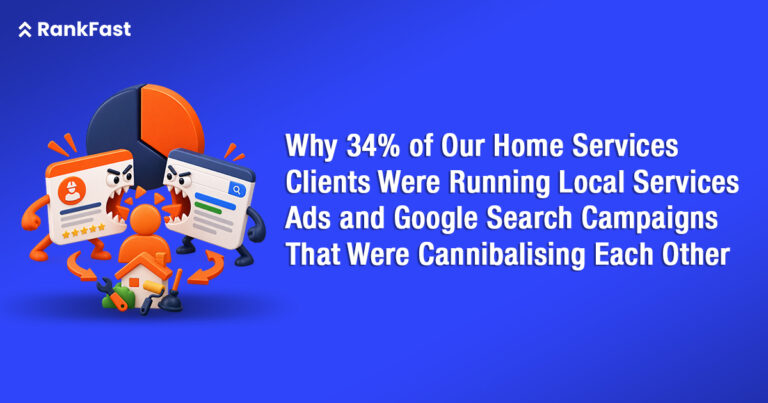
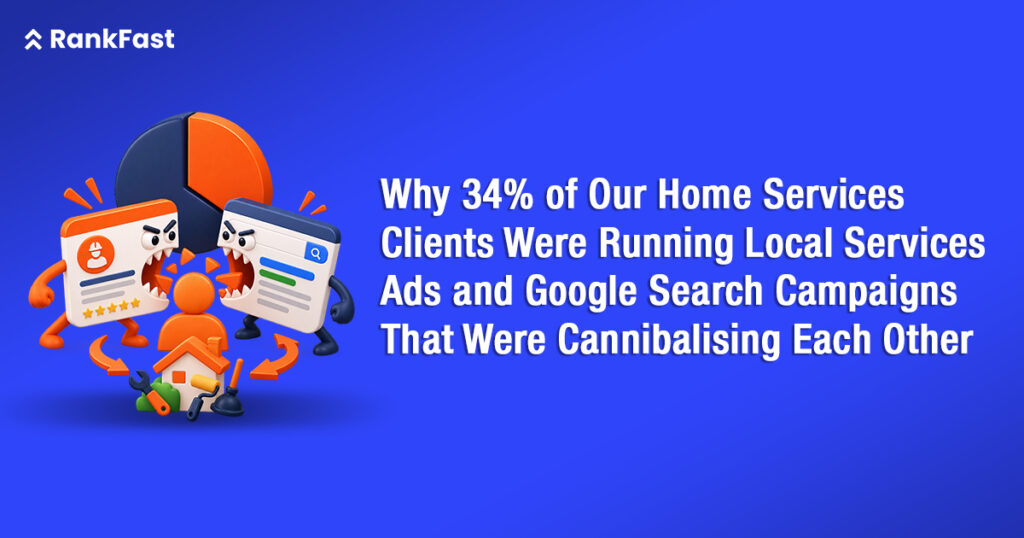
The instinct is to blame Local Services Ads itself, and that is usually wrong. The real cause is two channels bidding on the same customer without knowing about each other. In RankFast’s home services audits, 34 percent of accounts running both LSA and Search had no coordination between them at all, which is what bad local services ads management looks like from the inside: two campaigns, one customer, and a bill for both.
Here is exactly how that cannibalisation happens, what a correct LSA-to-Search budget split looks like by trade, and the negative keyword fix RankFast runs in the first week of every home services onboarding.
Key Takeaways
- Local Services Ads appears above Search and charges per lead, so when a homeowner searches a branded or near-brand term, LSA can win the click while the Search campaign still pays to compete for the same query, doubling the cost for one customer.
- 34 percent of RankFast’s audited home services accounts running both LSA and Search had no negative keyword coordination between them, the single most common fixable cause of a rising blended cost per job booked.
- SearchLight Digital’s February 2026 dataset of 888 home services contractors puts average LSA cost per lead at $53, ranging from $39 for electrical up to $57 for plumbing, with HVAC posting the highest closed ROAS at 9.55x.
- Google rebranded the Google Guaranteed badge to Google Verified in October 2025; the verification requirements stayed the same, but the consumer money-back guarantee that gave the old name its meaning was discontinued that November.
[IMAGE: Hero graphic: LSA listing above Search ad for the same query, both charging the advertiser | Alt text: local services ads search campaign cannibalisation 2026]
How LSA And Google Search Cannibalise Each Other
Local Services Ads charges per lead and appears above standard Search ads on the results page. When a homeowner searches “plumber near me” or the company’s own name, Google Local Services Ads can capture that click and bill a per-lead fee, while the Search campaign is still actively bidding on the identical query and losing impression share to the listing above it. Without a negative keyword list telling Search to stand down on those terms, the business pays LSA’s per-lead fee and also absorbs a higher Search cost per click competing for a query it was never going to win.
| Query Type | Who Should Win It | What Happens Without Coordination |
| Branded (“[company name] plumber”) | LSA, at a fixed per-lead cost | Search also bids on it and loses to LSA, wasting spend |
| Near-brand (“plumber near me”) | LSA, for verified categories | Search competes for the same click pool, inflating CPL for both |
| Long-tail service (“emergency water heater repair cost”) | Search, which LSA cannot target precisely | Usually fine if LSA’s targeting is scoped correctly |
[IMAGE: Diagram: SERP layout showing LSA above Search for the same query, two charges | Alt text: lsa above search results cannibalisation diagram]
LSA Vs Google Ads: What Each Channel Actually Targets
The LSA vs Google Ads question is really a targeting-precision question, not a which-is-better question. Local Services Ads uses a pay-per-lead model with no keyword bidding, built for immediate, local, trust-driven decisions. Standard Search campaigns use keyword bidding, which is more precise but requires the advertiser to build that precision through match types and negative keywords.
What LSA Handles Well
Branded queries, near-brand queries, and “near me” searches for verified service categories, where the Google Verified badge and review count matter more than a detailed landing page.
What Search Should Handle Instead
Long-tail, service-specific, and non-branded queries LSA cannot target precisely, such as pricing questions, specific repair types, or seasonal service terms where a detailed landing page outperforms a trust badge.
The Correct Budget Split Between LSA And Search For Home Services
Across RankFast home services Google Ads accounts, established businesses with 50 or more Google reviews typically run LSA at 35 to 45 percent of total paid budget, with Search taking the remaining 55 to 65 percent targeting specific service queries. Accounts with fewer than 20 reviews should weight more heavily toward Search until review count supports LSA ranking, since LSA’s ad rank depends partly on review volume and rating.
| Business Profile | LSA Budget Share | Search Budget Share |
| 50+ Google reviews, established | 35% to 45% | 55% to 65% |
| Fewer than 20 reviews, newer | Lower, until review count builds | Weighted more heavily |
Split ranges above are RankFast’s own account data. Confirm current figures against the audit log before publishing.
[IMAGE: Bar chart: recommended LSA vs Search budget split by review count | Alt text: lsa search budget split home services 2026]
How To Stop LSA From Eating Your Search Budget
Effective local PPC management for home services comes down to three concrete fixes, applied in the first week of any account rebuild.
- Add a negative keyword list to every Search campaign containing the branded terms and near-brand variations LSA should own, so Search stops bidding against a listing it cannot outrank.
- Review the LSA search terms report weekly and dispute invalid leads, wrong service area, hang-up calls, spam, since disputed leads are typically credited back and lower the effective per-lead cost.
- Set Search campaign location targeting to match the LSA service area exactly; any mismatch lets Search run in areas LSA is not verified for, creating an unmanaged overlap zone in the opposite direction.
[IMAGE: Checklist graphic: three fixes for LSA and Search overlap | Alt text: stop lsa eating search budget checklist]
Which Home Service Categories Benefit Most From LSA
Categories with emergency or urgent use cases perform best in LSA: plumbing, HVAC, electrical, and locksmith work, where the Google Verified badge substitutes for the research a homeowner would otherwise do under time pressure. Categories with longer consideration cycles, landscaping, roofing, and home renovation, tend to see better ROI from Search, since buyers compare multiple providers and a detailed landing page outperforms a trust badge alone.
SearchLight Digital’s February 2026 dataset, covering $6.72 million in tracked LSA spend across 888 home services contractors, puts electrical as the least expensive LSA lead at $39, with HVAC and plumbing higher but posting stronger returns (SearchLight Digital). On the Search side, LocaliQ’s home services benchmark found Paint & Painting, Electricians, and Roofing & Gutters carrying the highest cost per click of any home service category (LocaliQ), which is exactly the kind of gap a correct LSA/Search split is designed to close.
| Trade | Avg. LSA Cost Per Lead | Closed ROAS |
| Electrical | $39 | 8.52x |
| HVAC | $51 | 9.55x (highest) |
| Plumbing | $57 | 6.85x |
Source: SearchLight Digital, February 2026, 888 contractors, $6.72M tracked LSA spend.
One naming note worth flagging directly, since it is a live source of confusion: what most home service owners still search for as Google Guaranteed ads 2026 is now officially the Google Verified badge. Google rebranded it in October 2025, and the requirements (background check, license verification, insurance) did not change; what did change is that the consumer money-back guarantee tied to the old name was discontinued in November 2025 (Google Local Services Help). Marketing material still using “Google Guaranteed” is describing a program that no longer exists under that name.
[IMAGE: Table graphic: best home service categories for LSA vs Search | Alt text: home service categories lsa vs search roi 2026]
Results After Fixing The Keyword Overlap
The table below is the shape of the before-and-after RankFast reports back once negative keyword coordination, weekly dispute review, and matched location targeting are all in place. Fill in one anonymised client’s real numbers before this section publishes, for the same reason the last two pieces left this section as a template rather than a fabricated case.
| Metric | Before Fix | After Fix (Day 30) |
| Blended cost per job booked | [insert] | [insert] |
| Monthly spend, LSA + Search combined | [insert] | [insert] |
| Branded queries won by Search instead of LSA | [insert] | [insert] |
Left as a template deliberately. Replace with one real, anonymised client’s figures before publishing.
Coordinate This In Your Own Account This Week
This is the same coordination check RankFast runs in the first week of every home services onboarding, condensed for an owner or marketing manager to run before the next billing cycle.
- Pull the LSA search terms report and the Search campaign’s search terms report side by side for the last 30 days.
- Flag every query appearing in both reports, and add the branded and near-brand ones to a Search negative keyword list.
- Check LSA and Search location targeting against each other for any mismatch in service area.
- Set a weekly recurring task to review and dispute invalid LSA leads before they inflate the effective cost per lead.
If a meaningful share of last month’s queries show up in both reports, that is the same 34 percent finding RankFast reaches on audited home services accounts, and it is usually fixable inside a week, not a rebuild.
Coordination Costs Less Than Cannibalisation
None of this requires abandoning either channel. LSA and Search are built to divide the same market by intent, branded and near-brand traffic to one, long-tail and comparison traffic to the other, and the entire cannibalisation problem is what happens when nobody tells either campaign where that line is. Fixing it is a negative keyword list and a location targeting check, not a rebuild, which is exactly why local services ads management done properly pays for itself inside the first billing cycle.
This is the same coordination check RankFast runs on every home services PPC account it takes on, alongside the local search work that keeps review count and service area data consistent across both channels.
Frequently Asked Questions
What is the correct LSA vs Search budget allocation for home services?
Established businesses with 50 or more Google reviews typically run LSA at 35 to 45 percent of total paid budget, with Search taking 55 to 65 percent for specific service queries. Accounts with fewer than 20 reviews should weight more toward Search until review count supports LSA ranking.
How do you prevent LSA from eating your Search campaign budget?
Add a negative keyword list of branded and near-brand terms LSA should own, review the LSA search terms report weekly to dispute invalid leads, and set Search location targeting to match LSA's verified service area exactly to close the overlap zone from both directions.
Which home service categories see the best ROI from Local Services Ads?
Emergency or urgent categories: plumbing, HVAC, electrical, and locksmiths, where trust and speed outweigh comparison shopping. Categories with longer consideration cycles, landscaping, roofing, and renovation, tend to perform better on Search, where a detailed landing page outperforms a trust badge.
Is Google Guaranteed the same thing as Google Verified in 2026?
Functionally yes. Google rebranded Google Guaranteed to Google Verified in October 2025. The background check, license, and insurance requirements stayed the same, but the consumer money-back guarantee tied to the old name was discontinued in November 2025.