Financial services is one of the few industries where a single poorly substantiated claim on a webpage can trigger a manual review from Google. It is also one of the few industries where the gap between companies that have invested in organic search authority and those that have not is measured in millions of dollars of annual revenue. That gap exists because financial services SEO is genuinely difficult, and most generalist agencies are not equipped to work in it.
Google classifies financial content under its Your Money or Your Life (YMYL) guidelines, the highest scrutiny category in its quality rater framework. YMYL pages are evaluated with particular care because they can directly affect a person’s financial stability, health, or safety. That classification changes the entire approach to content production, author credentialing, link acquisition, and technical architecture.
This guide covers what separates a specialist SEO agency for financial services from a generalist provider, how E-A-T is built and maintained in banking and investment contexts, the technical and content priorities that drive organic performance in YMYL verticals, and what a financial services business should expect from a properly scoped SEO engagement in 2026.
Key Takeaways
- Financial services SEO operates under Google’s YMYL framework, which requires demonstrably higher standards of expertise, authoritativeness, and trustworthiness than most other verticals.
- E-A-T finance SEO is not a content format. It is a site-wide credibility architecture built through author credentials, institutional signals, compliance-cleared content, and authoritative third-party references.
- A specialist finance SEO agency brings compliance awareness, YMYL-specific technical architecture knowledge, and regulated-content link building capabilities that generalist providers do not have.
- Banking SEO services, investment SEO, and fintech SEO each require different keyword strategies, different trust signal frameworks, and different approaches to content authority.
- Measuring organic performance in financial services requires tracking beyond traffic and rankings. Share of voice in AI Overviews, branded query growth, and MQL attribution from organic are the metrics that connect SEO to revenue.
Why Financial Services SEO Is a Specialist Discipline
Most SEO principles apply across verticals: technical health matters, content quality matters, link authority matters. But financial services introduce a set of constraints and requirements that make a generalist approach structurally inadequate. A finance SEO agency that does not understand these constraints will not only produce poor results; it will produce content that creates compliance exposure for the client.
The three constraints that define financial services SEO as a specialist discipline are regulatory compliance, YMYL content standards, and the trust gap that search engines apply to financial institutions publishing their own claims about their own products.
Regulatory Compliance as an SEO Constraint
Banks, investment advisors, insurance companies, and regulated fintech platforms operate under disclosure requirements that affect what can be published, how it must be phrased, and what claims require qualifying language. In the United States, the SEC, FINRA, and CFPB each maintain content guidance that intersects with SEO content strategy. In the United Kingdom, the FCA’s financial promotions framework governs digital marketing including organic content. A financial services SEO agency that treats compliance as the legal team’s problem and SEO as the marketing team’s problem will create costly conflicts between the two.
The practical implication for banking SEO services is that content must be built with compliance review integrated into the production process, not appended to it. Approved language, qualifying disclosures, and fact-check requirements are not editorial preferences; in regulated environments, they are legal requirements.
The YMYL Content Standard
Google’s quality rater guidelines classify financial content as YMYL, meaning it is evaluated against the highest available quality standards. Pages that could affect a person’s financial decisions are assessed not just for accuracy but for the demonstrated expertise of the people behind them.
A page about mortgage refinancing written by an unnamed author on a thin domain will not perform at the same level as an equivalent page by a credentialed financial professional on an established institutional domain, regardless of keyword optimization.
The Trust Gap in Financial Content
Trust in financial services institutions sits at 53% globally, below the cross-industry average. That trust deficit is not just a brand problem; it is an SEO problem. Google’s quality rater framework instructs evaluators to assess whether a website’s reputation, as reflected in third-party sources, is consistent with the claims made in its content.
A financial institution with reputation management issues will underperform in organic search relative to its technical and content investments.
What E-A-T Means for Financial Services SEO
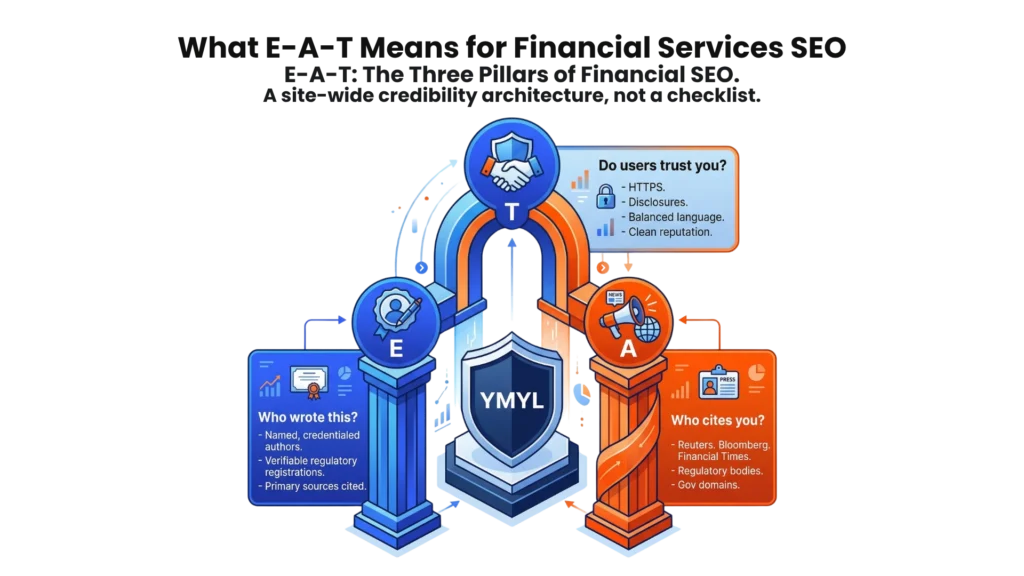
E-A-T (Expertise, Authoritativeness, Trustworthiness) is not a ranking factor in the direct technical sense. Google has been explicit about this. It is, however, a framework that Google’s quality raters use to evaluate page and site quality, and those quality signals influence the training and calibration of Google’s ranking systems over time. For financial services, understanding E-A-T as a site-wide architecture rather than a content formatting checklist is the foundation of any effective finance SEO strategy.
The three dimensions of E-A-T finance SEO each require specific investment and should each be visible not only to human evaluators but to Google’s automated systems through structured data, author markup, and institutional signals.
Expertise: Who Is Publishing This Content
In financial services, expertise must be demonstrable and verifiable. That means named authors with published credentials, regulatory registrations, or institutional affiliations. It means author bio pages that reference specific expertise and can be cross-referenced against LinkedIn profiles, regulatory databases like FINRA BrokerCheck, or institutional directories. A financial services SEO agency will typically build an author credentialing system as a foundational step, before content production begins, rather than retroactively attributing content to unnamed in-house teams.
Expertise signals also include the citation of primary sources: regulatory documents, peer-reviewed research, government data, and official institutional publications. A page about retirement planning that cites the IRS, the Social Security Administration, and the Federal Reserve signals expertise in a way that a page citing only internal blog posts does not.
Authoritativeness: What External Sources Say About You
Authoritativeness in E-A-T finance SEO is largely determined by what happens off your website. Which publications link to your content? Which journalists cite your analysts? Are your institutional spokespeople quoted in authoritative financial media?
A specialist investment SEO agency approaches link acquisition not as a volume exercise but as a reputation-building program. Coverage in the Financial Times, Reuters, Bloomberg, or regulated-sector trade publications carries far more E-A-T weight than equivalent content on general marketing blogs.
Trustworthiness: Site-Wide Signals That Build Credibility
Trustworthiness in financial services SEO encompasses technical signals (HTTPS everywhere, accurate contact information, regulatory disclosures prominently displayed), content signals (balanced, sourced, and qualifying language), and reputation signals (consistent positive third-party coverage, absence of compliance violations in public records, transparent ownership and leadership).
A banking SEO services engagement that does not address all three dimensions of trustworthiness is incomplete, regardless of how technically sophisticated the keyword strategy is.
| E-A-T Dimension | What It Requires | Where It Shows Up | Who Owns It |
| Expertise | Named, credentialed authors; primary source citations | Author bios, content pages, structured data | Content team + compliance |
| Authoritativeness | Coverage in regulated-sector media; institutional link acquisition | Backlink profile, press mentions, citations | SEO and PR teams |
| Trustworthiness | HTTPS, disclosures, regulatory transparency, balanced claims | Technical setup, content tone, about pages | Legal, compliance, and SEO |
| YMYL Compliance | Qualifying language, fact-checked claims, disclosure language | Every financial content piece | Compliance and editorial |
How a Finance SEO Agency Approaches Compliance-First Content
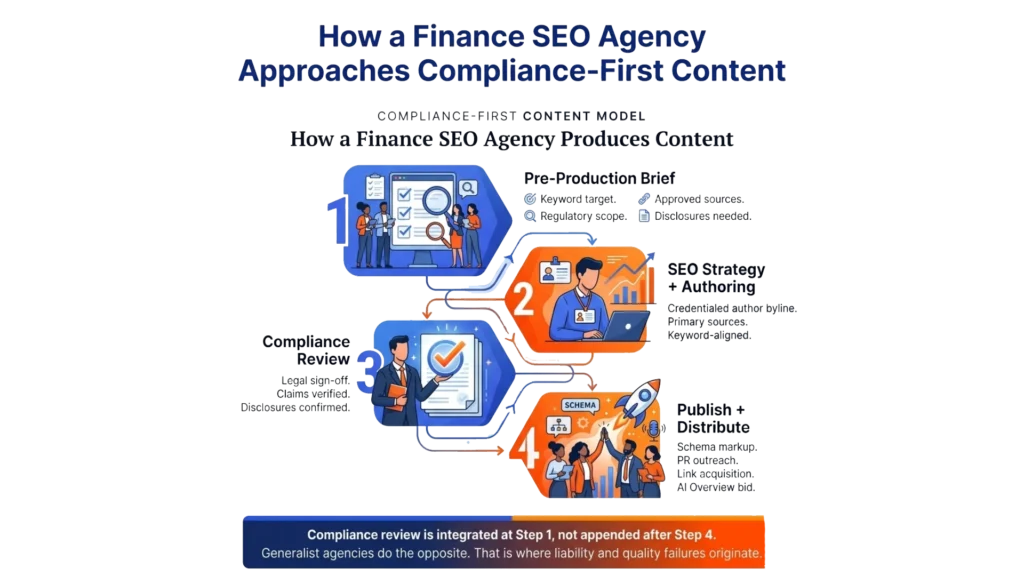
Content production in financial services is not the same as content production in most other industries. The output must satisfy Google’s quality standards, meet the regulatory requirements of the applicable jurisdiction, and serve the genuine information needs of the reader. A finance SEO agency that optimizes exclusively for search without integrating compliance review into the workflow creates liability for the client and content that underperforms on quality signals.
The compliance-first content model starts with a pre-production brief that identifies the regulatory environment for each content piece before writing begins. That brief should define required disclosures, prohibited claims, approved data sources, and the review pathway before the content reaches publication.
Content Architecture for YMYL Financial Verticals
Financial services content should be structured around demonstrable accuracy at every layer. Introductory paragraphs should make claims that are verifiable. Supporting sections should cite primary regulatory or institutional sources. Conclusions should avoid directional advice unless the author holds the credentials to provide it. This is not a stylistic preference; it is what separates content that performs in YMYL queries from content that is algorithmically suppressed or manually reviewed.
The most effective E-A-T finance SEO content formats for organic performance include regulatory explainers (breaking down complex financial rules into accessible language), comparison tools and data tables (rate comparisons, fee structures, product matrices), and analysis pieces authored by credentialed professionals and cross-published in industry media. Each format addresses a different stage of the financial buyer’s research process.
Balancing SEO Keyword Targets With Compliance Language
One of the most consistent friction points a financial services SEO agency encounters is the conflict between keyword-optimized language and legally required qualifying language. A page targeting ‘best savings accounts 2026’ cannot, in most regulated environments, make superlative claims without substantiation.
The solution is building content around informational architecture that answers the search query accurately without making claims the compliance team cannot approve. This requires collaboration between the SEO strategy team and the legal or compliance function, not a sequential handoff.
Author Credentialing and Byline Strategy
Every piece of financial services content should carry a byline linked to a full author profile. That profile should include the author’s professional credentials, regulatory registrations where applicable, institutional affiliation, and a brief professional history. Author profiles should be marked up with Person schema and reference verifiable external sources where the author’s expertise can be confirmed. This infrastructure is the single most impactful E-A-T investment a financial institution can make, and it is consistently overlooked in generalist SEO engagements.
Technical SEO Priorities for Banking and Investment Websites
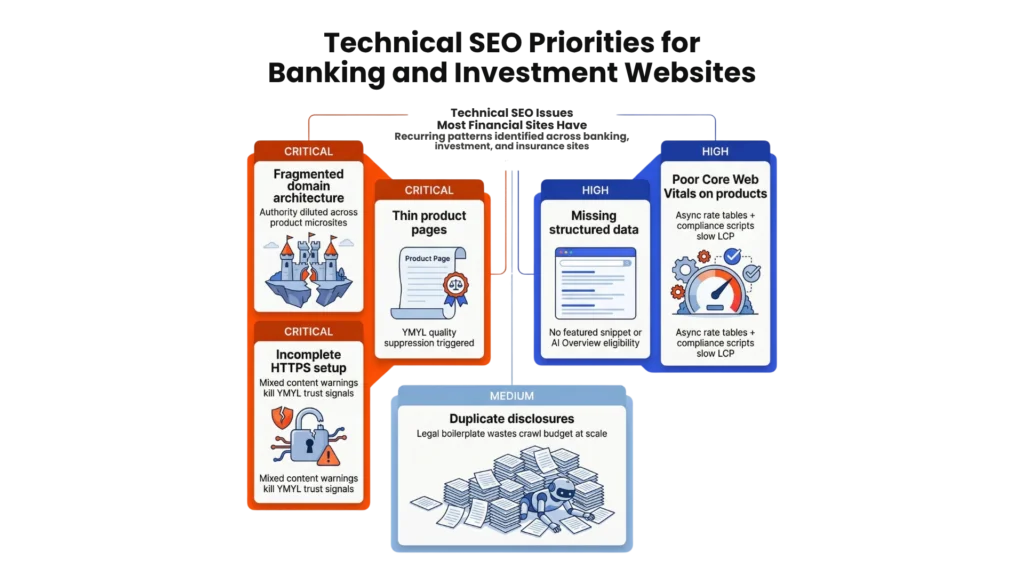
Technical SEO for financial services websites involves the same foundational requirements as any complex site, with several additional layers specific to YMYL classification, multi-product architecture, and the compliance requirements around content versioning and disclosure management.
A financial services SEO agency conducting a technical audit will typically identify the same recurring issues across banking, investment, and insurance websites: fragmented domain architecture, thin or duplicate product pages, inadequate structured data implementation, and slow mobile performance on product and calculator pages.
Site Architecture for Financial Product Portfolios
Financial institutions typically offer a wide range of products across multiple customer segments: personal banking, business banking, investment products, insurance, and lending. Without a deliberate information architecture, these product lines create a fragmented SEO structure where authority is diluted across dozens of subdirectories with no clear topical hierarchy.
A specialist investment SEO agency will typically recommend a hub-and-spoke content model where each product category has a pillar page that aggregates authority and distributes it to specific product and information pages within that category.
Structured Data for Financial Services
Structured data implementation in financial services extends beyond standard Organization and BreadcrumbList markup. Financial institutions benefit from FAQPage schema on regulatory explainer pages, which increases the likelihood of appearing in featured snippets for high-volume informational queries.
HowTo schema can be applied to account opening and application guidance pages. For fintech platforms with calculator tools, appropriate schema markup around the tool itself can improve indexation and visibility in AI Overview responses.
Core Web Vitals and Mobile Performance on Financial Pages
Largest Contentful Paint (LCP) should be under 2.5 seconds and Cumulative Layout Shift (CLS) should stay below 0.1 for pages to be considered meeting page experience thresholds. Financial services websites consistently underperform on these metrics due to heavy legal footer content, dynamic rate tables that load asynchronously, and third-party compliance scripts that delay rendering. Addressing these issues is a prerequisite for competitive performance in banking SEO services, not an optional enhancement.
| Technical Issue | Impact on Financial SEO | Priority Level | Common Cause |
| Fragmented domain architecture | Authority dilution across subdirectories | Critical | Separate brand or product microsites |
| Thin product pages | YMYL quality suppression | Critical | Template-generated pages with little unique content |
| Missing structured data | No featured snippet or AI Overview eligibility | High | Developer backlog or generalist SEO oversight |
| Poor Core Web Vitals on product pages | Page experience ranking signal underperformance | High | Async rate tables, third-party compliance scripts |
| Duplicate disclosure content | Crawl budget consumption and thin content signals | Medium | Legal boilerplate repeated across all product pages |
| Inadequate HTTPS configuration | Trust signal failure on YMYL pages | Critical | Mixed content warnings or incomplete SSL setup |
Link Building Strategies That Work for Financial Services
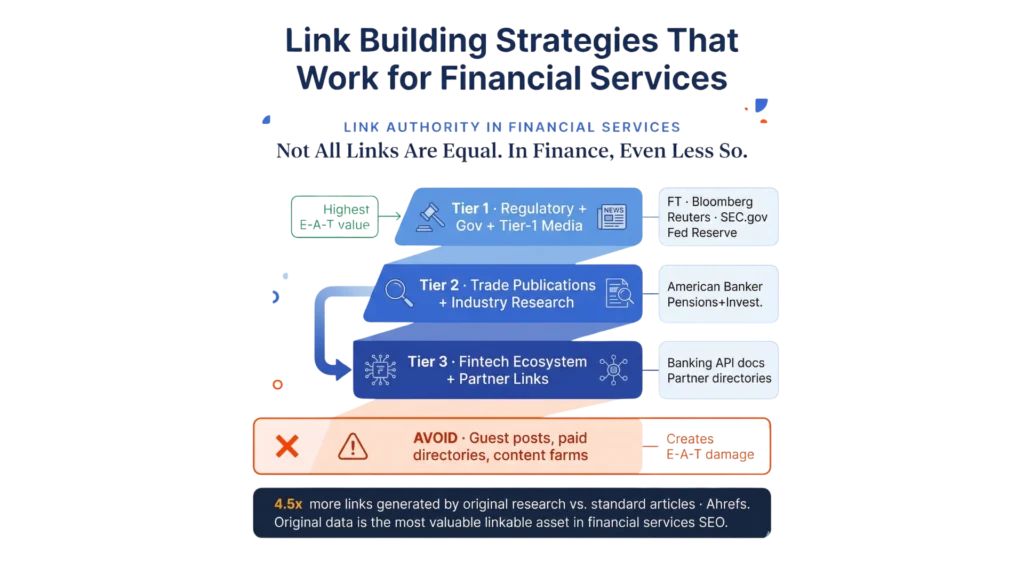
Link acquisition in financial services operates under different constraints than most industries. A fintech SEO agency or banking SEO services provider cannot approach financial link building the way a general agency approaches it. Guest posting on low-authority blogs, paying for directory inclusions, or acquiring links through content farms creates compliance exposure and E-A-T damage, not benefit.
The link building strategies that generate real authority in financial services are slower to execute and require genuine institutional credibility. That is exactly what makes them valuable: they are not replicable through volume or automation.
Regulatory and Government Source Citations
Financial regulatory bodies, central banks, and government agencies frequently link to content that accurately explains their guidance in accessible language. Creating authoritative explainers of regulatory changes, writing accessible breakdowns of central bank decisions, or producing data analysis based on government-published financial statistics can generate inbound links from .gov and regulatory domains that carry exceptional E-A-T weight. This is a content-led link acquisition strategy that requires genuine subject matter expertise to execute well.
Financial Media and Trade Publication Coverage
Coverage in authoritative financial media, Reuters, Bloomberg, the Financial Times, The Wall Street Journal, American Banker, and equivalent tier-one outlets in each market generates the highest-quality links available in financial services SEO.
A specialist financial services SEO agency will typically have a PR and editorial outreach component to their service rather than treating link acquisition as a purely technical exercise. Analyst comment placement, data story pitching, and contributed article programs in trade publications are the primary link generation mechanisms in this category.
Original Research and Proprietary Data
Original research and data-driven content generate 4.5 times more links than standard informational articles. In financial services, this finding is amplified because proprietary data is genuinely scarce. A bank or investment platform that publishes annual research on consumer savings behavior, regional investment trends, or financial wellbeing indices creates a linkable asset that financial journalists, academic researchers, and policy organizations will reference repeatedly over multiple years.
Fintech Partnership and Ecosystem Links
Fintech platforms operate within ecosystems of banking partners, payment networks, compliance technology providers, and developer communities. A fintech SEO agency will typically identify partnership and integration pages, developer documentation hubs, and regulated partner directories as link acquisition targets specific to the fintech vertical. These links are relevant, contextual, and not available to non-fintech sites, making them particularly valuable for building topical authority.
Measuring SEO Performance in Financial Services
Measurement in financial services SEO is more complex than in most verticals because the conversion events are longer, the attribution paths are less linear, and the relationship between organic visibility and commercial outcome is mediated by factors including sales cycles, institutional procurement processes, and regulatory considerations that affect whether a prospect can act on the information they find.
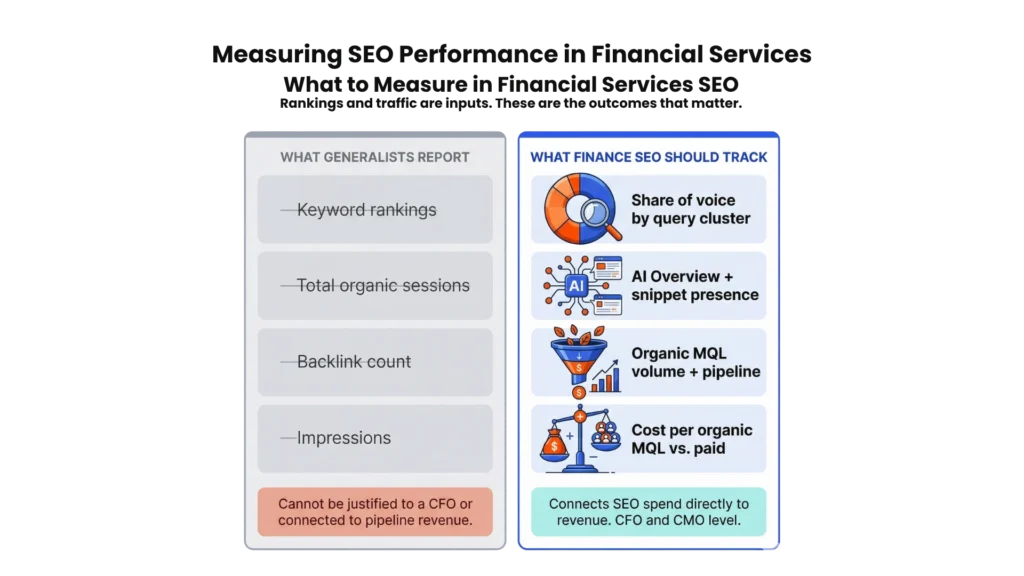
A finance SEO agency that reports primarily on traffic and keyword rankings is reporting on inputs. The metrics that matter in financial services are the ones that connect organic visibility to revenue-adjacent outcomes.
Share of Voice in High-Intent Queries
Share of voice (SOV) measures what percentage of total clicks for a defined keyword set your domain captures. In financial services, where the keyword universe is finite and the competitors are identifiable, SOV is a more meaningful performance metric than absolute traffic volume.
Organic search drives 53% of website traffic across industries, but in financial services the share is typically higher for informational queries and lower for product queries, where paid search dominates. Tracking SOV by query type gives a financial institution a clearer picture of where organic is performing and where paid channel support is needed.
AI Overview and Featured Snippet Visibility
Google’s AI Overviews, which expanded significantly through 2025 and into 2026, now appear for a substantial proportion of financial services informational queries. Appearing in an AI Overview for a high-volume query, such as ‘how to open a savings account’ or ‘what is a fiduciary financial advisor’, delivers brand exposure to a user who may never click through to the website. Tracking AI Overview presence for target queries should be a standard component of any banking SEO services or investment SEO agency reporting framework in 2026.
Organic MQL and Pipeline Attribution
For B2B fintech platforms and institutional investment managers, the meaningful conversion event from organic search is not a page view or a form fill; it is a marketing qualified lead (MQL) that enters the sales pipeline.
Connecting organic traffic sessions to CRM-tracked MQLs requires UTM discipline, CRM integration with the analytics platform, and a consistent lead scoring model. Without this connection, organic search investment cannot be justified to finance or executive stakeholders in terms they find meaningful.
| Metric | What It Measures | Reporting Frequency | Primary Audience |
| Keyword rankings by cluster | Organic position for target query groups | Monthly | SEO team |
| Share of voice by query type | Competitive capture rate for defined keyword sets | Monthly | Marketing leadership |
| AI Overview presence | Brand visibility in generative search results | Monthly | Marketing leadership |
| Organic sessions by content type | Traffic distribution across content architecture | Monthly | Content team |
| Organic MQL volume | Qualified leads attributable to organic search | Monthly | Revenue and executive team |
| Cost per organic MQL | Efficiency of SEO investment vs. other acquisition channels | Quarterly | CFO and CMO |
Conclusion
Financial services is one of the most consequential and most demanding environments for organic search. The stakes on every content decision are higher, the competitive field includes institutions with enormous domain authority, and the regulatory constraints create a content production challenge that generalist agencies are not built to navigate.
A specialist SEO agency for financial services earns its value through the parts of the engagement that are invisible in most reporting: compliance-integrated content workflows, author credentialing infrastructure, regulated-sector link acquisition, and YMYL-specific technical architecture. These are not premium add-ons to a standard SEO service. They are the foundational requirements for organic search to work in banking, investment, and fintech contexts.
The financial services firms that build durable organic authority in 2026 will be the ones that treat E-A-T finance SEO as a long-term institutional asset rather than a campaign. That means consistent investment in content quality, author credentialing, and institutional link acquisition across multiple years, tracked against metrics that reflect business outcomes rather than traffic alone.
Frequently Asked Questions
How does E-A-T finance SEO actually improve rankings?
E-A-T is not a direct ranking factor but it influences the quality signals that Google's systems use to calibrate ranking. Strong E-A-T finance SEO manifests in named and credentialed authors, primary source citations, coverage in authoritative financial media, and site-wide technical signals of institutional credibility. Over time, a site with strong E-A-T architecture will rank above technically equivalent competitors on YMYL queries because Google's quality rater evaluations calibrate the algorithm toward demonstrably credible sources for high-stakes content.
What should banking SEO services include in 2026?
Banking SEO services in 2026 should include a YMYL-specific technical audit addressing site architecture, structured data, and Core Web Vitals; a compliance-integrated content strategy with credentialed author infrastructure; a link acquisition program targeting financial media and regulatory sources rather than general publisher outreach; GBP optimization for branch-level local search visibility; and a reporting framework that tracks share of voice, AI Overview presence, and organic MQL attribution in addition to standard traffic and ranking data.
How long does it take to see results from a financial services SEO agency?
Financial services SEO timelines are typically longer than general local SEO because domain authority in YMYL categories is built incrementally. Most financial services firms see measurable ranking improvements within four to six months for informational content targeting low-to-medium competition queries. High-competition product queries in competitive markets such as personal loans, mortgages, and investment platforms can take 9 to 18 months to show significant organic gains. The investment thesis for financial services SEO is compounding long-term authority rather than rapid short-term visibility.
Does a fintech SEO agency work differently from a traditional finance SEO agency?
A fintech SEO agency needs to address both the YMYL content standards of financial services and the technology-sector content formats required to reach developer and institutional audiences. The keyword strategy, content architecture, and link acquisition channels differ meaningfully between consumer fintech, B2B fintech platforms, and regulatory technology subcategories. A specialist fintech SEO agency will build a separate content and authority strategy for each audience type rather than applying a single financial services template across all three.