The global search advertising market is projected to reach $351.5 billion in spend by 2025, and 96% of brands are currently spending money on Google Ads. Those are not small numbers. Neither is the cost of hiring the wrong partner. Businesses that invest in a poorly run search engine marketing company do not just lose the management fee. They lose the ad budget itself, often for months before realizing the campaign was never structured correctly in the first place.
The challenge is that the market for search engine marketing services has never been more crowded or more opaque. Every agency promises data-driven results and transparent reporting. The proposals look similar. The pricing varies without explanation. And the warning signs that separate credible providers from bad SEM agencies are rarely visible until after a contract has been signed.
This guide covers the specific, verifiable red flags to identify before committing to any SEM agency, PPC agency, or SEO agency partnership in 2026.
KEY TAKEAWAYS
- 49% of PPC marketers say managing campaigns is harder than it was two years ago. Choosing a poorly qualified search engine marketing company in this environment does not produce mediocre results. It produces active budget destruction.
- One analysis found companies wasting an average of 15% of their PPC budget on irrelevant keywords alone when campaigns are mismanaged. Across a $10,000 monthly spend, that is $1,500 per month in avoidable waste from a single structural error.
- Guaranteed rankings are a definitive disqualifier. No legitimate SEM agency guarantees specific positions. Google’s algorithm is outside any agency’s control, and guarantees are either backed by black hat tactics or are simply false.
- Ad fraud is projected to cost advertisers $172 billion annually by 2028. Agencies that do not actively monitor for invalid clicks and placement exclusions are exposing your budget to fraud risk that they are not managing.
Red Flag 1: Guaranteed Rankings or Guaranteed Results
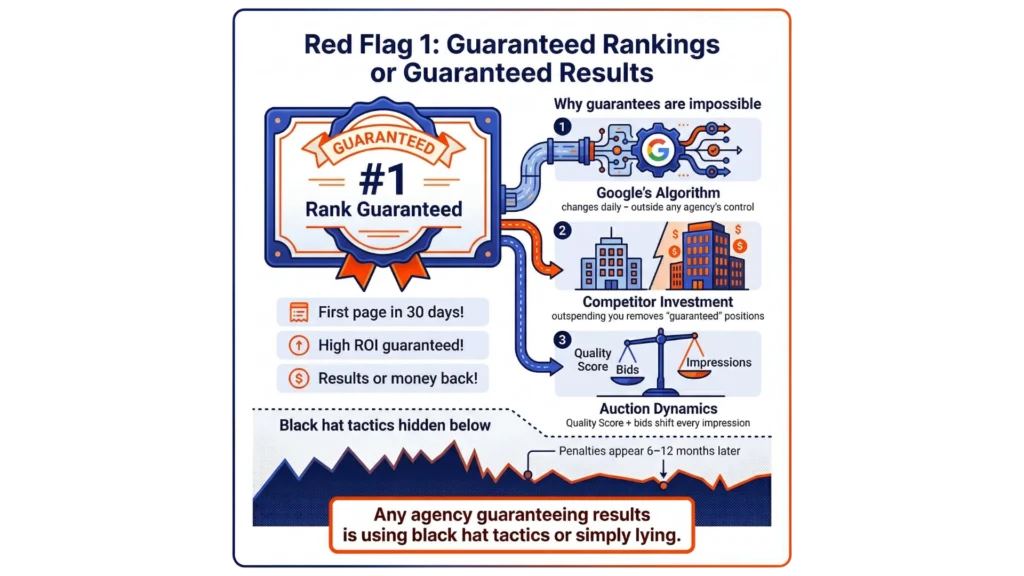
This is the single most reliable signal that a provider is either dishonest or inexperienced, and it applies equally to PPC and SEO engagements.
For SEO, the issue is structural. Rankings shift constantly from the volume of changes competitors and other sites make every second. No agency controls Google’s algorithm, and any guarantee of specific positions is either backed by black hat tactics that trigger penalties or is simply not true. The same applies to paid search: no credible ppc agency guarantees a specific cost per acquisition, ROAS figure, or ad position, because auction dynamics, competitor behavior, and Quality Scores all change continuously.
Agencies promising first page rankings overnight or high ROI within weeks may be using shortcuts or tricks that risk long term penalties. The short term appearance of success masks structural damage that becomes visible six to twelve months later when rankings collapse or an account is suspended.
Red Flag 2: Vague or Missing Deliverables in the Proposal
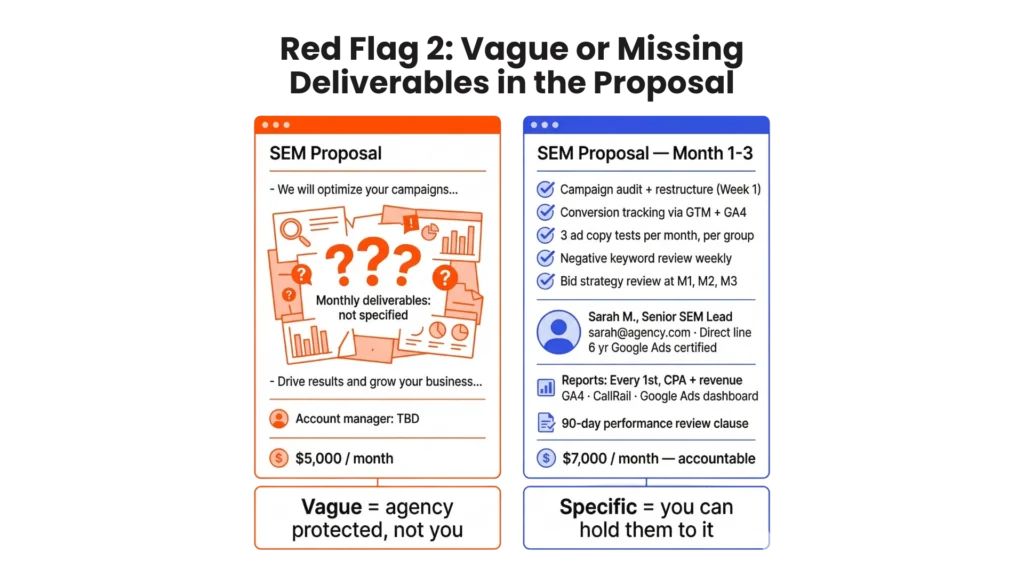
A proposal that describes outcomes without naming the actions required to achieve them is a structural warning sign. When you are evaluating how to hire SEM company providers, the question is not what results they are promising. The question is what they will actually do, in writing, every month.
A credible search engine marketing company will specify monthly deliverables with enough detail to be held accountable. Vague proposals protect the agency, not the client.
What a Credible SEM Proposal Includes
Before signing with any provider, the proposal should name these elements explicitly:
- Named campaign types and account structure: Which campaign types will be active, how ad groups will be organized, and what match type strategy will be used across keyword sets?
- Conversion tracking setup: Exactly which conversion actions will be tracked, through which tools (Google Tag Manager, GA4, call tracking), and how they connect to CRM or revenue data?
- Monthly content and optimization cadence: How many ad copy tests per month, how frequently bid strategies will be reviewed, and what the process is for responding to performance changes?
- Reporting format and frequency: Which metrics will appear in reports, when reports will be delivered, and whether they include revenue and conversion data or only impressions and clicks?
- Named account manager and escalation process: Who is responsible for the account day to day and how issues are communicated and resolved?
If a proposal is missing more than two of these elements, it signals that the agency has not thought through the execution. The gap typically becomes visible at month three when there is no structured optimization process and the account has been running on autopilot since setup.
Red Flag 3: No Access to Your Own Accounts
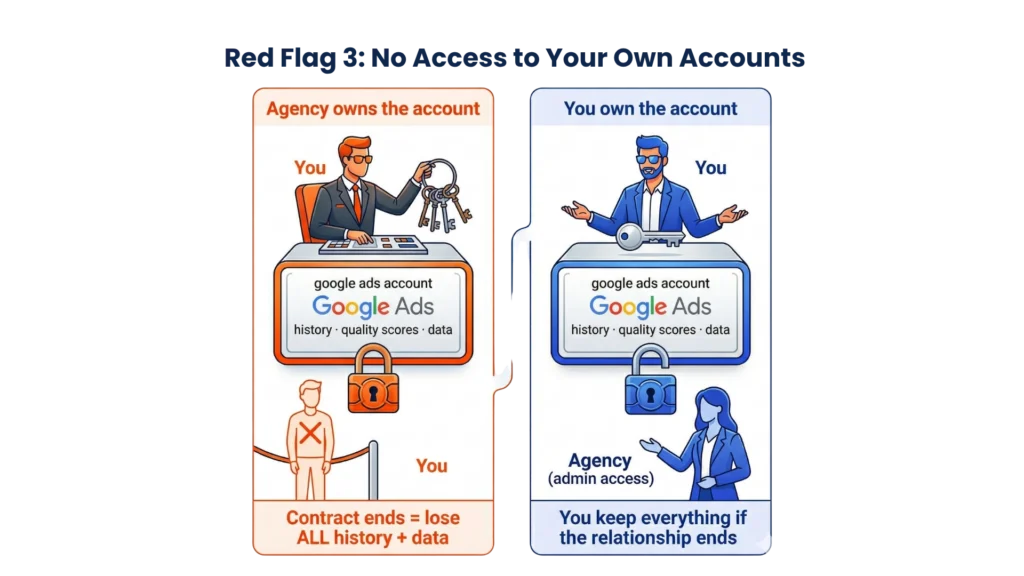
This is one of the most consequential red flags in SEM agency selection, and one of the most frequently encountered. Some agencies create Google Ads accounts, Meta accounts, or analytics properties under the agency’s own login and never grant the client full administrative access.
The consequence is not just inconvenience. If you end the engagement, you lose the account history, the conversion data, the quality scores built over months or years, and the campaign structure. You start over from zero. A credible search engine marketing company always sets up accounts under the client’s own Google or Meta Business Manager and grants the agency access as an admin. The client retains owner level access at all times.
Brand Amp’s guide to SEM agency warning signs lists lack of transparency about account structure as a primary red flag: if an agency is not providing clear reports or explanations about where your money is going, you are exposed both to poor performance and to losing your data if the relationship ends.
Red Flag 4: Reporting Built on Vanity Metrics
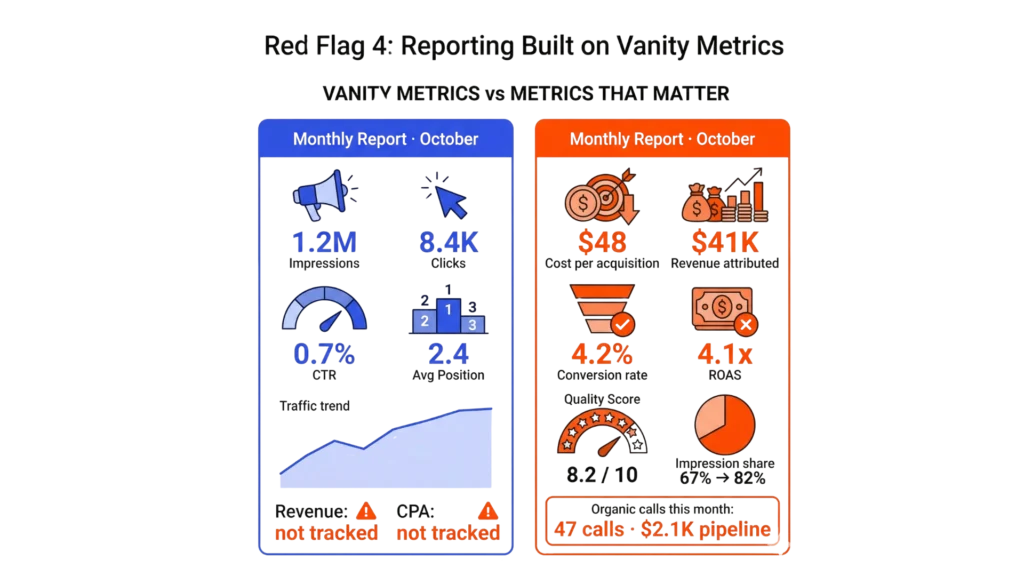
A monthly report that leads with impressions, click volume, and average position without connecting those numbers to leads, calls, or revenue is a sign that the seo agency or PPC provider is either not tracking the right things or is deliberately obscuring the absence of meaningful results.
Traffic is a vanity metric. If they cannot tie SEO or paid search activity to business outcomes, they are optimizing for the wrong goals. The same applies to paid search reports that show a high click-through rate alongside negligible conversion volume.
If your primary goal is acquiring new customers at a profitable CPA, but your agency is optimizing campaigns for clicks or impressions, there is a fundamental misalignment between what is being measured and what you are paying for.
Metrics a Legitimate SEM Agency Tracks
When evaluating how to approach choosing SEM agency options, ask prospective providers which of these metrics appear in their standard monthly report:
- Cost per acquisition (CPA): The total spend divided by the number of conversions in the reporting period, benchmarked against the previous period.
- Revenue or pipeline attributed to paid and organic: Either direct ecommerce revenue or an estimated pipeline value for lead generation businesses.
- Conversion rate by campaign and landing page: Showing where the funnel is converting well and where it is losing visitors before action.
- Search impression share: What percentage of eligible impressions the account is capturing and what is being lost to budget or rank constraints.
- Quality Score trends: For paid search, showing whether account health is improving or deteriorating over the reporting period.
Red Flag 5: Lock-In Contracts with No Performance Clauses
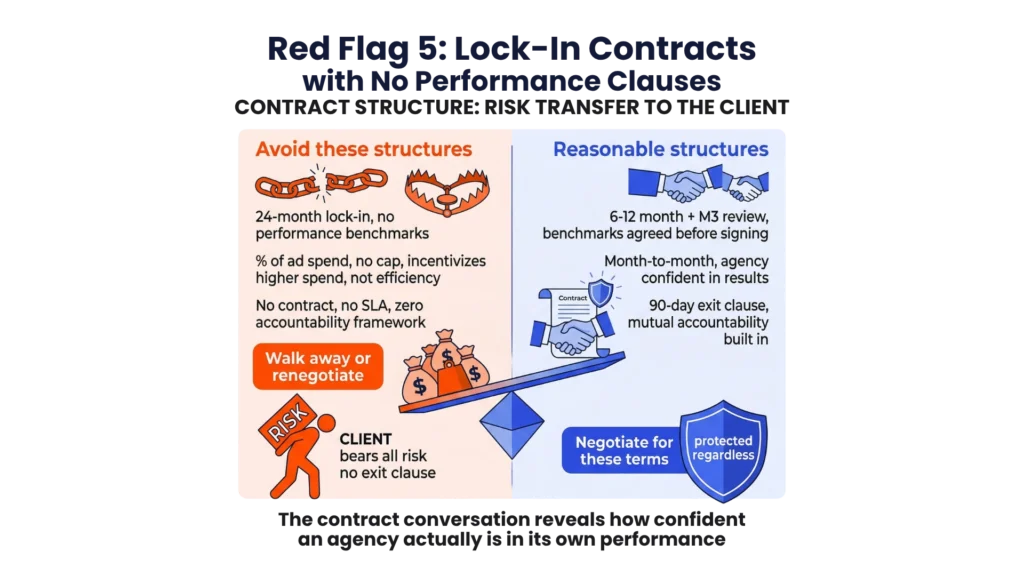
When you hire SEM company providers, the contract structure tells you a great deal about how confident the agency is in its own results. Agencies that require 12 to 24 month lock-in contracts without performance benchmarks are shifting all the risk to the client. A credible provider knows their work will produce measurable improvements within a defined timeline and is willing to build accountability into the agreement.
| Contract Term | What It Signals | What to Ask |
|---|---|---|
| Month to month with no notice period | Full confidence in ongoing performance | Confirm there is no hidden cancellation fee after 30 days |
| 6 to 12 month retainer with performance review | Standard for campaigns that need time to mature | Ask what the performance benchmarks are at month 3 and month 6 |
| 12 to 24 month lock-in, no performance clause | Risk transfer to client; agency protected regardless of results | Negotiate a 90 day performance clause or walk away |
| Percentage of ad spend with no retainer cap | Incentivises spend volume rather than efficiency | Ask how they handle months where reducing spend improves ROAS |
| No contract, no SLA | No accountability framework at all | Request a written scope of work and minimum deliverables document |
The contract conversation is one of the most revealing parts of the choosing SEM agency process.
Red Flag 6: Poor Communication Patterns Before You Sign
The responsiveness, clarity, and depth of an agency’s communication during the sales process are the most accurate previews of what you will experience as a client. If a prospective search engine marketing company takes three days to respond to a proposal request, sends generic answers to specific questions, or cannot explain its methodology without resorting to jargon, those patterns will be consistent throughout the engagement.
Communication failure is a primary driver of client dissatisfaction in bad SEM agencies. Optimum Click’s PPC agency red flag analysis identifies poor communication as a symptom of deeper problems: disorganization, lack of proactivity, poor results the agency is hesitant to share, or simply that your account is not a priority. All four of those outcomes represent the same problem from the client’s perspective: no one is actively managing the campaign.
Pre-Contract Communication Signals to Watch
- Response time to initial enquiry: More than 48 hours in the sales process suggests slower response when you have a live campaign issue.
- Quality of the proposal: A generic template with your company name inserted is a strong indicator of how customized the strategy will be.
- Ability to answer specific technical questions: Ask one or two specific questions about how they handle negative keyword lists, Quality Score optimization, or attribution modeling. The depth of the answer reveals the depth of the team.
- Named team members: An agency that cannot confirm who will manage your account before you sign is often running a model where accounts are assigned to junior staff or rotated without notice.
- Clarity on reporting cycle: If the agency cannot confirm exactly when reports are delivered and what format they use, reporting will be inconsistent once you are a client.
Making the Right SEM Agency Selection
The market for search engine marketing services contains a wide range of providers with equally wide variation in capability and integrity. The red flags in this guide are not hypothetical. They are the patterns that consistently precede wasted budget, poor results, and painful exits from agency relationships that should have been avoided at the selection stage.
The process of vetting a search engine marketing company before signing is not bureaucratic due diligence. It is the step that determines whether your paid search and organic investment compounds over time or drains without return. Every question about account ownership, deliverables, and reporting is a question about whether the agency will be accountable for the results they are being paid to produce.
Contact Rankfast to discuss your current SEM setup and get an independent assessment of whether your existing agency relationships are structured for long term growth or short term spend.
Frequently Asked Questions
Should I own my own Google Ads account?
Yes, always. You should have owner level access to every advertising account and analytics property created on your behalf. Accounts created under the agency's login and not transferred to you mean losing all campaign history, conversion data, and Quality Scores if the engagement ends. Any credible search engine marketing company will set accounts up under your own Business Manager or Google account and grant the agency managed access. If a provider resists this, it is a disqualifying red flag
How do I evaluate search engine marketing services before committing?
Ask for the proposal to include named monthly deliverables, confirmation of who will manage the account, a description of the reporting format with example metrics, and the process for the first 90 days. Confirm you will have full account ownership throughout. Ask one or two technical questions specific to your industry to test the depth of the team's expertise. Compare the level of detail across proposals rather than comparing price alone: a vague $5,000 per month proposal is more expensive than a specific $7,000 per month proposal if the latter includes a defined accountability framework.
What reporting metrics should a PPC agency provide?
A credible ppc agency should report on cost per acquisition, revenue or pipeline attributed to paid search, conversion rate by campaign and landing page, search impression share, and Quality Score trends. Reports that contain only impressions, clicks, and click-through rate without connecting activity to conversions or revenue are insufficient for evaluating whether the campaign is producing a return on investment.
What contract terms should I negotiate when choosing a SEM agency?
Negotiate a 90 day performance review clause into any retainer agreement longer than three months. This gives the agency sufficient time to build campaign momentum while giving you a defined point at which both parties assess performance against agreed benchmarks before the full term continues. Avoid percentage-of-spend pricing models without a cap, as they create an incentive to increase spend rather than improve efficiency. Confirm that all accounts and data created during the engagement are owned by you and transferable on exit.