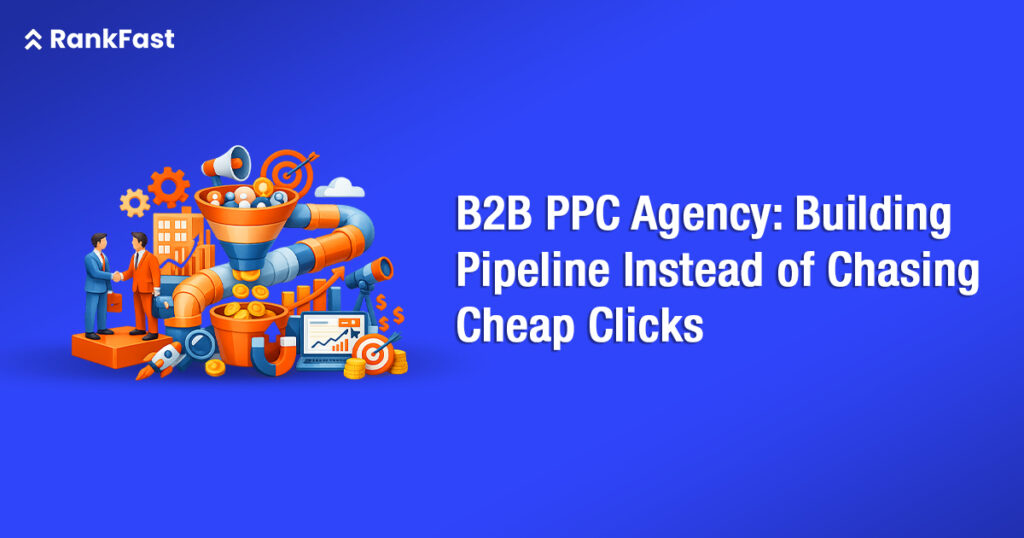
Most B2B marketing directors have sat through the same review meeting. Cost per click is down. Click-through rate is up. And the pipeline still hasn’t moved. That gap between paid media “wins” and actual revenue is the single biggest reason B2B companies fire PPC agencies, and it usually has nothing to do with bidding strategy. It has to do with an agency treating a seven-figure enterprise deal the same way it would treat a $40 ecommerce cart. This guide breaks down what separates a b2b ppc agency built for pipeline from one built for vanity metrics, what b2b ppc management actually costs, and the questions worth asking before a contract gets signed.
Key Takeaways
- B2B deals involve buying committees of 6 to 10 stakeholders on average, according to Gartner, which means a single-touch campaign structure will always underperform against pipeline goals.
- LinkedIn and Google Ads solve different problems in a b2b lead generation ppc strategy; treating them as interchangeable channels wastes budget on both.
- Cost per lead in B2B categories can run 5 to 10 times higher than B2C, so a “cheap CPL” pitch from an agency is often a red flag, not a selling point.
- Pricing models for b2b ppc management vary widely, from flat retainers to percentage-of-spend, and the wrong model can quietly misalign agency incentives with client goals.
- The strongest agencies report on pipeline and sales-qualified leads, not just clicks and form fills.
Why B2B PPC Behaves Differently From B2C Paid Media
A B2C campaign optimizes for a single moment: someone sees an ad, clicks, and buys within minutes or days. B2B paid media has to survive a much longer, much more crowded process before a dollar of pipeline ever shows up in a CRM.
The Buying Committee Problem
According to Gartner’s B2B buying journey research, the average B2B buying group includes six to ten stakeholders, each doing independent research before a group conversation even happens. A PPC agency running a single ad set aimed at one job title is, by design, only ever reaching a fraction of the people who need to say yes.
Longer Cycles, Higher Stakes Per Click
The average B2B buying journey involves roughly 88 touchpoints across four channels, with 281 days passing between the first ad impression and closed revenue, per Meet Lea’s 2026 LinkedIn Ads benchmark analysis. A PPC agency that reports success after week two is measuring the wrong window entirely.
The Real Cost of a Bad B2B PPC Agency Fit
Cheap clicks feel like progress. They rarely translate into revenue, and by the time that becomes obvious, months of budget are already gone.
Cheap Clicks vs. Qualified Pipeline
Average cost per lead swings enormously by category. Manufacturing B2B campaigns average a cost per lead of $819, compared to $70 for leisure-focused B2C campaigns, according to WebFX’s 2026 PPC benchmark report. An agency promising B2C-level CPLs in a complex B2B category is either targeting the wrong audience or reporting the wrong metric.
Warning Signs During the Sales Process
Watch for agencies that lead every pitch with click-through rate. Cost per acquisition for B2B services runs $100 to $300 on average, well above the $20 to $50 range typical of ecommerce, per WebFX’s 2026 Google Ads benchmarks. If a prospective agency can’t explain why B2B economics look different before you even ask, that’s worth noting.
What a B2B PPC Agency Actually Does Differently
The mechanics of running a campaign are similar across categories. What changes is the strategy layered on top.
Multi-Stakeholder Campaign Design
Rather than one campaign per persona, mature b2b ppc management builds parallel campaigns for economic buyers, technical evaluators, and end users, each with messaging suited to their concerns. This is closer to account-based marketing than traditional search advertising.
Platform Selection by Buying Stage
Top-of-funnel awareness plays differently than bottom-of-funnel intent capture. A good agency maps ad spend to where a buyer actually is, not just where the cheapest impressions live.
Google Ads vs. LinkedIn Ads for B2B Lead Generation
Both platforms show up in nearly every linkedin ads agency pitch deck, but they solve different problems.
| Metric | Google Ads (Search) | LinkedIn Ads |
| Average CPC | $5.26 across industries | $4.20 to $6.50 for B2B and SaaS |
| Average conversion rate | 3.75% | 6.1% (Lead Gen Forms) |
| Best use case | Capturing active, high-intent search demand | Reaching specific job titles and buying committee roles |
| Reported ROAS | 67% | 121% |
Sources: Meet Lea’s 2026 LinkedIn Ads benchmark analysis, which references the Dreamdata 2026 LinkedIn Ads Benchmarks Report showing LinkedIn as the only major paid channel delivering positive first-party ROAS; CPC Benchmarks by Industry 2026.
The takeaway isn’t that one platform beats the other. It’s that Google Ads tends to win on capturing existing demand, while LinkedIn tends to win on reaching people who haven’t started searching yet.
How to Evaluate a B2B PPC Agency Before You Sign
Most procurement conversations focus on price. The better questions focus on how success gets measured.
Questions to Ask About Attribution
Ask specifically how the agency ties ad spend to closed revenue, not just form fills. If the answer stops at “cost per lead,” the agency is likely optimizing for volume rather than pipeline quality.
Questions to Ask About Reporting Cadence
Given sales cycles that often stretch past nine months, monthly click and impression reports tell you very little. Ask for quarterly pipeline reviews that connect spend to opportunities created and, eventually, revenue closed.
Pricing Models: What B2B PPC Management Actually Costs
Agency pricing structures vary, and each one creates different incentives.
| Pricing Model | Typical Range | Best Fit | Watch Out For |
| Flat monthly retainer | $3,000 to $15,000/month | Predictable budgets, ongoing optimization | Scope creep without added spend management |
| Percentage of ad spend | 10% to 20% of spend | Larger budgets, established programs | Incentive to increase spend rather than efficiency |
| Hybrid (retainer + performance) | Base fee plus bonus on pipeline goals | Teams wanting shared accountability | Requires clean CRM data to calculate fairly |
| Project-based | Fixed fee per campaign launch | One-off product launches or events | Limited ongoing optimization included |
An agency-of-record approach to pricing works well for companies running paid media as a core, always-on channel. Agencies that work across both SMB and enterprise accounts, including firms like Rankfast, often build the pricing model around the client’s sales cycle length rather than defaulting to a single standard package.
Building a Full-Funnel B2B Lead Generation PPC Strategy
Pipeline doesn’t come from one campaign type. It comes from matching offers and channels to where a buyer actually stands in their process.
Matching Content to TOFU, MOFU, and BOFU Stages
Top-of-funnel campaigns should promote educational content, not demo requests. Middle-of-funnel campaigns can introduce comparison guides or webinars. Only bottom-of-funnel campaigns, aimed at people already evaluating vendors, should push directly for a sales conversation. Running a demo-request ad against a cold, top-of-funnel audience is one of the most common ways B2B budgets get wasted.
Signs Your Current Agency Is Optimizing for the Wrong Metric
A few patterns show up repeatedly when a b2b ppc agency relationship starts to underdeliver: reporting stays fixated on cost per click quarter after quarter, campaign structure never changes even as messaging tests fail, and nobody on the agency side can name your last three closed-won deals from paid channels. Because each additional stakeholder in a buying committee changes the probability of a deal closing, according to Gartner-sourced buying committee research, an agency that isn’t adjusting targeting as your sales team maps new contacts is running the same playbook regardless of what’s actually happening in your pipeline.
Conclusion
Cheap clicks are easy to sell and easy to report on, which is exactly why so many B2B companies end up with a paid media program that looks fine on a dashboard and does nothing for the pipeline. The agencies worth keeping are the ones willing to talk about buying committees, sales cycle length, and attribution before they talk about cost per click. That conversation, more than any single benchmark, tends to predict whether a b2b ppc agency will still be adding value six months from now. Before renewing or signing a contract, ask for a pipeline review instead of a click report, and judge the answer accordingly.
Frequently Asked Questions
How much does b2b ppc management typically cost per month?
Flat retainers generally range from $3,000 to $15,000 per month, while percentage-of-spend models run 10% to 20% of media budget. The right model depends on budget size and how established the paid program already is.
Is LinkedIn or Google Ads better for b2b lead generation ppc?
Neither is universally better. Google Ads tends to capture active search intent efficiently, while LinkedIn reaches specific job titles before they start searching. Most full-funnel strategies use both.
Why is B2B cost per lead so much higher than B2C?
B2B products often carry higher deal values and longer evaluation processes, so a single qualified lead is worth pursuing at a higher cost. A $819 average CPL in manufacturing, for example, still produces strong ROI against a six-figure contract.
How long should a company give a linkedin ads agency before judging results?
Given average B2B sales cycles stretching past nine months, three to six months is a more realistic evaluation window than 30 days. Early metrics like CTR and CPC matter less than pipeline created after quarter two.
What questions should I ask a b2b ppc agency during the sales process?
Ask how they attribute spend to closed revenue, how reporting cadence aligns with your sales cycle, and how targeting adapts once your sales team identifies new buying committee members.
Do B2B companies need a dedicated linkedin ads agency, or can one team run both platforms?
One team can usually run both platforms well, provided they understand the different roles each plays. A dedicated LinkedIn-only shop may miss the search-intent side of the funnel entirely.
What's a realistic conversion rate benchmark for B2B paid search?
Google Search converts at roughly 3.75% on average across industries, while LinkedIn Lead Gen Forms average around 6.1%. Actual results vary significantly by category and offer quality.
How does a buying committee affect PPC campaign structure?
Because B2B purchases typically involve six to ten stakeholders, effective campaigns run parallel ad sets targeting different roles rather than a single generic audience, matching messaging to each stakeholder's specific concerns.
Should PPC reporting focus on leads or pipeline?
Pipeline and sales-qualified leads give a far more accurate picture of paid media performance than raw lead volume. An agency that only reports form fills is measuring activity, not revenue impact.