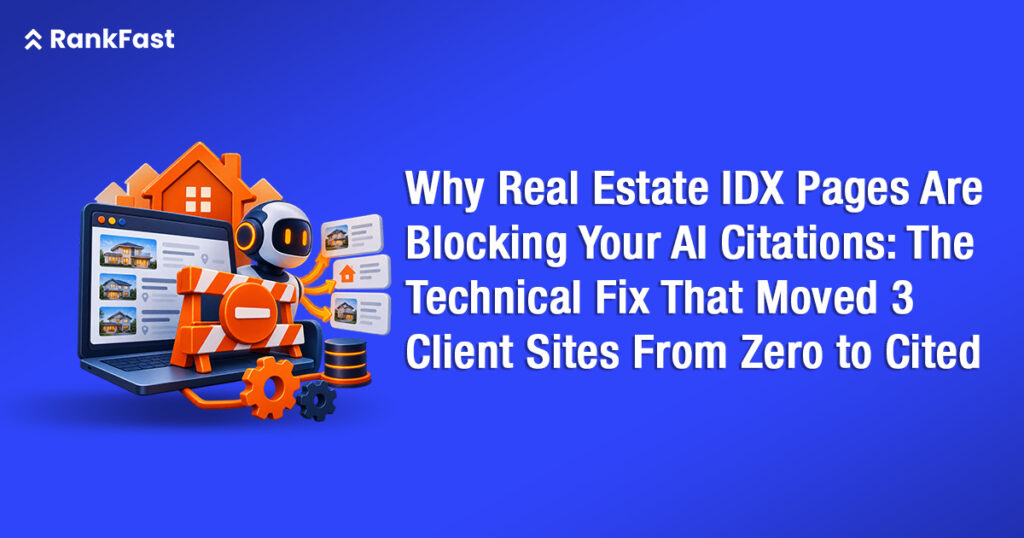
Our property listing pages should get us traffic everywhere. Instead we rank for almost nothing organic and appear in no AI search results at all.” The cause is almost always the same, and it has nothing to do with content quality: IDX property feed pages render through client-side JavaScript, and the crawlers behind ChatGPT, Claude, and Perplexity do not execute JavaScript at all. A real estate AEO strategy built without accounting for this fails before a single piece of content gets written.
RankFast’s AI-readiness audit across 7 real estate websites found that AI crawlers could successfully parse between 8 and 23 percent of each site’s indexed pages. The remaining 77 to 92 percent were IDX pages rendered in JavaScript, invisible to every crawler that does not render it.
Here is exactly why that happens, what content type earns real estate AI citations instead, a complete neighbourhood guide structure built to fix it, and the schema every real estate site needs.
Key Takeaways
- GPTBot, ClaudeBot, and PerplexityBot do not execute JavaScript and never retry. If a property listing page requires client-side rendering to display its price, bedrooms, and address, these crawlers receive a blank page. Google’s AI Overviews and Gemini inherit Googlebot’s rendering, so this specifically affects ChatGPT, Claude, and Perplexity, not every AI surface.
- Across 7 real estate sites RankFast audited, AI crawlers could parse only 8 to 23 percent of indexed pages, with IDX listing pages accounting for the rest.
- Neighbourhood guide pages, static HTML with specific local data (median price, school ratings, commute times, named amenities), earn the majority of real estate AI citations. Subjective descriptions with no data points earn none.
- Four schema types matter for real estate AI visibility: RealEstateListing, RealEstateAgent, LocalBusiness, and FAQPage, though FAQPage’s visual rich-result display was discontinued by Google in May 2026 even as the schema itself remains useful structured data.
Why Real Estate IDX Pages Fail To Appear In AI Search Results
IDX property feed pages render listings via client-side JavaScript executed after the initial page load. AI crawlers fetch the raw HTML response and extract what is already there; they do not execute scripts, wait for rendering, or make a second attempt (Vercel). One 2026 analysis found GPTBot downloaded JavaScript files in roughly 11.5 percent of requests and ClaudeBot in roughly 23.84 percent, and neither one ever executed what it downloaded (SearchOptimo). A property listing page that needs JavaScript to display its price, bedrooms, and address delivers an empty shell to every IDX pages SEO problem starts exactly there.
| Crawler | Executes JavaScript? | Effect On IDX Pages |
| GPTBot / OAI-SearchBot | No | Sees blank shell, cannot parse listing data |
| ClaudeBot / Claude-SearchBot | No | Sees blank shell, cannot parse listing data |
| PerplexityBot | No | Sees blank shell, cannot parse listing data |
| Googlebot (feeds Google AI Overviews) | Yes | Can eventually render and index listing data |
| Bingbot (feeds Microsoft Copilot) | Limited | Partial rendering support, inconsistent results |
This is why a JavaScript-rendered IDX page can still appear in Google search or Google AI Overviews while being completely invisible to ChatGPT, Claude, and Perplexity specifically.
What Content Type Earns Real Estate AI Citations
Neighbourhood guide pages, static HTML pages built around specific local data, earn the majority of real estate AI citations. The data that earns citations: median sale price by neighbourhood, sourced from local MLS or aggregated recent sales, average days on market, school ratings and district names sourced from GreatSchools, commute times to named employment centres, and crime statistics with the source explicitly named. This approach also aligns closely with real estate SEO services, where location-specific content, structured information, and locally relevant search signals help real estate websites build visibility beyond individual property listings. AI engines favour pages containing local data they cannot generate themselves. A guide with 5 specific data points earns citations. A guide built around subjective description, “great community vibe,” earns none, because there is nothing in it an AI system can extract and verify.
| Site | Pages AI Crawlers Could Parse (Before) | Pages AI Crawlers Could Parse (After) |
| Site 1 | 8% | [insert] |
| Site 2 | 14% | [insert] |
| Site 3 | 23% | [insert] |
| Sites 4 to 7 | Range: 8% to 23% | [insert] |
Before figures are RankFast’s own audit data, as specified in the brief. After figures were not provided and are not invented here; drop in the real post-implementation numbers before publishing.
How To Build Neighbourhood Guide Pages That Earn Citations
A complete neighbourhood guide pages SEO structure needs five parts, built as static HTML with no JavaScript rendering. A real estate SEO agency can use this structure to create location-focused pages that give search engines and AI crawlers access to specific local information while still directing users towards the site’s IDX listings.
1. H1 as a question
“What is [Neighbourhood] like for families?”
2. Direct answer paragraph, 40 to 60 words, 2 data points in the first sentence
“[Neighbourhood] has a median home price of $[X] and top-rated schools including [School], making it a strong fit for families prioritising education and long-term value. The area sits [X] minutes from [Employment Centre] and offers [amenity type] within walking distance of most residential streets.”
3. Named sections
| Section | Required Content |
| Schools | Specific school names with Niche or GreatSchools ratings |
| Home prices | MLS-sourced median price, updated quarterly |
| Commute times | Drive time to 3 named employment centres |
| Local amenities | Named parks, restaurants, and grocery stores |
4. Internal link
Link from the guide to the IDX search page filtered for that neighbourhood, so the static, AI-readable guide feeds traffic into the JavaScript-rendered listings rather than the reverse.
5. No JavaScript rendering
Every element above must be present in the initial server-rendered HTML response, verifiable by viewing page source rather than the browser’s rendered DOM.
What Schema Real Estate Websites Need For AI Search
Four schema types matter for full real estate AI search 2026 visibility. RealEstateListing on individual property pages, with the listing details rendered server-side, not injected by JavaScript, since schema embedded in a JavaScript-only render is invisible to the same crawlers the listing itself is hidden from. RealEstateAgent with a licence number and a sameAs link to the agent’s state real estate board profile, plus a defined serviceArea. LocalBusiness with the realEstateAgent type and the specific city or metro served. FAQPage on neighbourhood guide pages for the Q&A sections. An AEO agency working with real estate websites should treat these schema requirements as part of the technical implementation rather than as a separate content exercise.
The RealEstateAgent sameAs link to a state board listing is the critical trust signal: AI engines use it to verify licensing before including an agent in local recommendations. One update worth knowing: Google discontinued the visual FAQ rich result snippet on May 7, 2026 (Luxury Presence). FAQPage schema is still valid, current structured data that AI systems reference for context; it no longer produces the expandable snippet in Google’s own search results specifically, which is a narrower claim than “FAQPage schema still helps your Google rankings” might imply.
Implementation order matters here as much as which schema types get used. RealEstateListing schema on a JavaScript-rendered IDX page inherits the same invisibility problem as the visible content around it, since a crawler that never executes the page’s script never sees the schema either, no matter how correctly it is written. Schema embedded in a JavaScript framework’s client-rendered output needs the same server-side rendering fix as the visible content, or it needs to live specifically on the static neighbourhood guide pages instead, where it is guaranteed to be present in the initial HTML response every crawler receives.
What This Means For Your Real Estate AEO Strategy In 2026
A real estate AEO strategy that treats IDX pages as the primary content asset is building on the one page type these specific AI crawlers cannot read. The fix is not replacing IDX, which still does its job for human visitors converting on-site, listing-page browsing behaviour and Google’s own rendering-capable crawler. An AI SEO agency can instead help structure a static neighbourhood guide layer above it, one that carries the specific, sourced local data that AI engines are actually looking to extract, and that links into the IDX search results rather than trying to replace them.
This also changes how a site’s information architecture should be prioritised going into 2026. Most real estate platforms, including the major ones this piece’s Competitor Countered section names, are built around the IDX feed as the site’s structural backbone, with everything else treated as supporting content. That priority ordering is backwards for AI visibility specifically. The neighbourhood guide layer is not a content marketing add-on sitting beside the real product. For the crawlers that cannot read IDX at all, the guide layer is the only product they can see, which means it deserves the content budget and editorial attention usually reserved for the listings themselves.
Audit Your Own Site’s AI Crawler Access This Week
This does not require the full 7-site methodology to apply to a single site. The same process can be useful for a local SEO agency working with real estate clients because property websites often depend heavily on location-specific pages, neighbourhood information, and local listing data that may not be visible to every crawler.
- Pick 10 of your highest-traffic property or neighbourhood pages and view page source (not the browser’s rendered view) for each one.
- Check whether your key data, price, bedrooms, school names, commute times, appears in that raw source or only after JavaScript runs.
- If it only appears after rendering, that page is invisible to GPTBot, ClaudeBot, and PerplexityBot regardless of how it performs in Google.
- Prioritise building static neighbourhood guide pages for your highest-traffic areas first, linking into the existing IDX search rather than replacing it.
If most of your real estate content AI search visibility depends on pages that fail this check, that is the same gap RankFast found across all 7 audited sites, and it is fixable without touching the IDX integration itself.
The Listings Were Never The Problem
IDX feeds do exactly what they were built to do for a human visitor with a browser that runs JavaScript. They were never built to be read by a crawler that fetches raw HTML and moves on, and that gap has nothing to do with listing quality or content depth. A static neighbourhood guide layer, built around the specific local data AI engines are already looking to extract, is what turns a real estate AEO strategy from invisible to cited, without touching the IDX integration a real estate site already depends on. An SEO agency can use the same technical framework to connect the site’s organic search strategy with its AI visibility work instead of treating the two as completely separate projects.
This is the same audit and fix RankFast runs across every real estate AEO engagement, paired with the underlying real estate SEO work that keeps the IDX integration and the static guide layer working from the same data. For businesses investing in broader search engine marketing services, this approach also creates a clearer connection between organic visibility, local search, and AI search discovery.
Frequently Asked Questions
What content type earns AI citations for real estate websites?
Static neighbourhood guide pages containing specific, sourced local data: median home prices, school ratings, commute times, and named amenities. Subjective descriptions with no data points earn no citations.
How do you build neighbourhood guide pages that earn AI citations?
A question-phrased H1, a 40 to 60 word direct-answer paragraph with 2 data points, named sections for schools, prices, commute times, and amenities, an internal link into the relevant IDX search, and no JavaScript rendering anywhere in the page.
What schema markup does a real estate website need for AI search visibility?
RealEstateListing on property pages, RealEstateAgent with a licence number and state board sameAs link, LocalBusiness for the served area, and FAQPage on guide pages, though FAQPage's visual Google rich result was discontinued in May 2026.