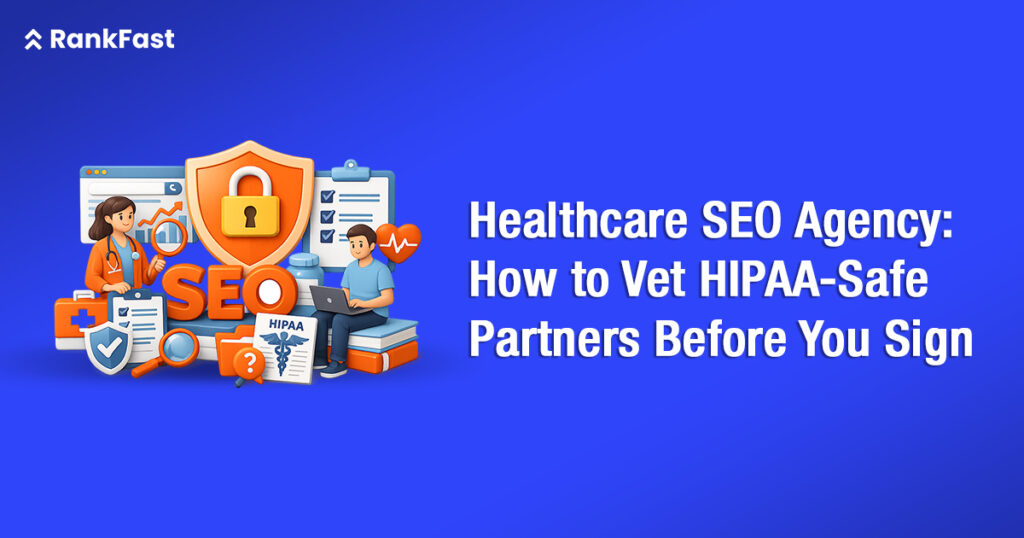
A single advertising pixel on a hospital website exposed 13.4 million patient records and became one of the largest healthcare data breaches on record. The vendor involved was not a hacker. It was a marketing tool, installed to track website visitors, running on a healthcare organization’s own site. That single detail should change how any practice or health system approaches a healthcare seo agency search.
Most vetting conversations focus on rankings, backlinks, and content calendars. Almost none of them ask whether the agency understands protected health information, business associate obligations, or what happens to patient data once it touches a tracking pixel, a call-tracking number, or a chatbot form. This guide walks through what “HIPAA-safe” actually means for an SEO vendor, the ten questions to ask before signing, and the red flags that should end a pitch meeting early.
Key Takeaways
- A healthcare seo agency that cannot explain how it handles protected health information is a liability, not a growth partner.
- Marketing vendors frequently qualify as HIPAA business associates the moment they touch tracking data, call recordings, or patient intake forms.
- Healthcare data breaches averaged $7.42 million per incident in 2025, the highest cost of any industry for the fourteenth consecutive year.
- A signed Business Associate Agreement is the minimum bar, not proof of compliance on its own.
- Case studies, certifications, and references should all be checked independently before a contract is signed.
Why Healthcare SEO Demands More Than Standard SEO Skills
A standard SEO contractor optimizes pages, builds links, and tracks keyword rankings. A medical seo agency does all of that while also touching systems that can expose regulated patient data if configured incorrectly. That difference changes what “qualified” means for this hire.
Patient Data Touches Everything In Healthcare Marketing
Contact forms, appointment schedulers, live chat widgets, call-tracking numbers, and even Google Analytics event tags can all capture information tied to a specific patient and a specific condition. Once that link exists, the data is protected under HIPAA, regardless of whether the agency intended to collect it. According to HIPAA Compliant Hosting, a 2024 hospital breach involving 13.4 million records originated from advertising pixels embedded on the health system’s own website, not an external hack.
Compliance Failures Move Faster Than Rankings
Ranking improvements take months to show up. A compliance failure can trigger a reportable breach within days of a tracking script going live. Business associates were involved in 34% of healthcare data breaches in 2025, according to MedhaCloud’s HIPAA compliance statistics, the highest share ever recorded. That number includes marketing and web vendors, not just IT contractors.
What “HIPAA-Safe” Actually Means For A Marketing Vendor
“HIPAA-safe” is not a certification a vendor can buy or a badge they place in a footer. It describes a set of operational practices around how a vendor accesses, stores, and transmits protected health information during the course of their work.
Business Associate Status Under HIPAA
Under the HIPAA Privacy Rule, any vendor that creates, receives, maintains, or transmits protected health information on behalf of a covered entity is a business associate. This status triggers a legal requirement for a signed agreement before any work involving that data can begin. A vendor who says a BAA is not necessary for “just marketing” work is either unfamiliar with the rule or hoping the practice will not ask again.
Marketing Activities That Commonly Trigger BAA Requirements
The list is longer than most practice owners expect. It includes call tracking software that records patient conversations, form submissions that route directly into a CRM, chat widgets staffed by agency employees, and analytics platforms configured without IP anonymization or PHI filtering. Each one creates a channel where identifiable patient information can move outside the practice’s direct control.
The Real Cost Of Choosing The Wrong Agency
The financial exposure from an unqualified vendor goes well beyond a wasted retainer. It includes breach notification costs, regulatory penalties, state attorney general fines, and the operational cost of a corrective action plan.
Healthcare breaches cost an average of $7.42 million per incident in 2025, according to IBM’s Cost of a Data Breach Report as cited by HIPAA Compliant Hosting, and they take an average of 279 days to identify and contain. Civil penalties for HIPAA violations, effective January 28, 2026, range from $145 to $2,190,294 per violation category, according to the HIPAA Journal. Smaller practices are not exempt from this exposure. In 2022, small practices accounted for 55% of OCR’s financial penalties, per data compiled by Sprinto.
| Risk Category | Typical Cause | Financial Exposure |
| Untracked marketing pixels | Analytics or ad tags capturing patient identifiers | Breach notification, OCR investigation, state AG fines |
| No signed BAA with vendor | Agency treated as a non-covered contractor | Separate HIPAA violation, regardless of breach occurrence |
| Call recording without consent controls | Call-tracking tools storing patient conversations | Right of Access and privacy rule violations |
| Weak access controls at the agency | Shared logins, unencrypted file transfers | Business associate breach, dual OCR and state penalties |
A recent example illustrates the dual-exposure pattern directly. In the Comstar case, a business associate faced a $515,000 state attorney general fine alongside a separate $75,000 OCR settlement for the same underlying breach, according to HIPAA Journal fines data. One vendor mistake produced two separate enforcement actions against two different parties.
Ten Questions To Ask Before You Sign
A short conversation reveals most of what a practice needs to know. Ask these questions directly and pay attention to how quickly and specifically the agency answers.
| # | Question To Ask | What A Strong Answer Sounds Like |
| 1 | Will you sign a Business Associate Agreement before any work begins? | Immediate yes, with a template ready to review |
| 2 | Which of your team members will have access to our data, and how? | Named roles, documented access controls, not “the whole team” |
| 3 | How do you configure analytics to avoid capturing PHI? | Specific mention of IP anonymization, event filtering, or server-side tracking |
| 4 | Do you use call tracking, and how is that data stored? | Encrypted storage, retention limits, consent language on record |
| 5 | What happens to our data if we end the contract? | A documented data return or deletion process |
| 6 | Have you had a breach or OCR complaint involving a client? | Direct disclosure, not deflection |
| 7 | Who handles compliance review internally? | A named person or process, not “we’re all careful” |
| 8 | Can we see redacted examples of past healthcare work? | Willingness to share, with patient and client identifiers removed |
| 9 | How do you handle subcontractors who touch our data? | Subcontractor BAAs in place, disclosed upfront |
| 10 | What training do staff receive on HIPAA basics? | Scheduled, recurring training, not a one-time onboarding note |
Red Flags That Signal An Agency Isn’t Ready
Some warning signs show up before a contract is even drafted. Watch for these during the pitch and discovery phase.
- Vague answers about data handling. Phrases like “we take security seriously” without specifics on tools, encryption, or access controls.
- No BAA template ready. A genuinely HIPAA-experienced vendor already has one drafted and reviewed by counsel.
- Generic case studies. Healthcare work described only as “medical clients” with no specialty, no metrics, and no compliance detail.
- Reluctance to name subcontractors. Freelancers or offshore teams handling patient-adjacent data without disclosure.
- Pressure to skip legal review. Any push to sign quickly before your compliance officer or attorney reviews the agreement.
Business Associate Agreements: What To Check Before Signing
A signed BAA is the legal floor, not the finish line. The document itself needs to hold up to scrutiny, and the agency’s actual practices need to match what it says on paper.
Required Clauses In A Marketing BAA
A usable agreement specifies permitted uses of PHI, required safeguards, breach notification timelines, subcontractor obligations, and data return or destruction terms at contract end. It should also name a specific point of contact for security incidents rather than a general support inbox.
What Happens Without One
Missing a BAA is treated by OCR as its own separate violation, independent of whether a breach ever occurs. This is a pattern we see consistently at Rankfast when auditing healthcare client relationships inherited from previous vendors: the marketing contract predates the BAA, or no BAA exists at all, and neither party had flagged the gap until an audit surfaced it.
Evaluating Case Studies And Compliance Claims
Ask for verification, not just assurance. A qualified healthcare digital marketing partner should be comfortable connecting a prospective client with an existing healthcare reference, sharing a redacted BAA template, or walking through their analytics configuration on a screen share.
Patient trust in digital research is only growing, which raises the stakes on getting the vendor relationship right. According to Digital Silk’s healthcare marketing research, 65% of patients search online before contacting a doctor, and over 70% read reviews before choosing a new provider. A vendor mishandling that visibility layer risks both compliance exposure and lost patient trust at the same time.
Building Your Final Vetting Checklist
Bring this list into the final vendor conversation before any contract gets signed. Treat a missing item as a reason to pause, not a detail to resolve later.
- Signed BAA reviewed by your compliance officer or legal counsel
- Named point of contact for security and privacy incidents
- Documented analytics and tracking configuration, including PHI filtering
- Disclosed list of subcontractors with their own signed BAAs
- Data retention and deletion terms specified in writing
- At least one verifiable healthcare reference willing to speak directly
- Staff HIPAA training documented and recurring, not one-time
Conclusion
Choosing a healthcare seo agency is a compliance decision as much as a marketing one. The agency that ranks a practice’s pages will also touch patient-adjacent data through forms, chat, and tracking tools, whether that data flow was part of the original pitch or not. A signed Business Associate Agreement, documented analytics practices, and a vendor willing to answer specific questions are the baseline, not extras.
Before signing anything, run the ten-question conversation from this guide and treat a vague answer as a real signal. The practices that build this vetting step into their process now avoid the breach notifications, penalties, and lost patient trust that follow when it gets skipped. Ask for the BAA template first, and let the rest of the conversation follow from there.
Frequently Asked Questions
Do all healthcare marketing vendors need to sign a BAA?
Any vendor that creates, receives, maintains, or transmits protected health information on a practice's behalf qualifies as a business associate and needs a signed BAA. This includes agencies managing call tracking, chat widgets, or forms connected to patient records, not only IT or hosting vendors.
Can a marketing agency see patient health information without realizing it?
Yes. Analytics tags, call recordings, and form submissions can capture identifiable health details even when that was not the intent. Without proper filtering and consent controls, an agency can become a business associate without either party recognizing it happened.
What is the average cost of a healthcare data breach in 2025?
Healthcare data breaches averaged $7.42 million per incident in 2025, according to IBM's Cost of a Data Breach Report, the highest cost of any industry for the fourteenth consecutive year. Breaches also took an average of 279 days to identify and contain.
Are small medical practices actually at risk of HIPAA penalties?
Yes. Small practices accounted for 55% of OCR's financial penalties in 2022, and OCR applies the same enforcement standard regardless of practice size. A solo practitioner faces the same investigation process as a large health system.
What should a healthcare SEO contract include beyond standard SEO deliverables?
It should include a signed BAA, named data access roles, documented analytics configuration, subcontractor disclosure, and a data return or deletion process at contract end. Standard deliverables like keyword targets and reporting cadence still apply on top of these terms.
How can a practice verify an agency's healthcare experience?
Ask for a direct reference call with an existing healthcare client, request a redacted BAA template, and have the agency walk through their analytics setup live. Generic case studies without named specialties or compliance detail are a signal to ask more questions.
What happens if an agency causes a HIPAA breach without a signed BAA?
The missing BAA is treated as a separate violation from the breach itself. Both the covered entity and the business associate can face independent penalties, and state attorneys general can pursue additional fines alongside federal OCR enforcement.
Does using call tracking software automatically create HIPAA exposure?
tool records patient conversations without consent controls, encryption, or retention limits. A HIPAA-safe agency configures call tracking with these safeguards in place and discloses exactly how recordings are stored and who can access them.
How often should a practice review its marketing vendor's compliance practices?
At least annually, and immediately after any change in tools, subcontractors, or team members with data access. Compliance is not a one-time signature; it requires periodic verification that actual practices still match what the BAA describes.