Magento is one of the most capable ecommerce platforms available. It is also one of the most reliably mishandled from an SEO standpoint. The architecture that gives enterprise retailers the flexibility to build complex catalogues at scale is the same architecture that, without deliberate management, generates duplicate content across thousands of URLs, wastes crawl budget on faceted navigation combinations that should never be indexed, and produces thin category pages that Google deprioritizes in favour of better-structured competitors.
A generalist ecommerce SEO agency can audit a Magento site and find surface-level issues. A specialist Magento SEO agency understands why those issues exist, how they interconnect at the platform level, and what the correct fix looks like inside Magento’s templating and configuration layers.
According to Ahrefs, 90.63% of pages receive zero organic traffic from Google. For Magento stores with large catalogues, that figure is often worse, because the platform’s default behaviour generates low-value URL variants at a rate that actively dilutes crawl attention from the pages that matter.
This guide covers the structural SEO problems Magento introduces by default, how a specialist agency approaches each of them, what Adobe Commerce SEO looks like when it is executed correctly, and how to evaluate whether the agency you are considering actually understands the platform.
Key Takeaways
- Magento’s default configuration generates duplicate URLs, thin category pages, and faceted navigation combinations that consume crawl budget without producing rankable content.
- A specialist Magento SEO agency addresses these issues at the platform and template level, not page by page, because the problems are structural and regenerate if fixed incorrectly.
- Adobe Commerce SEO requires a different technical approach than Shopify or WooCommerce. Agencies without Magento-specific experience will misdiagnose the root causes.
- Magento technical SEO work produces compounding returns. Fixing crawl budget waste at the infrastructure level allows Google to allocate more attention to the pages that actually drive revenue.
- Choosing an ecommerce SEO agency for Magento means verifying platform-specific experience, not just general technical SEO credentials.
Why Magento Creates Unique SEO Problems
Magento was built for flexibility at scale. That flexibility, by default, creates a set of SEO conditions that a retailer running a simpler platform will never encounter. Understanding why these problems exist is the foundation of any effective Magento SEO strategy.
The core issue is URL generation. Magento creates multiple URL paths to the same product depending on which category the product is accessed through. A product sitting in three categories can have three distinct URLs, all serving identical content. Without correct canonical tag configuration, all three versions compete against each other in search indexes and dilute whatever authority the product page has accumulated.
According to Google Search Central, duplicate content does not result in a manual penalty, but it does force Google to make indexation choices that may not align with your preferred URLs. At scale, this means a significant proportion of a Magento store’s indexed pages are versions Google chose rather than versions the retailer intended.
Compound this with the faceted navigation problem, where filtering by size, colour, price range, and material creates thousands of URL combinations, and a mid-sized Magento catalogue can generate hundreds of thousands of low-value indexed URLs. According to Botify’s analysis of large ecommerce sites, up to 70% of crawl budget on poorly configured stores is spent on URLs that generate zero organic sessions.
Magento Technical SEO: The Issues That Cost Rankings
Magento technical SEO covers a specific set of recurring problems that appear across virtually every Magento installation that has not had specialist attention. A competent Magento SEO agency will identify all of these in an initial audit, but more importantly, will implement fixes at the template and configuration level rather than applying one-off changes that the platform regenerates at the next deployment.
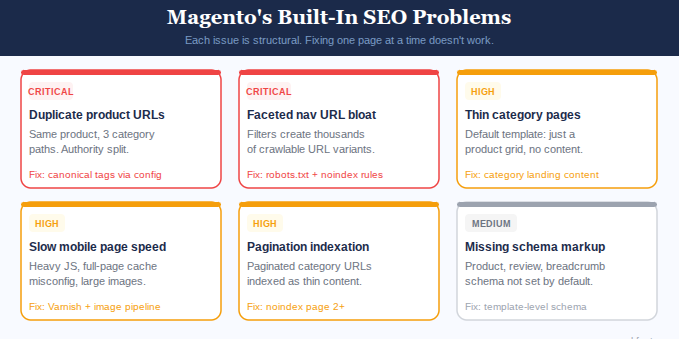
The six issues above are not independent problems. They interact. Duplicate product URLs split authority that is then distributed across category pages that have too little content to rank on their own. Thin category pages fail to accumulate links. Faceted navigation URLs consume the crawl budget that should be reaching the few high-quality pages that do exist. A Magento technical SEO engagement addresses these as a system, with a sequenced remediation plan rather than a parallel checklist.
According to Google’s crawl budget documentation, sites with fewer wasted crawl resources see faster indexation of new and updated pages. For a Magento retailer launching new collections or updating pricing, indexation speed directly affects revenue timing.
How a Magento SEO Agency Handles Faceted Navigation
Faceted navigation is the single most significant crawl efficiency problem in Magento. Most large Magento stores have filtering systems that allow users to combine attributes: size, colour, price band, material, brand, rating. Each combination generates a unique URL. A catalogue with ten filterable attributes at five values each can produce over 100,000 URL variants from a single category page.
The correct approach for adobe commerce seo is not to block all filter URLs. Some filter combinations, specifically those targeting high-volume commercial queries, are worth indexing and optimizing. A specialist Magento SEO agency builds a filter crawl policy that distinguishes between three types of filter URLs: those worth indexing and targeting as landing pages, those that should be crawlable but not indexed, and those that should be blocked at the robots.txt level.
This policy is implemented through a combination of Magento’s native URL configuration, robots.txt directives, meta robots noindex tags, and in some cases a custom module that controls indexation behaviour at the attribute level. The implementation must be tested against Magento’s caching layer to ensure that noindex tags are served correctly to Googlebot rather than cached versions without them.
According to Screaming Frog’s analysis of ecommerce crawl data, faceted navigation URL management consistently delivers the highest ROI of any single technical intervention for large catalogue sites, because the crawl budget recovered is immediately redistributed to high-value product and category URLs.
Content Architecture for Adobe Commerce SEO
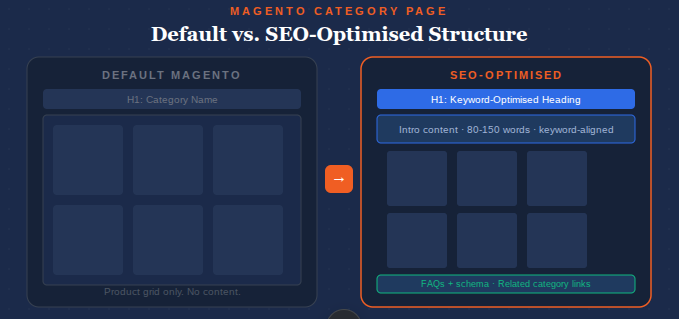
The content problem on Magento is partly structural and partly a resourcing failure. Magento’s default category page template is a product grid with a title. There is no introductory content, no contextual copy, no FAQ section, and no structured text for Google to assess topical relevance. For a competitive category like “women’s running shoes” or “industrial hydraulic fittings,” a product grid alone will not rank against competitors who have built genuine content depth into their category pages.
Effective adobe commerce seo requires a category content architecture that treats each category page as a landing page, not just a product container. That means keyword-aligned introductory content above the product grid, specifications or buying guide content below the fold, internal links to related categories and subcategories, and where appropriate, an FAQ section marked up with FAQPage schema.
| Content Element | Standard Magento Default | Optimised Adobe Commerce SEO |
| Category intro content | None | 80-150 words, keyword-aligned |
| Below-fold content | None | Buying guide or specification context |
| FAQ section | None | 3-5 FAQs with schema markup |
| Internal links | Breadcrumb only | Related categories + subcategories |
| Schema markup | None | BreadcrumbList + ItemList |
| H1 tag | Category name only | Keyword-optimised category heading |
Programmatic category content at scale requires a template-based approach. A Magento SEO agency will build content templates that populate category-level fields through Magento’s CMS block system, allowing the merchandising team to manage content without touching code. This is the difference between a one-time SEO project and a sustainable content architecture.
Link Building and Measurement for Magento Stores
Ecommerce link acquisition is a distinct discipline from service-business link building. For Magento stores, the highest-value link targets are industry publications and review platforms that reach buyers in the purchase consideration stage. Trade publications, comparison sites, and editorial product roundups generate links that are both authoritative and commercially relevant.
Agencies like Rankfast that manage ecommerce SEO across multiple verticals build digital PR programs specifically around product data and original retail research, treating linkable asset development as a core deliverable rather than an afterthought. For a Magento store with a large catalogue, category-level data, such as average price trends by product type or seasonality analysis by segment, creates assets that industry journalists reference repeatedly.
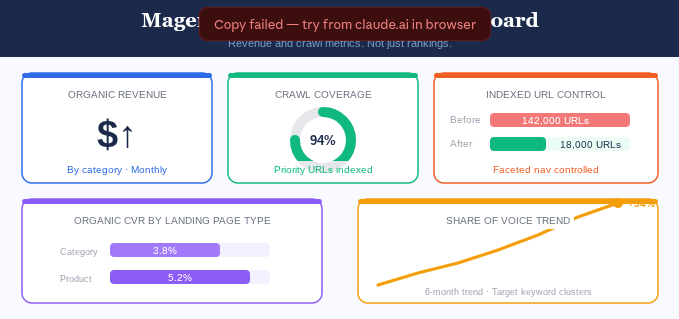
Measurement for Magento SEO requires attribution at the category and product level, not just aggregate organic traffic. The metrics that matter for an ecommerce SEO agency engagement are organic revenue by category, conversion rate from organic sessions by landing page type, crawl coverage of priority product URLs, and indexed page count by template type.
| Metric | What It Tells You | Review Cadence |
| Organic revenue by category | Which categories are generating commercial returns from SEO | Monthly |
| Crawl coverage of product URLs | Whether Googlebot is reaching priority pages | Monthly |
| Indexed URL count by type | Whether faceted nav and duplicate pages are under control | Monthly |
| Organic conversion rate by landing page | Which page templates convert organic traffic to purchases | Monthly |
| Share of voice vs. competitors | Competitive position across target keyword clusters | Quarterly |
According to HubSpot’s State of Marketing Report, marketers who track revenue from organic search are significantly more likely to increase SEO investment, because connecting rankings to revenue makes the ROI case clear. For Magento stores managing thousands of SKUs, category-level revenue attribution is what separates an accountable ecommerce SEO agency from one that reports on impressions.
Choosing the Right Ecommerce SEO Agency for Magento
Not every ecommerce SEO agency is equipped to work on Magento. The platform is technically complex, and the SEO fixes for its built-in problems require familiarity with Magento’s configuration panel, XML layout system, CMS block architecture, and deployment pipeline. An agency that has only worked on Shopify or WooCommerce will treat Magento as a generic PHP site and miss the platform-specific issues entirely.
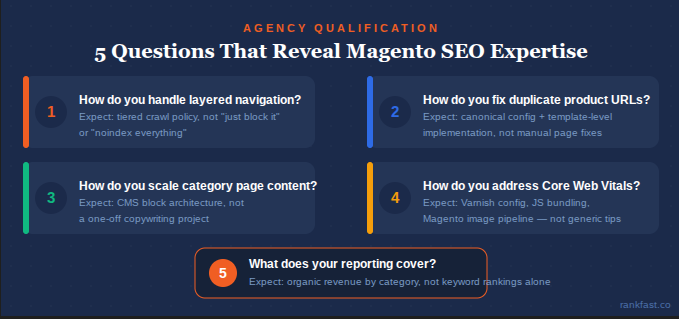
When evaluating a Magento SEO agency, ask these specific questions before signing any agreement:
How do you handle Magento’s layered navigation from an SEO perspective?
The answer should describe a tiered crawl policy distinguishing indexable filter combinations from those to be noindexed or blocked, and should reference implementation via robots.txt, meta robots tags, or a custom attribute control module.
What is your approach to Magento’s duplicate product URL problem?
The correct answer references the Use Categories Path for Product URLs configuration setting and canonical tag implementation at the template level, not a manual page-by-page fix.
How do you handle large-scale content production for category pages on Magento?
The answer should describe CMS block integration for above-fold and below-fold content, not a one-off copywriting project.
Can you describe how you address Core Web Vitals issues specific to Magento?
A knowledgeable magento seo agency will reference Varnish caching configuration, full-page cache management, JavaScript bundling optimization, and image format conversion through Magento’s media processing pipeline.
What does your reporting framework look like for a Magento store?
The answer should connect organic sessions to revenue by category, not just report on keyword rankings.
Conclusion
Magento’s SEO problems are real, well-documented, and addressable. The gap between a Magento store generating 40% of its traffic from organic search and one generating 8% is almost always a technical and content architecture gap, not a link gap. The platform generates the problems. A specialist Magento SEO agency provides the structural fixes that prevent them from regenerating.
The entry point is always a technical audit that quantifies exactly how much crawl budget is being wasted, how many duplicate URLs exist, and what the indexed page composition looks like. That audit creates the priority order. The priority order drives the remediation plan. The remediation plan, executed at the platform level rather than page by page, produces compounding organic returns that continue to accumulate as the catalogue grows.
Ready to identify what is costing your Magento store its organic rankings? Start with a technical audit that maps crawl waste, duplicate content, and category content gaps before building a remediation plan.
Frequently Asked Questions
What does magento technical seo actually involve?
Magento technical SEO covers six primary areas: duplicate URL management via canonical tags and URL configuration, faceted navigation crawl control via robots directives and meta robots, pagination handling, page speed optimization through Varnish and full-page cache configuration, schema markup implementation at the template level, and crawl budget management via sitemap optimization and internal link architecture. Each of these must be implemented at the platform level to remain stable through deployments.
How long do Magento SEO services take to show results?
Initial technical remediation, specifically faceted navigation control and canonical tag implementation, typically produces measurable crawl efficiency improvements within 30 to 60 days. Category content improvements begin to show ranking movement within 90 to 120 days. Full organic revenue impact from a structured Magento SEO services engagement is typically visible at the six to nine month mark, depending on the competitive intensity of the category keywords being targeted.
Can a Magento SEO agency help with Adobe Commerce Cloud specifically?
Yes. Adobe Commerce Cloud introduces additional considerations around CDN configuration, Fastly caching layer management, and deployment pipeline SEO review that are specific to the managed cloud environment. A Magento SEO agency experienced with Adobe Commerce SEO on cloud will address these in the technical audit and establish a review process for the deployment pipeline to prevent SEO regressions at each release.
What is the biggest mistake Magento store owners make with SEO?
Treating Magento SEO as a one-time project rather than an ongoing operational discipline. Magento regenerates many of its SEO problem patterns with each catalogue update, extension installation, or platform upgrade. Faceted navigation controls need to be maintained as new attributes are added. Canonical tag configuration needs to be verified after platform upgrades. Category content needs to be updated as keyword landscapes shift. A one-time audit produces one-time results. A structured magento seo services engagement maintains and compounds performance over time.