Search didn’t change gradually. It shifted. Google’s AI Overviews launched in May 2024 and expanded aggressively through 2025 into 2026, reaching approximately 2 billion users monthly across 200+ countries. ChatGPT now handles over 5 billion monthly visits. Perplexity crossed 170 million global monthly visitors. Meanwhile, zero-click searches have climbed to 60–83% depending on whether AI Overviews are present, and AI Mode queries show an even more extreme 93% zero-click rate.
For most businesses, their SEO playbook was written for a world that no longer exists. The agency that helped them rank on page one in 2022 may have no framework for getting their brand cited inside a ChatGPT answer or an AI Overview in 2026. That gap is exactly where AI SEO agencies come in.
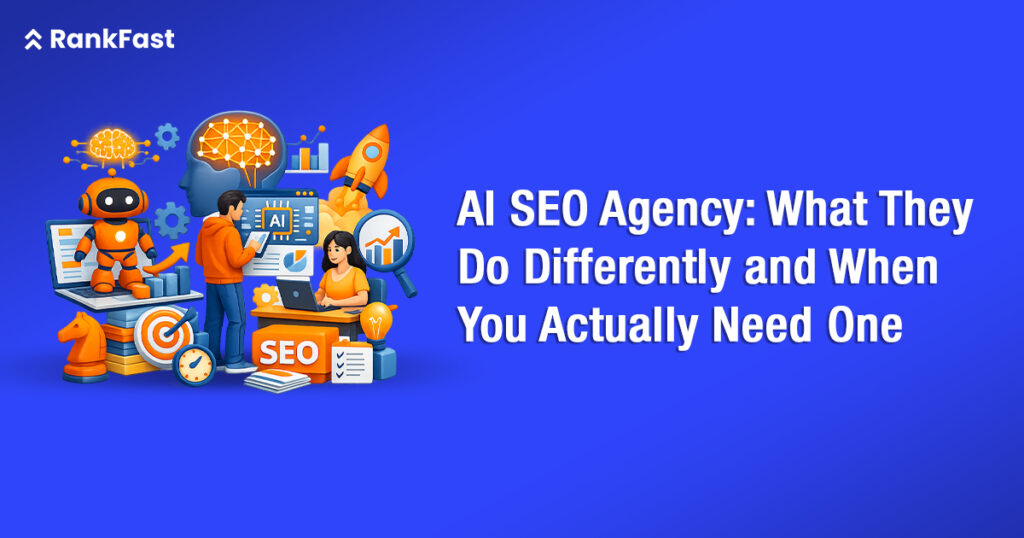
This guide breaks down what an AI SEO agency actually does, how their work differs from a conventional SEO firm, which businesses genuinely need one now, and what to look for when evaluating the best AI SEO agencies for your situation.
Key Takeaways
- AI search optimization now requires a separate discipline from traditional SEO. Ranking on Google and getting cited by AI engines are related but distinct goals.
- AI-referred visitors convert 23x higher than organic search visitors, making even small volumes of AI traffic worth optimizing for.
- The best AI SEO agencies track citations across ChatGPT, Perplexity, and Google AI Overviews using tools that standard analytics platforms do not capture.
- Answer Engine Optimization (AEO) and LLM Optimization are formal services now, not experimental add-ons.
- Businesses in high-intent verticals, including SaaS, legal, finance, and healthcare, face the steepest AI visibility gaps and gain the most from working with a specialist AEO agency.
What an AI SEO Agency Actually Does
Most agencies that call themselves AI SEO agencies fall into one of two camps, and the difference matters considerably.
The first type uses AI tools to do traditional SEO faster. They use machine learning to speed up keyword clustering, content briefs, and technical audits. That is a workflow improvement, not a strategic shift. The second type has rebuilt their service model around the reality that search visibility now means ranking in traditional results AND getting cited, referenced, or summarised by AI-powered answer engines. That second camp is what most businesses actually need when they search for a top AI SEO agency in 2026.
Generative Engine Optimization (GEO)
GEO is the practice of structuring content so it earns citations inside AI-generated answers. Generative Engine Optimization targets inclusion in AI-generated answers, a form of visibility that may produce no direct click but significantly influences brand trust and downstream search behavior. A capable AI SEO agency runs GEO audits as a core service, not as a bolt-on offering.
The mechanics of GEO differ from conventional on-page SEO. Pages covering 26–50% of ChatGPT’s fanout sub-queries get cited more than pages covering 100%. Counterintuitively, trying to be the single comprehensive source on a topic is less effective than being the best answer to a specific slice of it. That kind of insight requires deep familiarity with how LLMs retrieve and evaluate content, which is not knowledge a traditional SEO team typically holds.
Answer Engine Optimization (AEO)
AEO (Answer Engine Optimization) is the discipline of making content directly extractable by AI systems. An AEO agency focuses on structuring content in a format that answer engines can pull into their responses without friction. This means concise definitional paragraphs, clear Q&A formatting, cited statistics presented cleanly, and content written to answer specific search intents at sentence-level granularity, not just at page-level relevance.
Goodfirms’ 2026 survey found 43% of marketers are actively implementing GEO and AEO strategies, up from near zero in 2025. The discipline has crossed from early adopter to mainstream in under two years.
LLM Visibility Tracking and Reporting
This is where most traditional agencies fall short entirely. Only 14% of marketers currently use AI citation tracking, despite 43% naming AI search optimization as a core 2026 strategy. A legitimate LLM optimization agency builds citation tracking into monthly reporting as standard practice. They monitor whether a brand appears in ChatGPT, Perplexity, and Google AI Overviews responses for relevant queries, and they track movement in those citations over time.
Some agencies, including Rankfast, have started building LLM visibility tracking into standard monthly reporting rather than treating it as an add-on, recognizing that clients cannot optimize what they cannot measure.
How the Search Landscape Changed and Why It Demands a Different Approach
The data from 2025 and early 2026 tells a clear story. AI search referral traffic grew 527% year-over-year from January–May 2024 to the same period in 2025. That is not a marginal trend. It is a structural shift in how people find information, products, and services.
At the same time, traditional organic traffic has held more resilience than the headlines suggested. Organic search traffic is down slightly by 2.5% between February 2024 and November 2025, not 25% or 50% as some predicted. The picture, then, is not that traditional search is dying. It is that a new search surface has emerged alongside it, one that operates by different rules and rewards different types of content.
Why Traditional SEO Firms Miss the AI Layer
Traditional SEO is built around signals: backlinks, keyword density, domain authority, technical crawlability. Those signals still matter for Google rankings. But they have limited impact on AI citation decisions.
Branded web mentions have the strongest correlation (0.664) with AI Overview appearances, much higher than backlinks (0.218). An agency optimizing only for backlinks is missing the primary lever for AI visibility. Meanwhile, ChatGPT only cites 15% of the pages it retrieves, and 85% of the sources retrieved during a user’s search are never cited. Getting retrieved is not the same as getting cited. A specialist AI SEO agency understands this distinction and builds content architecture around citation likelihood, not just crawlability.
The Measurement Gap Businesses Cannot Afford to Ignore
Traditional analytics platforms track direct sessions and conversions but do not capture the indirect influence of a brand mention in an AI answer. This creates a dangerous blind spot. A business can be losing ground in AI search for months without seeing it in their Google Analytics dashboard. By the time the drop shows in organic traffic numbers, the citation gap has widened considerably.
| Metric | Traditional SEO Tracking | AI SEO Tracking |
| Keyword rankings | Google Search Console | Not applicable |
| Organic traffic | GA4 sessions | LLM referral sessions (ChatGPT, Perplexity) |
| Brand visibility | SERP position monitoring | AI citation rate by platform |
| Content performance | Click-through rate | Citation frequency, answer inclusion rate |
| Authority signals | Backlink count and DA | Brand mentions, E-E-A-T signals, third-party citations |
Signs You Actually Need an AI SEO Agency Right Now
Not every business needs to hire an AI SEO agency today. But there are specific situations where working with a generalist firm carries real risk.
Your Audience Is Asking Questions Before They Search
High-consideration purchases increasingly start with an AI conversation, not a keyword search. Around three in four American respondents say they search with AI weekly, with their top use cases including quick facts, shopping research, and health information. If your buyers are researching solutions, comparing providers, or building shortlists via AI tools before they ever visit a website, your brand needs to be present inside those conversations.
You Operate in a High-Intent, High-Stakes Vertical
YMYL industries show the biggest AI adoption: legal (11.9x growth), finance (2.9x), and health (2.9x). If your business operates in legal services, financial advice, healthcare, or other trust-critical verticals, your potential clients are using AI to vet options. Being absent from AI answers in those categories is not a missed opportunity. It is a competitive disadvantage that compounds over time.
Your Competitors Are Already Getting Cited
Brands that began GEO optimization in 2024 are reporting measurable citation rate improvements heading into 2026. The competitive window for early GEO investment is narrowing. If you run a competitive analysis and find rival brands appearing in AI Overviews or ChatGPT responses for your core queries while your brand does not appear, you are already behind. The longer that gap persists, the harder it becomes to close.
You Are Seeing Traffic Drop Without a Clear Technical Cause
AI Overviews reduce organic CTR for position-1 rankings by up to 34.5% across 300,000 keywords. If your rankings have held but your organic traffic has declined, AI Overviews appearing above your results are the most likely cause. A conventional SEO agency will look for technical issues. An AI SEO agency will diagnose whether the problem is AI Overview displacement and build a strategy that addresses both surfaces simultaneously.
What to Look for When Evaluating the Best AI SEO Agencies
The market for AI search optimization services has grown fast enough that the terminology has outpaced the actual capabilities behind it. Many firms added “AI SEO” to their service pages without materially changing what they deliver. Here is how to evaluate what you are actually buying.
Specific GEO and AEO Deliverables, Not Just Strategy Decks
A capable AI SEO agency should be able to show you a citation audit from a prior client engagement. They should explain how they structure content to improve citation likelihood across ChatGPT, Perplexity, and Google AI Overviews. If the conversation stays at the level of “AI is changing search and here is how we adapt” without specific deliverables, that is a red flag.
LLM Monitoring as a Standard Reporting Feature
Ask directly: what tools do you use to track AI citations, and how frequently do you report on LLM visibility? A genuine LLM optimization agency will have an answer that goes beyond Google Search Console and Semrush. Platforms like Profound, Otterly, or custom monitoring workflows should feature in their answer.
Evidence of E-E-A-T Building Beyond On-Page Signals
E-E-A-T is evaluated by AI systems not through on-page signals like author bios or credentials pages, but through off-site validation: which authoritative publications mention your brand, which trusted third-party platforms reference you, and what the broader web consensus is about your credibility. The best AI SEO agencies run proactive digital PR and citation building campaigns, not just on-site content optimization.
A Track Record With AI Traffic, Not Just Ranking Reports
Ask to see examples of clients who have grown their LLM referral traffic. AI-referred visitors show 27% lower bounce rates and longer session durations than traditional organic visitors. Agencies that can demonstrate improvement in that traffic quality have practical experience, not just theoretical knowledge of AI search optimization.
| Evaluation Criteria | Standard SEO Agency | Specialist AI SEO Agency |
| Citation tracking | Not offered | Monthly LLM citation reports |
| GEO audits | Not offered | Core deliverable |
| AEO content structure | Basic FAQ schema | Intent-mapped, extractable answer architecture |
| E-E-A-T strategy | Author bios, about pages | Off-site mentions, PR, third-party validation |
| Reporting surfaces | Google Search Console, GA4 | + ChatGPT, Perplexity, AI Overviews citation data |
| Keyword strategy | Search volume and difficulty | + AI query patterns and fanout sub-queries |
The ROI Case for AI Search Optimization
Skepticism about investing in a relatively new discipline is reasonable. The ROI data, however, is increasingly difficult to dismiss.
The GEO market is projected to grow from $886 million in 2024 to $7.3 billion by 2031, a 34% compound annual growth rate. Companies seeing positive GEO ROI report 300–500% returns within 6–12 months.
More practically: B2B SaaS companies report 6x to 27x higher conversion rates from AI traffic versus traditional search. Some companies report 8% of total signups now come from LLMs like ChatGPT and Perplexity. At those conversion multiples, even a modest volume of AI referral traffic generates meaningful revenue impact.
The calculation changes further when you factor in the competitive cost of absence. Brands mentioned in AI responses experience 91% higher paid CTR as a halo effect that extends beyond organic. Visibility inside AI answers does not just drive direct clicks. It increases brand recognition that flows through into paid search performance, direct traffic, and branded query volume.
Final Thoughts
The businesses that treat AI search optimization as a 2027 consideration are making the same mistake early SEO holdouts made in 2005. The window where early movers capture disproportionate AI citation share is open now and narrowing quarter by quarter.
An AI SEO agency is not a replacement for solid SEO fundamentals. Technical health, content quality, and link authority still matter. What has changed is that those fundamentals now need to be extended onto a second search surface where different signals determine visibility. Brands that appear consistently in AI answers for their category are building trust with buyers before those buyers ever type a query into a traditional search bar.
If your brand is not showing up in the AI answers your potential customers are reading, your competitors who are showing up are filling that space. The question worth asking your current agency: what is our citation rate in ChatGPT and Perplexity for our top five queries? If they cannot answer it, you already know what kind of agency you need.
Frequently Asked Questions
What is AI search optimization and how does it work?
AI search optimization is the practice of making content discoverable, retrievable, and citable by AI-powered answer engines. It involves structuring content to answer specific queries directly, building off-site authority signals that AI systems recognize, and tracking citation performance across platforms. The discipline draws from traditional SEO but requires different tactics, particularly around content format, entity clarity, and E-E-A-T signals validated through third-party sources rather than on-page credentials.
What is an AEO agency?
An AEO agency (Answer Engine Optimization agency) specializes in structuring content so it is extracted and featured inside AI-generated answers. This means writing concise, directly answerable content, formatting it for AI retrieval, and building the brand authority signals that AI systems use to decide which sources to cite. Most top AI SEO agencies now include AEO as a core service rather than a separate offering.
How do I know if I need an LLM optimization agency?
You likely need an LLM optimization agency if your competitors are appearing in AI Overview responses for queries where your brand does not show up, if your organic traffic has dropped despite stable rankings, or if you operate in a high-intent vertical where AI-assisted research is common. Businesses in SaaS, legal, financial services, and healthcare have the strongest immediate case for LLM optimization investment.
How do the best AI SEO agencies measure results?
The best AI SEO agencies report on LLM citation rates across ChatGPT, Perplexity, and Google AI Overviews alongside traditional metrics like rankings and organic traffic. They use specialist monitoring platforms to track how frequently a brand appears in AI responses for target queries, whether citation rates are improving over time, and what content formats are driving the most AI visibility gains.
Is AI SEO relevant for small businesses or only for enterprise brands?
AI search optimization is relevant for businesses of any size, but the urgency and investment level differ. Enterprise brands in competitive verticals face immediate pressure to protect AI visibility. Smaller businesses can take a more targeted approach, focusing on local AI search visibility, structured FAQ content, and building brand mentions in niche publications that AI systems draw from. The underlying discipline applies across size, though the scale of implementation varies.