A brand selling premium skincare in the UK launches a German version of its website. The team translates the product pages, sets up a /de/ subfolder, and submits a new sitemap to Google Search Console. Six months later, German organic traffic is negligible. The UK pages are appearing for German search queries. Product pages in English are outranking their German equivalents on google.de. The hreflang tags are in place — but they are wrong in three separate ways that took an agency audit to identify.
This is not an unusual outcome. International SEO is the discipline where implementation errors are hardest to detect because they fail silently. No crawl error, no manual penalty, no warning in Search Console. Just the wrong version of your site ranking in the wrong country, and organic revenue from new markets that never materializes. Global ecommerce is on track to reach nearly $7 trillion in 2026, with cross-border transactions accounting for roughly 45% of all B2C online sales. The commercial opportunity is substantial. The technical gap between a multi-market strategy that works and one that quietly fails is precisely where a specialist international SEO agency earns its value.
This guide covers the technical foundations that determine whether multi-country SEO succeeds or stalls — hreflang implementation, URL structure decisions, content localization strategy, and how to approach multi-market growth in a search environment shaped increasingly by AI-generated answers.
Key Takeaways
- 75% of hreflang implementations across international sites contain errors, and a single error in a hreflang cluster causes Google to ignore the entire cluster — not just the affected page.
- Businesses targeting three or more international markets with dedicated local content see 40-60% of their organic traffic come from non-primary markets within 18 months of correct implementation.
- Localized content achieves up to six times higher conversion rates than English-only alternatives, and 60% of shoppers rarely or never buy from English-only websites.
- Subdirectories (example.com/de/) are the recommended default for most international expansions because they consolidate domain authority; ccTLDs (example.de) are reserved for markets where local trust signals and legal separation justify the authority fragmentation.
- Properly localized multilingual sites see up to 327% more visibility in AI Overviews compared to sites with machine-translated content, making localization quality a direct AI search ranking factor in 2026.
Why International SEO Fails Without Specialist Management
Most brands approach international expansion as a translation project. They hire a translation agency, localize the content, set up the URL structure, and hand implementation to their development team. What they miss is that international SEO is not a translation project with some technical configuration on top. It is a distinct discipline requiring simultaneous management of URL architecture, hreflang annotation clusters, canonical signals, content localization strategy, local link authority, and — in 2026 — AI search visibility across markets. Failing in any one of these layers produces the same surface symptom: organic traffic from target markets that does not grow.
The stakes of getting it wrong are higher than they appear. When hreflang is incorrectly implemented, Google does not simply ignore the misconfigured tags. It attempts to resolve the ambiguity using other signals — internal links, server location, content language — which frequently results in the wrong page version being served in the wrong country. An English product page appearing for German commercial queries captures some organic traffic that would otherwise convert at a much lower rate, while the correctly localized German page sits unindexed or deeply buried.
Research shows that 96% of B2B leaders report positive ROI from localization efforts, and 65% report at least 3x ROI. But these returns are conditional on correct implementation. An international SEO agency manages the gap between the potential and the reality — the technical precision required to make search engines serve the right version to the right audience in every market simultaneously.
The Complexity That Scales With Each Market
A single-market SEO operation involves one set of pages, one set of canonical signals, one keyword strategy, and one backlink profile. Adding a second market doubles most of this complexity and introduces hreflang — an annotation system that must be symmetrically configured across every URL in every language version. Adding a third market means every page now requires hreflang annotations pointing to three different versions, and every one of those annotations must be reciprocal. A 500-page website targeting five markets generates 2,500 pages that must maintain consistent hreflang clusters, canonical signals, and localized structured data — simultaneously.
This is why international SEO management does not scale linearly with the size of a development team. It scales with specialized experience in catching the specific failure modes that appear across multi-language site architectures.
Hreflang: The Most Commonly Broken Element in International SEO
Hreflang is the HTML annotation that tells Google which language and regional version of a page to serve to which user. In theory, it resolves the duplicate content problem created by multilingual sites. In practice, 75% of hreflang implementations contain errors — and when a hreflang cluster contains errors, Google typically ignores the entire cluster rather than applying partial instructions.
The three non-negotiable requirements for a functioning hreflang implementation are self-referencing tags on every page, symmetric reciprocal annotations between all language versions, and valid ISO language and country codes in the correct format. Each of these is a common failure point.
Self-Referencing Tags: The Error 16% of Sites Make
Every page in a hreflang cluster must include a tag pointing to itself, in addition to tags pointing to all other language versions. Around 16% of multilingual sites are missing self-referencing hreflang tags. Without the self-reference, search engines cannot properly map the relationship between versions and will default to other signals to determine which page to rank in each market.
Reciprocal Annotations: The Failure That Breaks Entire Clusters
If page A (English) includes a hreflang tag pointing to page B (German), page B must include a hreflang tag pointing back to page A. If this reciprocal annotation is missing, Google treats the implementation as incomplete and may ignore the entire cluster for the pages involved. This is the most frequent cause of hreflang failure — incomplete linking between language versions that makes the annotation system non-functional despite appearing correctly configured in the source code.
The problem scales with site size. A 200-product ecommerce store targeting four markets requires 800 pages to maintain correct reciprocal hreflang annotations. Missing one reciprocal tag in a cluster of four pages breaks all four pages’ hreflang signals simultaneously.
The Canonical Conflict That Invalidates Hreflang
Each language version must canonicalize to itself — not to a “master” version, not to the English original. When a German page includes a canonical tag pointing to the English version of the same page, two contradictory signals are sent simultaneously: the canonical tag tells Google the German page is a duplicate of the English page, while the hreflang tag tells Google the German page serves German users. Google cannot reconcile these signals and typically defaults to the canonical signal — treating the German page as duplicate content and suppressing it from German search results.
This conflict is extremely common when hreflang is added to an existing site that was previously managed with English-primary canonicalization. An international SEO audit checks canonical and hreflang signals together because they must be consistent to function correctly.
| Hreflang Error Type | Frequency | Impact |
| Missing self-referencing tags | ~16% of multilingual sites | Google cannot map language version relationships |
| Missing reciprocal annotations | Most common failure | Entire hreflang cluster ignored |
| Canonical-hreflang conflict | Widespread on sites with English-primary canonicalization | Target-language pages treated as duplicate content |
| Incorrect ISO code formatting | Common from CMS plugins | Entire implementation invalidated (e.g., en-uk instead of en-GB) |
| Non-absolute URLs in hreflang | Less common | Relative URLs frequently misread by crawlers |
URL Structure: The Decision That Cannot Easily Be Reversed
Before implementing hreflang, before commissioning localized content, and before registering in Google Search Console for new markets, the most consequential decision in international SEO must be made: which URL structure to use. This choice has long-term implications for authority consolidation, operational cost, geo-targeting signal strength, and migration risk. Changing it later typically involves a cross-domain migration with its own set of ranking risks.
There are three options. Understanding their trade-offs — not just in theory but in the specific conditions where each performs best — is a core deliverable of any international SEO services engagement.
Subdirectories: The Default Recommendation for Most Businesses
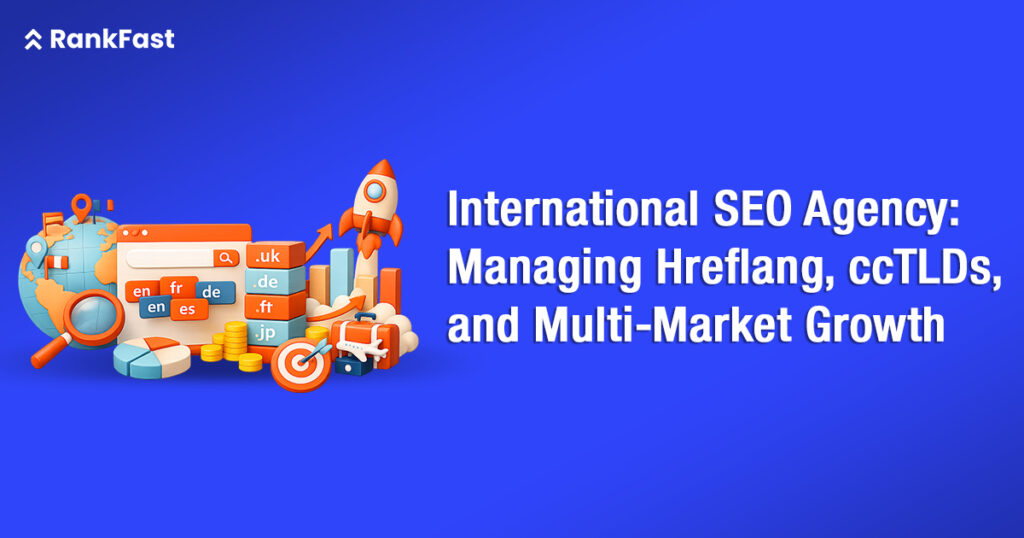
Subdirectories place international content within the main domain (example.com/de/, example.com/fr/). All backlinks, domain history, and accumulated authority flow to a single domain. New market pages benefit immediately from the main domain’s existing ranking strength rather than starting from zero. Picodi, an international ecommerce brand, moved 23 ccTLDs into one .com domain with country subfolders and recorded an 841% visibility increase across Google results within months of the consolidation.
The subdirectory structure is the default recommendation for most international expansions for one specific reason: authority consolidation. Every link earned anywhere on the domain benefits all market versions simultaneously. This is a compounding advantage that becomes more significant as the link profile grows.
Subdirectories do require correct hreflang implementation and Search Console geotargeting configuration to achieve strong country-specific signals, because the domain extension itself carries no inherent geographic indicator. This is manageable with correct setup but requires ongoing monitoring.
ccTLDs: When Local Trust Justifies the Cost
Country code top-level domains (example.de, example.co.uk, example.fr) send the strongest geographic signal to both search engines and users. In markets where local trust is a primary conversion factor — government procurement, heavily regulated industries, markets with nationalistic consumer preferences — a local domain extension can meaningfully improve both click-through rates and conversion rates.
The cost is authority fragmentation. Every ccTLD starts from zero domain authority and must build its own backlink profile independently. A business running five ccTLDs is running five parallel link-building programs. The operational overhead is proportional: separate DNS management, SSL certificates, analytics properties, CMS instances, and in many cases separate development and content teams per market.
ccTLDs make strategic sense when a business has established local operations — offices, legal entities, local payment processing — in each target market, and when the brand positioning in those markets benefits from appearing locally rooted rather than internationally expanded.
Subdomains: The Middle Ground With the Weakest Authority Profile
Subdomains (de.example.com, fr.example.com) sit between subdirectories and ccTLDs. Search engines treat them as semi-independent sites, which means they share some authority with the main domain but not as directly as subdirectory pages. The primary use case for subdomains is technical separation — when different markets require different hosting infrastructure, separate payment gateway integrations, or independent deployment pipelines.
For most international SEO strategies, subdomains are the option that combines the disadvantages of both alternatives without the primary advantage of either: they lack the geo-signal clarity of ccTLDs and the authority consolidation of subdirectories.
Multilingual SEO: Why Translation Is Not Localization
The most persistent error in international content strategy is treating translation and localization as equivalent. They are not, and the distinction affects both search rankings and conversion rates in ways that compound over time.
Translation produces content in the target language. Localization produces content that reflects how people in the target market actually search, what intent they bring to those searches, and what cultural references, pricing conventions, and trust signals resonate with them. The difference appears clearly in keyword research.
A user in the United States searching for “best running shoes” is typically looking for reviews and price comparisons. A user in Japan searching for the equivalent phrase may be more interested in brand heritage and technical specifications. A direct translation of keyword-targeted US content into Japanese misses both the search phrasing and the intent. According to localization data, multilingual websites see on average 30% higher engagement rates and 40% longer on-site durations compared to sites serving markets in a non-native language. Localized content achieves up to six times higher conversion rates than English-only alternatives.
Machine Translation: The AI Detection Problem
Google’s quality systems detect machine-translated content with high accuracy. Unedited machine translation generates low-quality content signals that suppress rankings — not just for the translated page, but potentially across all language versions of the site. This is a critical distinction: a machine-translated German version does not simply underperform in Germany. It can drag the entire site’s quality signals downward.
In 2026, this risk extends to AI search visibility. Research from early 2026 indicates that properly localized multilingual sites see up to 327% more visibility in AI Overviews compared to sites with machine-translated content. AI systems evaluating content for citation in generated answers assess authenticity, specificity, and local market relevance — qualities that machine translation cannot produce at the standard required.
The minimum viable localization process involves a native speaker reviewing and substantively editing machine-translated drafts, not simply approving them. High-value pages — homepages, key product pages, conversion-critical landing pages — require professional translation from the outset, with machine translation reserved for high-volume, lower-stakes content.
Market-Specific Keyword Research
Keyword research cannot be translated. A keyword strategy built on English search data cannot be converted into an effective German keyword strategy by running the target keywords through a translation tool. Search volume, keyword competition, and the specific phrasing people use to search for a product category differ substantially between markets — not because the product is different, but because language, search culture, and competitive SERP dynamics evolve independently.
An international SEO agency conducts keyword research in each target market using local search tools, local SERP analysis, and if possible, native speaker insight into how the target audience describes the product category. This is not a scalable shortcut — it is a market-by-market process that forms the foundation of a localization strategy that actually ranks.
International Technical SEO: The Infrastructure Layer That Goes Unmanaged
Beyond hreflang and URL structure, international SEO requires a set of technical configurations that are commonly overlooked when in-house teams manage international expansion without specialist support.
Structured data localization is the most frequently missed technical requirement. Product schema needs to reflect local currencies, local availability signals, and local pricing. Organization schema should reference the local entity — registered business name, local address, local phone number — not just the parent company. FAQ schema must be written in the target language with locally relevant question phrasing. When structured data is not localized, the rich result eligibility for each market version is reduced, and AI search systems are less likely to cite localized pages in generated answers.
Crawl budget allocation across markets becomes a management problem as the number of international pages grows. A site with five market versions has five times the indexed page count of its domestic version, but Googlebot’s crawl budget for the domain does not scale proportionally. Incorrect sitemap configuration — including non-canonical URLs or pages that are hreflang-annotated but not yet indexed — wastes crawl budget and slows the indexation of new or updated international pages.
Core Web Vitals measurement per market is often handled as a single aggregate metric. A site that passes Core Web Vitals for users in the United States may fail for users in markets with slower average internet infrastructure. CDN configuration, regional hosting choices, and image delivery optimization need to be evaluated separately for each primary market, not assessed from a single origin server’s perspective.
Rankfast approaches international technical audits by examining each market version as an independent indexation unit — checking hreflang clusters, canonical signals, structured data, sitemap entries, and Core Web Vitals measurements separately for each target market — because the failure modes in each market are often distinct even when the underlying codebase is shared.
Multi-Market Growth: How to Prioritize and Scale International Expansion
The most common mistake in international expansion is attempting to enter too many markets simultaneously. Spreading budget, content production capacity, and link-building resources across six markets at once typically produces six markets with inadequate organic presence rather than two or three markets with genuine competitive visibility.
A more effective approach is sequential prioritization based on three criteria: existing organic signals, competitive density, and operational readiness. Existing organic signals — traffic from a country in Google Search Console despite no localized presence — indicate latent demand. Competitive density determines how much investment is required to achieve first-page rankings in the target market. Operational readiness means having localized payment processing, customer support, shipping logistics, and legal compliance in place before committing to SEO investment in a market.
Businesses should have at least 10,000 monthly organic visitors to their primary domain before meaningful international expansion begins. Below that threshold, the authority base is unlikely to generate competitive international rankings quickly enough to justify the operational overhead of managing market-specific content and technical infrastructure.
The 18-Month Compounding Effect
International SEO does not produce rapid results, but it produces compounding results. Businesses targeting three or more international markets with dedicated local content see 40-60% of their organic traffic come from non-primary markets within 18 months of correct implementation. This is not because international rankings appear instantly — they do not. Early indexation and initial ranking movement typically appears within four to eight weeks. Meaningful pipeline contribution usually requires three to six months. The compounding effect at 18 months reflects the combination of accumulated local link authority, improved topical depth in each market’s local language, and the reinforcing effect of local behavioral signals on rankings.
| Expansion Stage | Typical Timeline | Key Activities | Expected Outcome |
| Foundation | Months 1-2 | URL structure, hreflang implementation, Search Console setup | Correct indexation of all market versions |
| Initial indexation | Months 2-4 | Sitemap submission, Core Web Vitals per market, structured data localization | All target market pages appearing in local SERPs |
| Early ranking growth | Months 3-6 | Localized content publication, local link acquisition | First-page rankings for lower-competition local queries |
| Authority compounding | Months 6-18 | Ongoing content, local PR and link-building | 40-60% of organic traffic from non-primary markets |
What to Look for in an International SEO Agency
International SEO services vary widely in depth. Most agencies can configure hreflang tags. Fewer have worked through the canonical conflicts, crawl budget management, and structured data localization that determine whether an international strategy compounds into meaningful revenue or stalls after initial indexation.
These questions identify the agencies with genuine multi-market expertise:
Ask how they handle hreflang validation at scale. The answer should describe automated crawl monitoring using tools like Screaming Frog configured for hreflang cluster analysis, combined with weekly Search Console International Targeting report review and alerting for new hreflang errors. Manual validation does not scale across thousands of pages.
Ask what their process is for identifying which market to enter first. The answer should involve analysis of existing Search Console data filtered by country, local competitive SERP analysis, and assessment of operational readiness — not simply market size or GDP.
Ask how they approach localized keyword research. The answer should describe market-by-market research using local keyword tools and native speaker input, not translation of existing English keyword lists.
Ask for a case study that includes hreflang error discovery and resolution. The specific errors found, the fixes implemented, and the measured impact on international organic traffic — before and after — tells you more about an agency’s genuine technical depth than any service description.
Conclusion
International SEO is not a checklist to complete before moving on to content or link building. It is a sustained technical and content management discipline that determines whether a brand’s organic presence in new markets compounds into revenue or flatlines after initial indexation.
The 75% error rate in hreflang implementations across international sites is not a reflection of careless implementation teams. It reflects the genuine complexity of maintaining consistent signals across hundreds or thousands of pages in multiple languages, with a specification that fails silently when any single element is wrong. This is precisely the kind of problem that specialist international SEO services are built to solve — not because the rules are secret, but because the error detection, monitoring, and maintenance at scale requires systems and experience that most in-house teams are not configured to maintain.
Global ecommerce is growing. The structural mismatch between English content supply and non-English search demand creates opportunity for brands that localize well and implement correctly. The gap between a multi-market strategy that compounds and one that stalls is a technical precision problem — and technical precision problems have clear solutions when the right expertise is applied.
Frequently Asked Questions
What is hreflang and why is it so frequently broken?
Hreflang is an HTML annotation that tells Google which language and regional version of a page to serve to which user. It requires self-referencing tags on every page, symmetric reciprocal annotations between all language versions, and valid ISO codes. A single error breaks the entire hreflang cluster for the affected pages. Most implementations fail because they are added to existing site architectures without a full audit of the canonical signals they need to align with.
Should I use a ccTLD or subdirectory structure for international SEO?
Subdirectories (example.com/de/) are the recommended default for most businesses entering new markets because they consolidate domain authority — all backlinks benefit all market versions simultaneously. ccTLDs (example.de) are appropriate when the brand needs local trust signals and legal separation and has the resources to build independent authority for each domain. Changing structure after launch involves a risky cross-domain migration, so the decision should be made before launch with long-term goals in mind.
What is the difference between multilingual SEO and international SEO?
Multilingual SEO optimizes for users in different languages (English versus German), while international SEO optimizes for users in different countries (UK English versus Australian English). Most global strategies require both. Multilingual SEO focuses on language-specific content and keyword research. International SEO additionally covers country-specific URL structures, geotargeting configuration, and local market signals that differ between countries regardless of shared language.
How long does it take to see results from international SEO?
Initial indexation of correctly configured international pages typically occurs within four to eight weeks. Early ranking movement for lower-competition local queries appears in three to six months. Meaningful organic traffic contribution from non-primary markets — the 40-60% threshold for businesses targeting three or more markets — develops over 12-18 months as local link authority builds and content depth compounds.
Why does machine-translated content hurt international SEO rankings?
Google's quality systems detect machine-translated content with high accuracy and treat it as low-quality content, which suppresses rankings across affected language versions. In 2026, this penalty extends to AI search: properly localized multilingual sites see up to 327% more visibility in AI Overviews than sites with machine-translated content. AI systems assess authenticity and local market relevance when selecting content for citation in generated answers.
What structured data needs to be localized for international markets?
Product schema must reflect local currencies, local pricing, and local availability. Organization schema should reference the local legal entity — registered name, local address, local contact details — not the parent company. FAQ schema must be written in the target language with locally relevant phrasing. When structured data is not localized, rich result eligibility in each market and AI Overview citation probability are both reduced.
How do I know which international market to target first?
Prioritize markets where you already have existing organic signals — countries sending traffic to your English pages in Google Search Console — combined with markets where your products solve real problems and operational infrastructure (payment, shipping, support) can be put in place. Avoid distributing budget across too many markets simultaneously; sequential expansion with adequate investment per market consistently outperforms simultaneous thin coverage across many markets.
What is the risk of changing URL structure after an international site is live?
Changing URL structure after launch — for example, moving from ccTLDs to subdirectories — involves a cross-domain migration with the same SEO risks as any major migration: redirect chains, lost link equity during transition, and ranking fluctuations. Most migrations of this type lose 20-50% of organic traffic temporarily and take several months to stabilize. The risk is manageable with meticulous redirect mapping and hreflang updates, but the correct decision is to choose the right structure before the first market is launched.
How does international SEO interact with AI search in 2026?
In 2026, AI search systems including Google AI Overviews, Perplexity, and ChatGPT select content for citations based on entity clarity, content authenticity, and local market relevance — not just traditional ranking signals. A page can be correctly indexed, hreflang-annotated, and ranking on page one and still not appear in AI-generated answers. Genuine localization, attribute-rich structured data, and local authority signals are the primary levers for AI search visibility in international markets, beyond the technical hreflang and URL structure foundations.