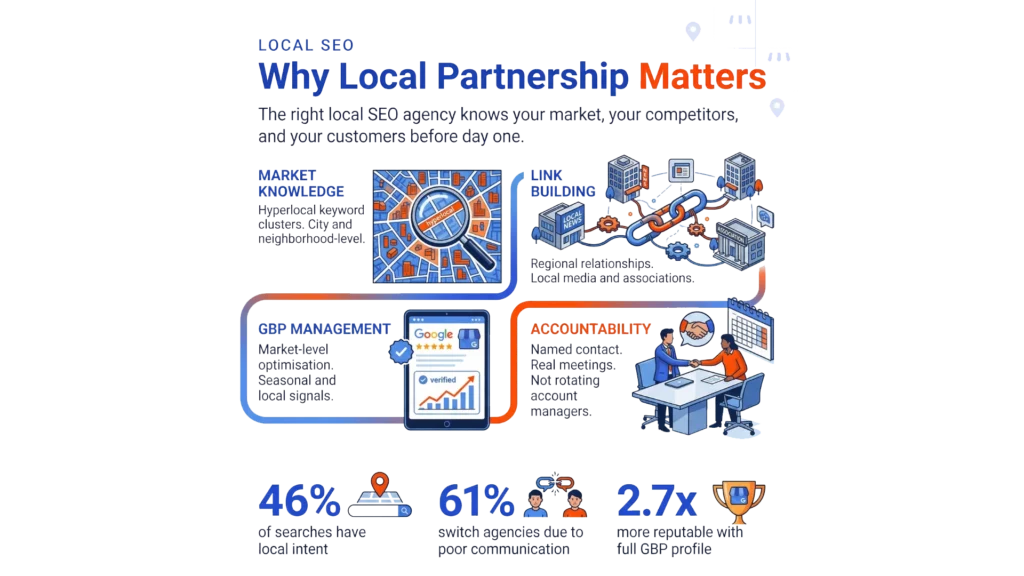
Most business owners searching for SEO services near me are not looking for a vendor. They have usually already dealt with one. They watched their budget disappear into monthly retainer invoices, received reports full of vanity metrics, and ended a contract with rankings no better than where they started. What they want now is accountability, and that starts with proximity.
The global SEO market was valued at $122.11 billion in 2024 and is projected to grow significantly through the remainder of the decade. But the businesses that consistently get results from SEO are not chasing the biggest agency or the cheapest package. They are choosing local SEO services near me because proximity changes the nature of the relationship. A local SEO agency brings something no offshore team can replicate: direct knowledge of your market, your competitors, and the local search behavior your customers actually exhibit.
This guide covers why local expertise is a strategic asset, how to evaluate a nearby SEO agency before signing any agreement, what a well-structured local SEO engagement looks like in 2026, and how to measure whether it is working.
Key Takeaways
- Businesses that work with a local SEO partner report faster onboarding and sharper campaign alignment than those using remote-only providers.
- Searching for an SEO agency near me is a deliberate choice. It signals a buyer who understands what generic agency relationships actually deliver.
- A local SEO agency brings hyperlocal keyword intelligence, regional link-building relationships, and GBP management tuned to your specific city.
- When you hire an SEO company locally, you gain direct access to decision-makers and a reporting relationship tied to real business outcomes, not rank positions alone.
- Evaluating local SEO services near me requires structured criteria: market depth, reporting quality, and the ability to name your competitors before you even brief them.
Why Business Owners Are Searching for SEO Services Near Me
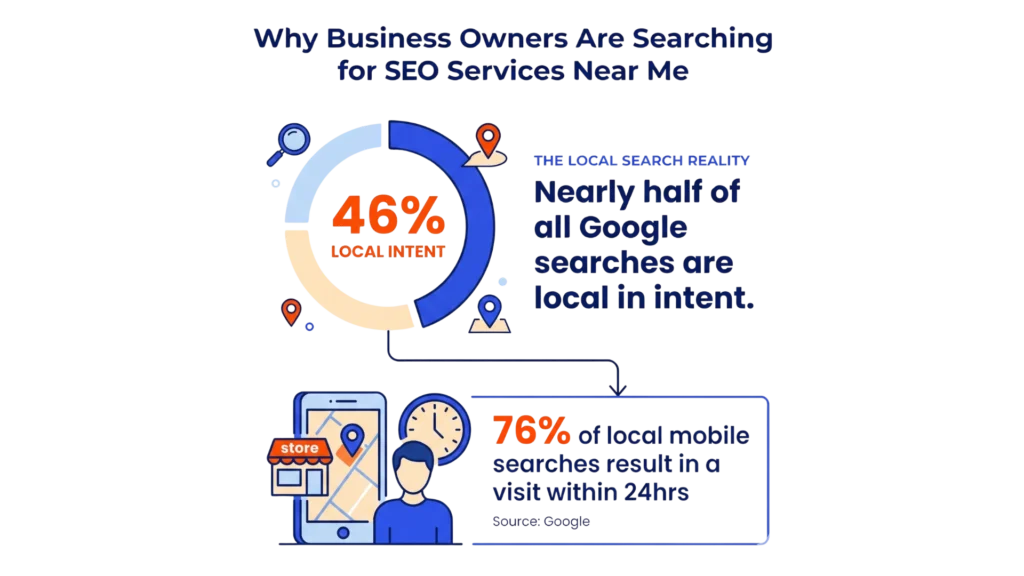
The phrase ‘SEO services near me’ has grown steadily in search volume through 2025 and into 2026, reflecting a clear shift in buyer intent. Business owners have more data than ever about what separates a functional agency relationship from an expensive disappointment. Location is not simply a preference; for many, it is a qualification filter.
This search behavior is not driven by geographic loyalty. It is driven by a recognition that the problems most businesses face with SEO are structural problems in how agencies communicate, prioritize, and report. Choosing a local SEO service starts to solve those problems before the first invoice is signed.
The Agency Communication Problem
61% of small and mid-sized businesses cited poor agency communication as their primary reason for switching providers. That figure is not surprising to anyone who has managed a relationship with a large, remote agency. Rotating account managers, ticket-based support systems, and reporting that arrives on a fixed schedule regardless of what is happening in the account are structural features of scale, not exceptions.
A nearby SEO agency eliminates most of these structural issues by design. When you can schedule a face-to-face meeting, meet your account lead in person, and hold someone accountable by name, the entire dynamic of the relationship shifts.
The Local Market Knowledge Gap
National agencies process hundreds of clients across dozens of verticals. Their keyword research tools pull national volume data. Their link-building outreach targets the same general pool of publishers every other national agency approaches. For a business competing in a specific city, that approach leaves significant competitive ground unclaimed.
A local SEO partner operates differently. They know which local directories carry authority in your vertical, which regional publications accept editorial pitches, and which competitor has quietly built a citation network across every relevant local platform. That contextual intelligence does not exist in any tool. It comes from operating in a market.
What the Search Data Shows
46% of all Google searches contain local intent. For service-area businesses, that share climbs significantly. Meanwhile, Google’s AI Overviews, which launched in May 2024 and expanded significantly through 2025, now surface local business information directly in the search experience, making local visibility more consequential than it was two years ago.
What a Local SEO Agency Does Differently
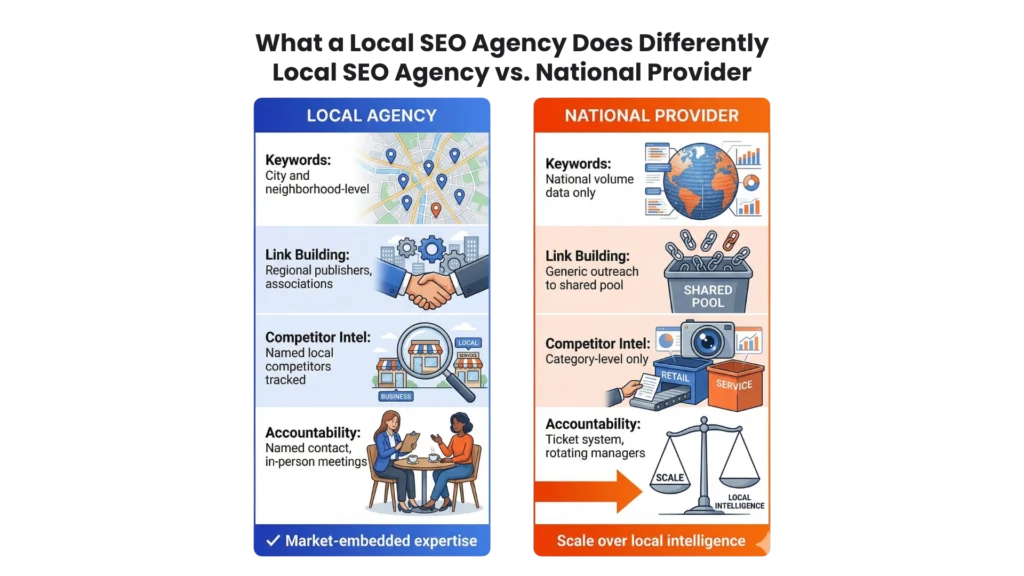
When you hire an SEO company locally, you are not choosing a smaller version of a national firm. The operational differences are structural, and they show up in campaign outcomes in ways that monthly ranking reports will not capture on their own.
The most effective local SEO agencies build their services around market immersion, not just keyword targeting. They track your competitors’ local presence, monitor shifts in your local search landscape, and adjust strategy based on what is happening in your city, not what is trending in the industry at large.
Hyperlocal Keyword Strategy
Standard keyword research tools are built for national or broad regional data. A local SEO agency working in your market builds keyword clusters at the city, neighborhood, and even street-level for certain verticals. Ranking for ’emergency plumber Austin Heights’ requires different content architecture, citation strategy, and GBP management than ranking for ’emergency plumber Texas.’ That distinction is invisible from a national vantage point.
Regional Link Building and Citations
Citation consistency and local link acquisition remain among the top-five signals for local organic results. A nearby SEO agency has existing relationships with local business associations, regional media, neighborhood publishers, and vertical-specific directories that cannot be replicated through cold outreach alone. Those relationships translate into links that carry genuine local authority.
Google Business Profile Management at Market Level
Businesses with complete and regularly updated Google Business Profiles are 2.7 times more likely to be considered reputable by local searchers. Managing a GBP well requires more than filling in every field. It requires understanding seasonal search patterns in your city, responding to reviews with a voice that matches your local audience, and publishing posts that reflect what is relevant to customers in your specific area.
| Local SEO Task | National Agency Approach | Local SEO Agency Approach |
| Keyword Research | National volume-based clusters | City and neighborhood-level clusters |
| Link Building | Generic publisher outreach | Regional media and association relationships |
| GBP Management | Template-driven updates | Locally-informed content and Q&A |
| Competitor Analysis | Category-level tracking | Named local competitor monitoring |
| Citation Building | Standard directory submission | Vertical and city-specific directory targeting |
| Review Strategy | Generic response templates | Locally-appropriate tone and context |
How to Evaluate a Nearby SEO Agency Before You Sign
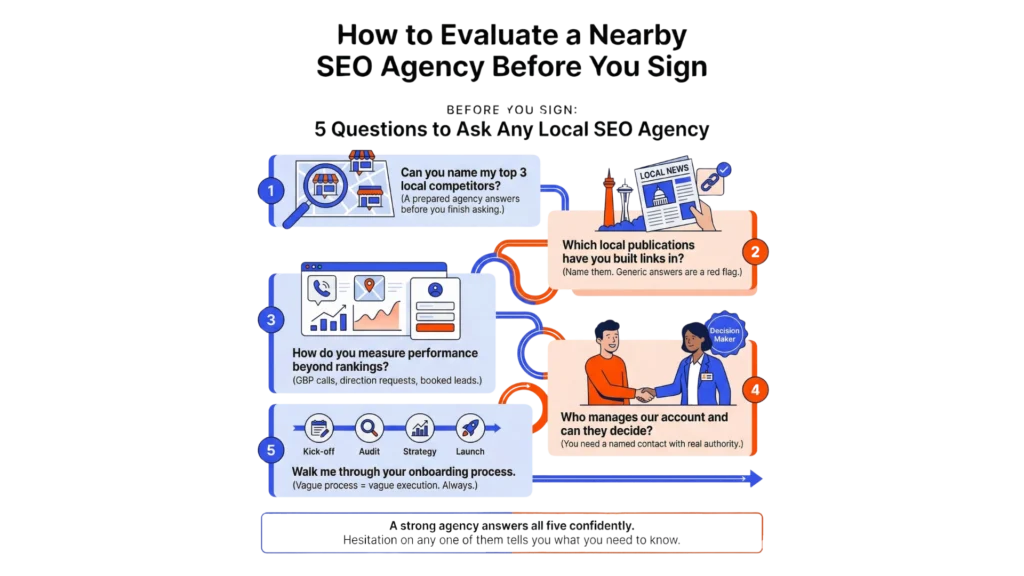
The most expensive mistake businesses make when choosing an SEO agency near me is evaluating on presentation quality rather than operational fit. A polished proposal does not tell you whether an agency can move your rankings in your specific market against your specific competitors.
When you decide to hire an SEO company locally, apply a consistent framework to every agency you speak with. The goal is to generate comparable data, not to be impressed during a sales call.
Five Questions That Reveal Real Capability
- Can you name three of my direct local competitors and describe one SEO gap each of them has? An agency that cannot answer this without prior research has not prepared. A competent local SEO partner will have done basic competitive reconnaissance before your first call.
- What local link sources have you used in our vertical in this city? Vague answers such as ‘we do outreach to relevant blogs and directories’ are a red flag. A legitimate nearby SEO agency will name specific publications or associations and explain why they carry authority in your market.
- How do you measure local SEO performance beyond keyword rankings? Rankings are an input. The right answer involves GBP impressions, direction requests, call volume from organic search, and conversion events tied to organic traffic sessions.
- Who will manage our account and what is their decision-making authority? Rotating account managers and async-only communication are structural risks. You need a named contact with the authority to act, not just report.
- Walk me through your onboarding process for a business at our stage. Onboarding quality predicts execution quality. If the description is vague or generic, the execution will follow the same pattern.
Red Flags to Screen Out Early
- Guaranteed rankings within a specific timeframe from any SEO service provider.
- Pricing is significantly below market rate without a clear explanation of the scope.
- No local case studies or client references from businesses in your city.
- Reporting focused exclusively on keyword positions rather than business outcomes.
- Reluctance to disclose tools, tactics, or third-party partners used in their process.
| Evaluation Criterion | Strong Signal | Weak Signal |
| Local Market Knowledge | Name your competitors unprompted | Requires a full briefing to begin |
| Reporting Framework | Tied to leads, calls, and revenue | Rank-only reporting |
| Account Management | Named contact with direct access | Ticket system and rotating managers |
| Link Building Approach | Named regional sources and relationships | Generic ‘outreach’ description |
| Onboarding Process | Documented and phased | Ad hoc and undefined |
| Pricing Transparency | Itemized scope with clear deliverables | Flat retainer with vague inclusions |
The Real Cost of the Wrong Local SEO Partner
Many businesses discover the cost of a poor agency decision six to twelve months in. By that point, the sunk cost is real, the recovery timeline stretches further than the original investment would suggest, and a competitor has quietly taken ground that is now harder to reclaim.
Choosing between local SEO services near me on price alone is a structural mistake. The variable is not the monthly retainer. It is the compounding cost of slow or misdirected work.
Direct Budget Losses
Wasted retainer spend is the obvious line item. Less visible is the opportunity cost: every month a competitor ranks above you for commercial-intent queries is a month of qualified leads flowing to another business. SEO leads close at a 14.6% rate, compared to 1.7% for outbound channels. At that conversion differential, six months of ranking underperformance carries a material revenue impact for any local service business.
Technical Penalties and Recovery Timelines
Poor SEO work, particularly low-quality link acquisition and thin content strategies, can trigger algorithmic suppression or manual actions. Recovering from a manual action typically takes between three and six months after the underlying issues are resolved and a reconsideration request is filed. The agency relationship ends; the penalty does not.
The Competitive Window Problem
The average time for a new page to reach Google’s top 10 is between 61 and 182 days, depending on domain authority and competition level. When an agency spends the first three to four months on generic, low-impact work, that competitive window narrows in ways that require significantly more investment to reopen.
What a Well-Run Local SEO Service Delivers Month to Month
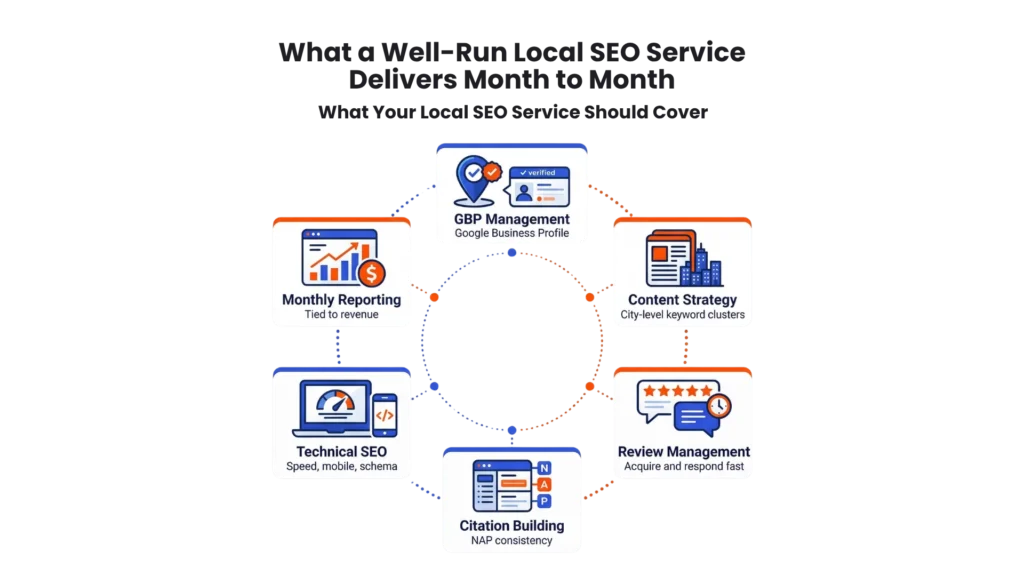
When a local SEO service is operating correctly, the engagement should feel structured and transparent from day one. There is a measurable difference between agencies that run a documented process and those that improvise based on what is easiest to deliver in a given month.
A properly scoped local SEO engagement in 2026 covers six core areas. Each should be documented, assigned, and reported against every month.
Technical SEO Foundation
Before content or link work begins, a thorough technical audit should identify crawlability issues, site speed problems, mobile usability gaps, Core Web Vitals failures, and structured data errors. Pages that load within 2.5 seconds retain significantly more visitors than slower alternatives, with bounce rates increasing sharply past the three-second mark. Technical remediation is not optional; it is what makes everything else work.
Local Content Strategy and Production
Content for local SEO is not generic blogging. Each piece should target a specific city-level keyword cluster, map to a defined audience stage, and be structured to surface in both traditional search results and AI Overviews. Volume and cadence should be driven by competitive gap analysis, not publishing convenience.
Citation Building and NAP Consistency
Inconsistent name, address, and phone (NAP) data across directories actively suppresses local rankings. 68% of consumers lose trust in a business when they find inconsistent information online. A local SEO agency will audit existing citations, correct discrepancies, and build new listings in directories that carry authority in your vertical and region.
Review Generation and Reputation Management
87% of consumers read online reviews for local businesses before making a decision. A structured review acquisition process that complies with Google’s guidelines is both a ranking factor and a conversion factor. How you respond to reviews, and at what speed, also signals trust to search engines and prospective customers alike.
Monthly Reporting Tied to Business Outcomes
Reporting should connect SEO activity to what the business actually cares about: qualified calls, form submissions, appointment requests, and revenue where trackable. Agencies like Rankfast, which operate across local service businesses and enterprise verticals, have begun building AI Overview visibility tracking into standard monthly reporting frameworks, treating it as a core metric alongside traditional organic traffic data rather than an optional add-on.
Local SEO vs. Paid Alternatives: Understanding the ROI

One of the most consistent questions from business owners evaluating SEO services near me is how organic search compares to Google Ads or Meta Ads on a return-on-investment basis. The answer depends on timeline and business model, but the long-term economics of local SEO are consistently favorable for businesses with sustained demand in their market.
Paid channels deliver speed. Organic SEO delivers compounding returns. That distinction matters when planning a 12-month or 24-month growth strategy.
Why Organic Traffic Has a Structural Advantage
Traffic from paid channels stops the moment the spend stops. Traffic from a well-executed local SEO service compounds over time, because every piece of content, every earned link, and every citation improvement builds on the authority already established. Businesses that invest consistently in organic search for 12 or more months report a declining cost per lead as performance scales.
| Metric | Local SEO | Google Ads (PPC) |
| Time to First Results | 3 to 6 months | Immediate |
| Cost Per Lead Over Time | Decreases as authority builds | Stable or rising with competition |
| Traffic After Spend Stops | Sustained | Stops immediately |
| Competitive Defensibility | High (authority compounds) | Low (anyone can outbid) |
| Brand Trust Signal | High (organic implies earned) | Moderate |
| Best Use Case | Long-term market share | Short-term volume and testing |
The right answer for most local businesses is a sequenced approach: paid search fills the pipeline during the first three to six months while organic foundations are being built. Beyond that window, a properly executed local SEO program should be generating qualified leads at a declining cost per acquisition.
Building a Long-Term Relationship With Your SEO Agency Near Me
The businesses that extract the most value from local SEO do not treat it as a vendor relationship with clearly defined deliverables and nothing more. They treat their SEO agency near me as a growth partner with shared visibility into business goals, revenue targets, and competitive priorities.
That requires the agency to have more than keyword rankings data. They need to understand your sales cycle, your margin structure, your highest-value service lines, and what a qualified lead is worth in real terms. The more business context they have, the more precisely they can prioritize work that drives revenue over work that produces metrics.
What Effective Onboarding Looks Like
Month one should be defined by structured access and discovery, not immediate deliverables. The agency needs access to Google Search Console, Google Analytics, Google Business Profile, and any existing call tracking or CRM data. A competent local SEO partner will run a competitive gap analysis, a technical audit, and a citation health check before recommending a content or link-building approach.
Quarterly Business Reviews
A local SEO agency worth retaining will initiate quarterly business reviews, not just send monthly reports. These reviews should cover progress against stated goals, shifts in the competitive landscape observed during the quarter, and a forward-looking plan with prioritized actions for the next 90 days.
Signs the Relationship Is Working
- Commercial-intent keyword rankings are trending upward over a 90-day window.
- GBP impressions, call volume, and direction requests from organic sources are increasing.
- The agency identifies issues and brings them to you before you discover them independently.
- Reporting connects SEO activity to leads and revenue, not just traffic and ranking positions.
Conclusion
Searching for SEO services near me is not a compromise. It is a strategic decision made by business owners who understand that local market knowledge, direct accountability, and a real working relationship are competitive assets, not conveniences.
Local SEO in 2026 requires more than keyword optimization. It requires a local SEO partner who understands your city, your customers, and your competitors at a level that no centralized, high-volume agency can match from a distance. GBP management, hyperlocal content strategy, regional link acquisition, and citation consistency all benefit directly from the kind of market immersion that only a genuine local SEO agency can provide.
Before you take the next call from an agency, define what you need: who will manage your account, how performance will be measured, and what a qualified lead is actually worth to your business. That clarity will help you identify the right local partner faster and hold them accountable from day one.
Frequently Asked Questions
How long does it take to see results from local SEO services near me?
Most businesses begin to see measurable movement in local pack rankings within three to four months of a structured campaign. Significant organic traffic growth and lead volume increases typically follow in months five through eight. Highly competitive markets such as legal, dental, and financial services often take longer. The timeline depends on your current domain authority, citation health, and the competitive density of your specific market.
Is it better to hire a local SEO agency or work with a national provider?
For businesses that depend on local customers, a local SEO agency consistently outperforms national providers on market-specific keyword strategy, local link acquisition, and GBP management. National agencies offer scale and breadth but lack the contextual intelligence that drives results in competitive local markets. Multi-location businesses with a mix of national and local traffic goals may benefit from a hybrid model, but the local component should be managed by someone embedded in each market.
What should I look for when searching for an SEO agency near me?
Prioritize local case studies, named account management, transparent reporting tied to business outcomes, and clear evidence of local market knowledge. Avoid any SEO service that guarantees specific rankings within a fixed timeframe, relies exclusively on automated reporting, or cannot name your direct competitors during an initial consultation. A genuine local SEO partner will want to understand your business model and competitive position before proposing any strategy.
How do I know if my current local SEO service is actually working?
Track GBP impressions, local pack appearances, organic call volume, and form submissions from organic traffic sessions. Rankings alone are insufficient as a performance measure. A well-run local SEO service will produce monthly reporting that directly connects campaign activity to business outcomes. If your agency cannot demonstrate how SEO is contributing to leads or revenue after six months, that is a performance gap worth addressing directly.
Can a small business benefit from working with a nearby SEO agency on a limited budget?
Yes. Small businesses with constrained budgets benefit most from a tightly scoped local SEO strategy that prioritizes GBP optimization, citation cleanup, and content targeting a focused set of high-intent local keywords. A disciplined approach with a competent nearby SEO agency will outperform a broad but unfocused campaign from a lower-quality provider at any budget level. Start with the highest-leverage activities and expand scope as results justify additional investment.